


Translation Quality Isn’t Enough for Regulatory Compliance

Traditional translation reviews focus on linguistic accuracy, but regulatory submissions require structural and contextual precision. Even well-translated documents can fail compliance if terminology, section order, or phrasing differ from official reference standards. Sponsors, CROs, and device manufacturers risk repeated audits, delayed approvals, and costly rework due to inconsistent localization across clinical and labeling content.

Key Pain Points

  • Divergent translations of ICFs or SmPCs across countries
  • Missed MedDRA or WHO-Drug term alignment
  • Inconsistent template structures or labeling elements

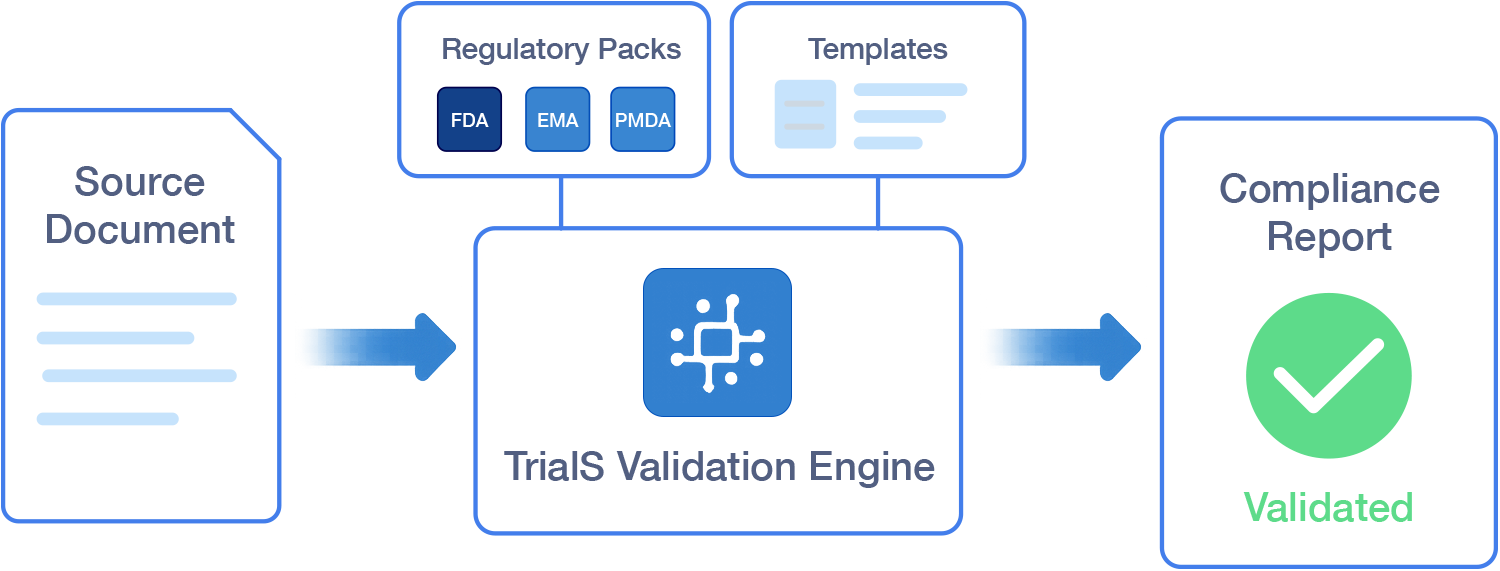
TrialS™ resolves these issues with AI-driven regulatory validation that automatically aligns every translated document with the correct templates, authority packs, and terminology frameworks for global submission compliance.

The Future of Clinical Translation Compliance

Built on the SesenGPT foundation, TrialS™ is an AI-enabled validation engine that elevates translation quality into a true compliance verification system. It automatically reviews translated clinical, labeling, and regulatory content against global authority standards, transforming quality assurance into a proactive, audit-ready process for every submission.

Pre-curated authority packs covering FDA, EMA, PMDA, NMPA, Health Canada, and other major regulators. Each pack is organized by region, scope, and submission type to ensure accurate alignment.

Structured authoring frameworks mapped to ICH CTD modules, EMA QRD templates, and national ethics requirements for consistent formatting and phrasing across all trial materials.

Centralized management of controlled vocabularies, including MedDRA, WHO-DRL, and sponsor-specific glossaries, validated across all target languages to ensure accuracy and consistency.

Automated cross-checks that detect structural, lexical, and contextual inconsistencies, producing clear, human-auditable reports that confirm submission readiness.

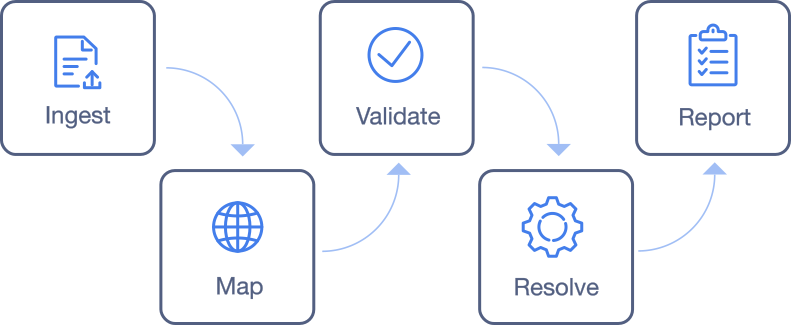
From Translation to Regulatory Confidence in Five Steps

TrialS simplifies complex regulatory validation into a streamlined, AI-assisted process. Each step is designed to ensure translated clinical and labeling materials meet every authority’s structural and terminology requirements before submission.

Upload translated documents along with key project details such as language pairs, target authorities, and study phase.

TrialS™ automatically links each document to the appropriate Regulatory Pack and Compliance Template based on region, scope, and submission type.

The AI engine reviews structure, terminology, and content alignment against official reference standards to detect inconsistencies or deviations.

Identified issues are clearly flagged with plain-language explanations, validation scores, and actionable recommendations for correction.

Generate a complete, audit-ready validation summary for archiving or integration with eTMF, CTMS, or internal quality systems, ensuring full regulatory traceability.

Clinical AI Trained for Regulatory Translation Intelligence

Clinical AI Trained for Regulatory Translation Intelligence

TrialS is powered by SesenGPT, Sesen’s proprietary large-language model built specifically for the life sciences. Fine-tuned on regulatory, clinical, and labeling datasets, SesenGPT understands CTD hierarchies, labeling structures, and domain-specific terminology in more than 150 languages. It goes beyond surface-level text checks to perform true compliance reasoning, ensuring every translation aligns with regulatory expectations.

Uses semantic mapping to evaluate meaning, not just wording, across languages and document types.

Applies intelligent weighting to identify and prioritize sections that pose the greatest compliance risk.

Continuously improves through exposure to real-world submissions and feedback from global regulatory authorities.

Documents Validated by TrialS

TrialS validates a wide range of clinical, regulatory, and labeling materials across all phases of a study. By aligning each document with the correct regulatory packs, templates, and terminology frameworks, it ensures every translated artifact is compliant, consistent, and ready for submission.

  • Protocol synopses
  • Investigator Brochures
  • Site initiation materials
  • Informed Consent Forms (ICFs)
  • eCOA and ePRO screens
  • Patient diaries
  • Instruction sheets, reminders, and notifications
  • SMS and email communications
  • Labeling leaflets (SmPC or PI)
  • Ethics submission packets
  • IRB correspondence and revisions
  • Site communications
  • Investigator training materials
  • Audit responses and deviation summaries

Key Capabilities

TrialS combines advanced AI technology with regulatory intelligence to deliver end-to-end validation of clinical and labeling translations. Each capability is designed to improve accuracy, accelerate compliance, and reduce manual review effort across global submission workflows.

Performs instant validation of structure, sequence, and phrasing consistency against region-specific regulatory templates and authority packs.

Automatically cross-references MedDRA, WHO-DRL, and approved sponsor glossaries to maintain precise term usage across all languages.

Identifies high-risk or critical inconsistencies and routes them for expert linguistic review to ensure compliance accuracy.

Generates clear, audit-ready reports with compliance scores, explanations, and actionable recommendations for correction.

Learns from every validation cycle, adapting to new regulations and user feedback to deliver smarter, faster, and more consistent outcomes.

150 Languages. Global Regulatory Frameworks. One Validation Engine.

TrialS provides worldwide coverage across 150 languages, supporting submissions to leading health authorities including the FDA, EMA, PMDA, NMPA, and Health Canada. Its libraries of regulatory packs and templates are continuously updated to align with the latest global and regional guidance, ensuring every validation reflects current compliance standards and submission expectations.

Validated Accuracy That Scales with Your Trials

TrialS delivers measurable results across speed, quality, and compliance, helping sponsors and CROs accelerate submissions while maintaining complete regulatory confidence.

Key Outcomes

  • 40% faster submission readiness
  • 60% reduction in post-submission revision cycles
  • 99.8% terminology consistency
  • 100% audit traceability

Security & Compliance

TrialS is built on a secure, enterprise-grade infrastructure designed for regulated life sciences environments. All data is processed and stored on AWS with region-based residency controls and encrypted transmission. The platform operates under certified quality and security frameworks to protect sensitive clinical information at every stage.

  • Hosted on AWS with region-based data residency
  • ISO 17100, ISO 9001:2015, and ISO 13485:2016 certified
  • HIPAA and GDPR aligned for global data protection
  • Single Sign-On access with full audit logs and traceability

Integration & Ecosystem

TrialS integrates effortlessly into existing clinical and regulatory technology environments, enabling smooth data exchange and validation within established workflows. Its flexible architecture supports both direct integrations and secure enterprise connections for end-to-end efficiency.

  • Compatible with eTMF, CTMS, and eCOA/ePRO systems
  • Connects with Sesen’s AI for Clinical Trial Translation module
  • Works with Sesen Translation Memory and Glossary tools
  • Supports enterprise connectors through API, SFTP, and secure portal uploads

Why Sesen?

Life Sciences Expertise Meets AI Intelligence

Sesen focuses exclusively on life sciences translation, bringing together deep regulatory knowledge, linguistic expertise, and advanced AI technology. With TrialS, every translated clinical, labeling, and regulatory document is validated for accuracy, consistency, and compliance, ensuring your global submissions are ready for authority review the first time.

See TrialS in Action

Experience how TrialS validates translated clinical and regulatory content against global authority standards in real time.