Labeling Translation Services for Global Life Sciences

Specialized multilingual labeling support for pharmaceutical, biotechnology, medical device, diagnostic, and other regulated life sciences organizations.

From product information and patient leaflets to device labels, IFUs, packaging, artwork, and digital labeling, Sesen helps global teams keep multilingual content accurate, consistent, and controlled across languages, formats, markets, and product lifecycle changes. Our workflows connect specialized translation, terminology management, professional review, multilingual formatting, and in-context QA.

Life Sciences Specialization
ISO-Certified Quality
150+ Languages
In-Context QA

Connected Labeling

Global Labeling Requires More Than Accurate Translation

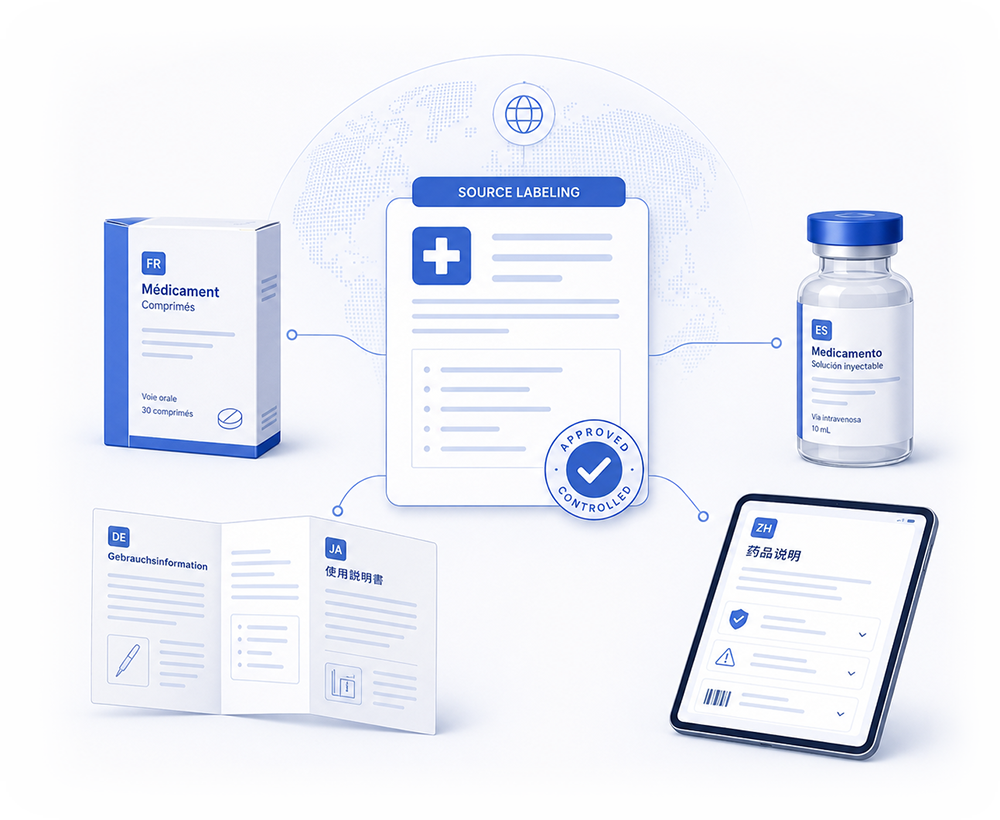
A label rarely exists as an isolated piece of content. Approved product information can flow through packaging, patient communication, instructions, digital channels, and future safety updates.

When one source changes, the impact can extend across multiple assets, languages, and markets. Sesen supports this complexity through multilingual workflows designed to maintain terminology, meaning, formatting, and version consistency from source content through final labeling and future revisions.

The objective is not simply to translate each document correctly. It is to help keep the entire multilingual labeling ecosystem aligned as the product evolves.

01

Approved Source Content

Product information, controlled source files, approved terminology, and labeling references.

02

Translation & Terminology

Specialized translation supported by glossaries, translation memory, references, and linguistic rules.

03

Artwork & Formatting

Localized content adapted to the space, structure, typography, and production requirements of the target format.

04

In-Context QA

Language reviewed within final or near-final labels, packaging, IFUs, and other layouts.

05

Market Use

Multilingual content prepared for the appropriate client review, regulatory, production, or market workflow.

06

Lifecycle Updates

New safety information, product changes, additional markets, and future labeling versions managed with continuity.

Specialized Labeling Translation Across the Life Sciences

Different products have different labeling requirements, audiences, risk profiles, formats, and regulatory pathways. Sesen supports distinct labeling ecosystems without treating every regulated product the same.

Pharmaceutical & Biotechnology Labeling

Support multilingual product information, patient communication, packaging, safety language, and commercial supply across global pharmaceutical and biotechnology markets.

  • Prescribing and product information
  • SmPCs, package inserts, PILs, and medication guides
  • Carton, container, and primary/secondary packaging
  • Investigational product labeling
  • Biologic and advanced-therapy product information
  • Warnings, contraindications, precautions, and safety language
  • Post-approval labeling changes
  • Market-specific labeling updates
Explore Drug Labeling & Packaging Translation

Medical Device & IVD Labeling

Support multilingual device and diagnostic labeling that combines technical content, safety information, operating instructions, symbols, product identifiers, packaging, software references, and user-facing information.

  • Medical device and IVD labels
  • Device packaging
  • IFUs and eIFUs
  • User and operating instructions
  • Warnings, precautions, and contraindications
  • Safety information and quick-start instructions
  • Software and on-device text
  • Digital and market-specific labeling

Multilingual Content Across the Labeling Ecosystem

Global labeling extends well beyond the text printed directly on a product. Sesen helps life sciences teams translate and manage connected content across print, packaging, instructions, patient communication, professional information, and digital channels.

Product & Regulatory Labeling

  • Product information
  • Prescribing information
  • SmPC content
  • Package inserts
  • Patient Information Leaflets (PILs)
  • Medication guides
  • Market-specific product information
  • Labeling supplements and updates

Medical Device & Diagnostic Labeling

  • Device labels
  • IVD labels
  • IFUs and eIFUs
  • User and operating instructions
  • Safety information
  • Warnings and precautions
  • Symbols and explanatory content
  • Digital labeling

Packaging & Artwork

  • Cartons
  • Container labels
  • Primary and secondary packaging
  • Blister packs
  • Bottles and vials
  • Inserts and leaflets
  • Artwork-linked text
  • Market-specific packaging

Patient & HCP Information

  • Patient-facing product information
  • Healthcare professional information
  • Safe-use instructions
  • Administration guidance
  • Warnings and precautions
  • Patient instructions
  • Product education related to safe use

Digital & Electronic Labeling

  • Electronic product information
  • eIFUs
  • Digital labels
  • Web-based product information
  • PDF labeling
  • Structured and electronic labeling content
  • Product information delivered through digital channels

Lifecycle & Safety Updates

  • Safety-driven revisions
  • Product information updates
  • Post-approval changes
  • New language additions
  • Market expansion
  • Packaging revisions
  • Product extensions
  • Recurring global labeling maintenance
Print and digital labeling increasingly need to work as one content system. As product information moves across physical packaging, PDFs, eIFUs, electronic product information, and other digital channels, terminology and version continuity become even more important.

A Controlled Workflow from Source Content to Final Labeling

Regulated labeling translation requires more than linguistic fluency. It requires control over terminology, versions, safety-critical information, numbers, formatting, artwork, and related content.

Sesen adapts the workflow to the content type, product, languages, markets, file formats, client requirements, and intended downstream use.

01

Source & Version Review

We begin by understanding what is changing and how the translated content will be used. Source files, prior versions, references, artwork, target languages, markets, and delivery requirements are reviewed to establish the appropriate workflow.

For update projects, version-aware review helps identify changed content while preserving relevant previously approved material.

02

Terminology Alignment

Product terminology should remain consistent wherever it appears. Sesen can incorporate client-approved glossaries, existing translations, translation memories, product names, medical and regulatory terminology, safety language, style guides, and market preferences.

Terminology governance is especially valuable when the same concepts recur across product information, packaging, patient materials, IFUs, regulatory documents, and successive labeling updates.

03

Specialized Life Sciences Translation

Content is assigned to professional linguists suited to the language pair, subject matter, audience, and intended use, with attention to clinical and technical meaning, safety-critical language, readability, and approved references.

For regulated labeling, the goal is precise, controlled multilingual communication appropriate to the content and audience.

04

Independent Review & Quality Assurance

Structured review can address meaning, completeness, terminology, product names, numbers, units, warnings, repeated content, source-to-target correspondence, formatting, and client-specific requirements.

Sesen combines professional human review with technology-assisted QA to help reviewers focus on potential risk areas.

05

Multilingual Artwork & Formatting

A correct translation must also work inside the actual label, carton, leaflet, IFU, or digital format. Our multilingual production teams support localized layouts while accounting for text expansion, typography, tables, callouts, line breaks, page flow, and script-specific requirements.

The aim is to preserve hierarchy, readability, and production integrity across target-language formats.

06

In-Context Linguistic QA

Some issues only become visible after translated text is placed into its final layout. In-context review can help identify truncation, missing content, poor line breaks, misplaced language, inconsistent terminology, formatting shifts, and visual ambiguity.

This final-context perspective is particularly important for labels, cartons, packaging, IFUs, and other space-constrained or safety-sensitive materials.

07

Controlled Delivery & Update Support

Final files are prepared in the required formats for the client's review, regulatory, production, publishing, or market workflow.

For recurring programs, terminology assets, translation memories, approved references, and prior translations can support subsequent labeling revisions and language expansion.

Lifecycle Management

Keep Multilingual Labeling Synchronized as Products Evolve

The first translation is only one moment in the labeling lifecycle. Safety updates, regulatory changes, manufacturing changes, product extensions, new markets, and additional languages can create a chain of multilingual dependencies.

Sesen helps global labeling teams manage those changes without treating every revision as an entirely new project.

Connected Content
Product Information↔Patient Leaflet↔Carton↔Product Label↔IFU↔Digital Labeling

Version-Aware Updates

Distinguish revised content from unchanged material so teams can focus translation and review while retaining consistency with existing approved language.

Translation Memory Reuse

Reuse relevant approved content across labeling revisions, IFU updates, product families, related packaging, additional languages, and recurring safety content.

Terminology Governance

Maintain consistent product names, indications, warnings, instructions, device components, safety statements, and regulatory terminology across languages.

Cross-Asset Consistency

Help keep product information, patient materials, cartons, product labels, IFUs, and digital labeling aligned as connected content.

New Markets & Languages

Carry established terminology, approved references, and product knowledge forward when a labeling program expands into additional markets.

Reviewer Feedback Management

Capture approved client and in-market language decisions so they can inform future updates instead of being rediscovered in each new project.

Recurring Labeling Programs

Manage Recurring Global Labeling in One Controlled Workspace

Organizations with frequent labeling changes often need more than project-by-project file exchange.

The Sesen Life Sciences Labeling Workspace provides a centralized environment for multilingual labeling translation, validation, review, version tracking, approvals, and ongoing lifecycle updates.

Product-level organization
Language and market views
Terminology management
Translation memory
AI-assisted quality checks
Professional linguist review
Numeric and terminology validation
Version comparison
Stakeholder review
Approval traceability
Delivery history
Audit-ready records
Explore the Labeling Workspace
Global Labeling Program Controlled
Product Information12 languagesVersion 4.2
Patient Leaflet12 languagesIn review
Carton & Packaging8 marketsValidated
IFU / eIFU18 languagesVersion 7.1
Safety Update6 assetsNew change

Artwork & Final Context

Protect Labeling Quality Beyond the Translated Text

A translation can be linguistically correct in a bilingual file and still contain problems in final artwork.

Labels and packaging create demanding conditions for multilingual content. Space is limited, text length changes between languages, and warnings, strengths, symbols, identifiers, tables, and instructions may need to remain aligned across several components.

Multilingual DTP & Artwork Support

Support localized labels, cartons, inserts, leaflets, IFUs, PDFs, and artwork-linked files while preserving hierarchy, readability, and visual structure.

Explore Medical Packaging Translation & Formatting

In-Context Linguistic Review

Review translated language in its actual layout to help identify truncation, text expansion, line-break problems, misplaced content, visual ambiguity, and formatting inconsistencies.

Explore Label Review & In-Context QA

UDI, Identifier & Artwork Integrity

Translate what requires translation while protecting content that must remain unchanged or structurally controlled.

  • Product and part numbers
  • Model and lot-related fields
  • Measurements, dates, and numeric information
  • UDI-related identifiers and barcodes
  • Controlled symbols

Human-Controlled Technology

AI-Assisted Quality Checks. Expert Human Decisions.

AI can strengthen labeling workflows when it is used for the right tasks and within appropriate controls. Sesen uses technology to support professional reviewers—not replace expert judgment.

AI-Assisted QA Can Help Surface

Terminology inconsistencies
Numeric and unit discrepancies
Missing or added content
Repeated-content mismatches
Version differences
Formatting and structural anomalies

Human Expertise Remains Responsible For

Linguistic meaning and nuance
Product-specific terminology
Clinical and technical context
Appropriateness for the intended audience
Resolution of flagged differences
Final linguistic decisions
Technology helps surface potential issues. Life sciences experts evaluate and resolve them.

Support for Regulated Labeling Across Global Markets

Labeling requirements vary by product category, intended user, market, regulatory pathway, presentation, and local-language requirements. There is no universal global labeling template.

Sesen supports multilingual labeling workflows using client-approved source content, regulatory references, terminology, and market requirements appropriate to each engagement.

Our role is to help clients prepare accurate, consistent multilingual content that supports their applicable regulatory, quality, production, and market processes—not to confer regulatory approval.

FDA

U.S. product- and context-specific labeling workflows supported with client-approved references and applicable requirements.

EMA / QRD

European medicinal product information, multilingual terminology, and market-specific product-information workflows.

EU MDR

Medical device labeling and information workflows for applicable European device requirements and market languages.

EU IVDR

IVD labeling, instructions, safety information, and multilingual market requirements.

MHRA

United Kingdom product-information and labeling workflows supported according to applicable client requirements.

PMDA

Japanese labeling and product-information workflows supported with appropriate linguistic and market expertise.

Other Markets

Country- and region-specific labeling workflows supported according to product, language, and client requirements.

Quality Controls Designed for High-Stakes Life Sciences Content

Life sciences labeling can communicate how a product is prescribed, administered, stored, operated, interpreted, or used safely. That requires a quality model designed for regulated content.

Life Sciences Specialization

Sesen focuses on life sciences translation and localization across pharmaceutical, biotechnology, medical device, CRO, healthcare, and related regulated environments.

Professional Native Linguists

Projects can be matched with native-language professionals whose medical, scientific, pharmaceutical, technical, or regulatory experience fits the content and audience.

ISO-Certified Quality

Quality processes support structured translation, review, documentation, and regulated-content workflows for global life sciences programs.

Terminology & Translation Memory

Approved glossaries, translation memory, style guides, product references, and client-specific rules help maintain consistency across recurring labeling programs.

Version & Change Control

Version-aware workflows support labeling revisions, IFU updates, safety changes, regulatory updates, and ongoing multilingual product communication.

Secure Enterprise Delivery

Controlled project workflows support confidential product information, unpublished regulatory materials, proprietary terminology, and pre-launch content.

Specialized Services for Every Part of the Labeling Workflow

Global labeling programs often require several connected language and production capabilities. Explore specialized Sesen services based on your product, content, and workflow.

Drug Labeling & Packaging Translation

Pharmaceutical and biotechnology product information, patient leaflets, cartons, packaging, safety updates, and market-specific labeling.

Explore Drug Labeling

Medical Device Labeling Translation

Medical device and diagnostic labels, packaging, safety information, IVD labeling, digital labeling, and market updates.

Explore Medical Device Labeling

IFU Translation Services

Multilingual IFUs and eIFUs with terminology control, formatting support, update management, and linguistic QA.

Explore IFU Translation

Label Review & In-Context QA

Linguistic review of translated content within final or near-final packaging, labels, artwork, IFUs, and other formatted materials.

Explore In-Context QA

Medical Packaging Translation & Formatting

Translation, typesetting, formatting, and artwork support for cartons, labels, inserts, packaging, and production-sensitive content.

Explore Packaging Services

Life Sciences Labeling Workspace

A centralized environment for recurring multilingual labeling translation, validation, terminology, versions, review, approvals, and lifecycle maintenance.

Explore the Labeling Workspace
Product Information / SmPC
Patient Information / PIL
Carton & Packaging
Primary Product Label
IFU / eIFU
Digital Labeling
Safety & Lifecycle Updates

Program-Level Consistency

One Labeling Program. Many Connected Assets.

A single product or safety change can affect an interconnected set of multilingual assets. When these materials are translated independently, terminology, versions, and approved wording can gradually diverge.

A connected multilingual labeling workflow helps preserve continuity by managing relationships between content—not simply processing a sequence of disconnected files.

Terminology Governance Maintain consistent product, medical, regulatory, and safety terminology wherever it appears.
Translation Memory Reuse relevant approved translations instead of recreating recurring language during every update.
Version Awareness Identify what changed, what remains approved, and what downstream multilingual content may require attention.
In-Context QA Review language within the actual label, package, IFU, or digital presentation.
Centralized Program Management Coordinate languages, files, reviewers, updates, and delivery across the broader product labeling ecosystem.

A Specialized Partner for Global Labeling Programs

Whether you are translating one new label or managing recurring updates across a global product portfolio, Sesen can adapt the workflow to your program.

Life Sciences Focus

Specialized workflows for regulated pharmaceutical, biotechnology, medical device, diagnostic, and related content.

150+ Languages

Global language coverage for product launches, market expansion, and recurring labeling programs.

Human Expertise + Technology

Professional linguists and reviewers supported by terminology tools, translation memory, automation, and AI-assisted QA.

Artwork & In-Context QA

Support can continue through multilingual layout and final-context review instead of ending with bilingual text.

Lifecycle Support

Support initial launches, safety updates, version changes, new languages, packaging revisions, and ongoing maintenance.

Scalable Program Management

Support individual assignments, coordinated multi-language launches, and recurring global labeling programs.

Labeling Translation FAQs

Common questions about multilingual labeling, regulated life sciences content, updates, artwork, and ongoing global programs.

What are labeling translation services?

Labeling translation services adapt regulated product labeling from a source language into one or more target languages while preserving meaning, terminology, safety information, product information, formatting requirements, and relevant market context. In life sciences, this can include pharmaceutical product information, patient leaflets, medical device labels, IFUs, eIFUs, packaging, cartons, warnings, digital labeling, and related product content.

How is life sciences labeling translation different from general translation?

Life sciences labeling often contains safety-critical, technical, medical, and regulated information. In addition to linguistic accuracy, teams may need to control approved terminology, numbers, units, warnings, product identifiers, versions, reference materials, formatting, artwork, and consistency across related labeling assets. That makes specialized expertise, structured review, terminology management, and in-context QA particularly important.

Does Sesen support both pharmaceutical and medical device labeling?

Yes. Sesen supports pharmaceutical, biotechnology, medical device, IVD, and related life sciences labeling programs, with dedicated service workflows for drug labeling, medical device labeling, IFUs, packaging, and in-context QA.

Can Sesen translate IFUs and eIFUs?

Yes. Sesen provides specialized IFU translation services for medical devices, diagnostics, and related products, including multilingual formatting, terminology consistency, updates, and in-context review. Sesen can also support electronic IFUs and other digital labeling content.

Can Sesen work with packaging and artwork files?

Yes. Sesen supports multilingual formatting and artwork-sensitive workflows for labels, cartons, packaging, leaflets, inserts, IFUs, and other formatted life sciences content. In-context QA can also be performed after translated text is placed into final or near-final artwork.

How does Sesen manage recurring labeling updates across multiple languages?

Sesen can use version-aware workflows, terminology resources, translation memory, approved reference content, and structured review to support recurring labeling changes. Existing approved translations can be reused where appropriate while changed content receives focused translation and review.

Can Sesen support labeling translation for global markets?

Yes. Sesen supports more than 150 languages. The exact workflow depends on the product, target markets, intended audience, applicable requirements, source materials, and client-approved regulatory references.

How does Sesen use AI in labeling translation?

AI-enabled technology can assist with terminology comparison, numeric checks, missing-content detection, repeated-content consistency, version review, and multilingual QA. For regulated labeling, professional human expertise remains central: qualified linguists and project teams evaluate findings in context and make the final linguistic decisions.

Can Sesen review translations after they are placed into final label artwork?

Yes. Sesen's in-context QA services help evaluate translated content in final or near-final layouts and can help identify issues involving truncation, text expansion, line breaks, misplaced content, formatting, terminology, and the relationship between language and visual presentation.

Can Sesen support an ongoing global labeling program?

Yes. Sesen supports both individual labeling projects and recurring multilingual programs involving multiple products, languages, markets, revisions, and reviewers. The Sesen Labeling Workspace can centralize multilingual labeling translation, validation, version tracking, review, approvals, delivery history, and lifecycle management.

Simplify Global Labeling Across Languages, Markets, and Product Lifecycles

Whether you are preparing a new global launch, adding markets, translating an IFU, updating safety information, revising packaging, or building a more scalable multilingual labeling program, Team Sesen is ready to help.