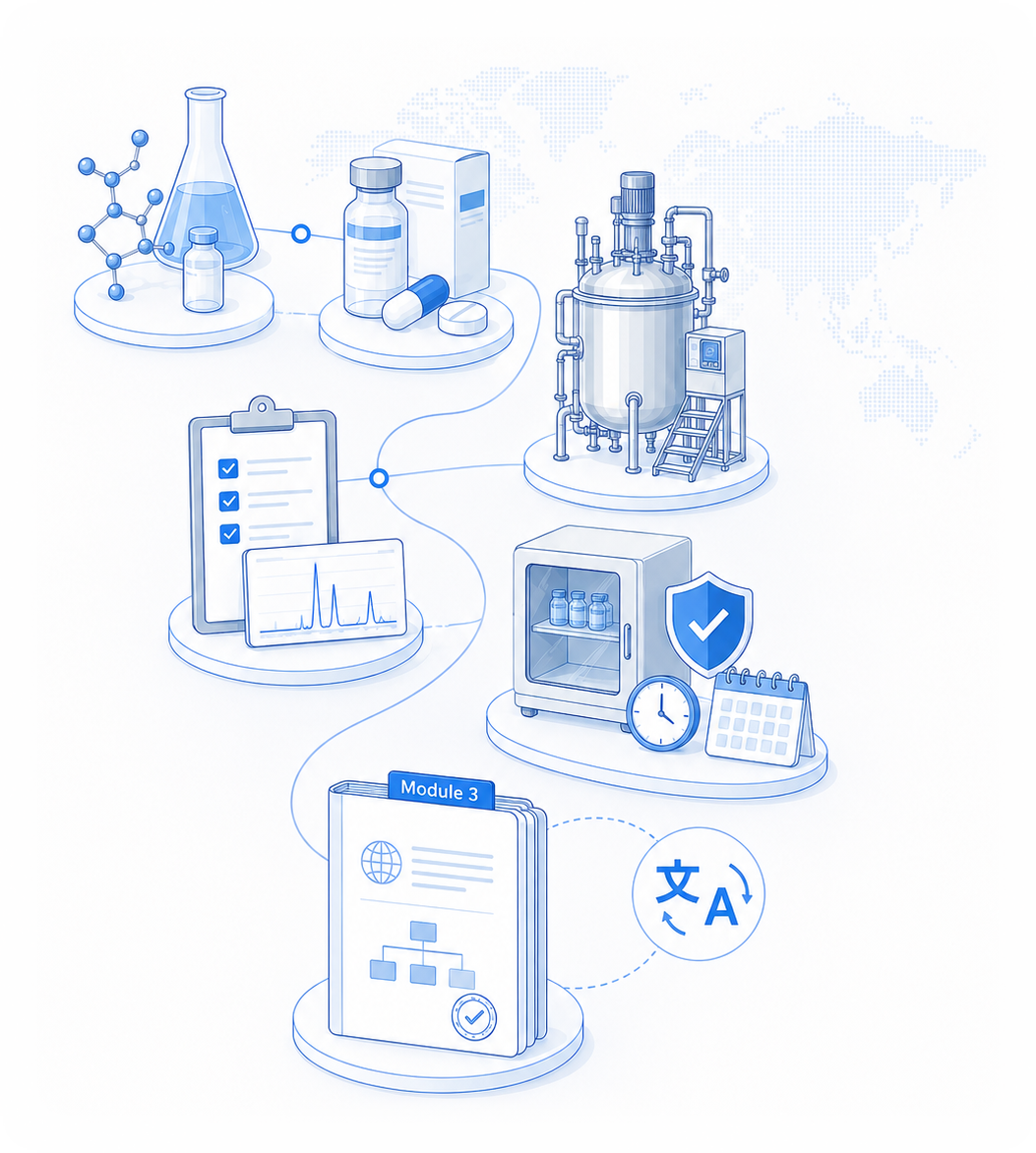
What is CMC document translation?
CMC document translation is the specialized translation of Chemistry, Manufacturing and Controls content used to describe a pharmaceutical product’s composition, manufacture, controls, analytical procedures, specifications, validation, stability, and related quality information. Because the same product and process information can appear across many documents, effective CMC translation requires both technical accuracy and terminology consistency.
What types of CMC documents does Sesen translate?
Sesen translates drug substance and drug product documentation, manufacturing process descriptions, specifications, analytical methods, method and process validation documentation, stability protocols and reports, Certificates of Analysis, quality-control documentation, Drug Master Files, CTD Module 3 content, Quality Overall Summary content, CMC amendments, health authority responses, and post-approval change documentation.
Can Sesen translate CTD Module 3 content?
Yes. Sesen supports translation of CTD Module 3 quality content while helping maintain terminology consistency with the drug substance, drug product, manufacturing, analytical, validation, specification, and stability documentation that supports the dossier.
How does Sesen maintain terminology consistency across CMC documents?
Sesen can combine client-approved terminology, product-specific glossaries, translation memories, previous translations, reference documentation, automated consistency checks, and expert human review. Related CMC files can be treated as one connected multilingual documentation set rather than a series of isolated translations.
Does Sesen translate both small-molecule and biologic CMC documentation?
Yes. Sesen supports small-molecule, biologic, biopharmaceutical, and biosimilar CMC content, with translation resources selected according to the language pair, technical subject matter, document type, and project requirements.
Can Sesen update previously translated CMC documents after a manufacturing or regulatory change?
Yes. Existing translation memories, glossaries, prior translations, and reference documents can support revised multilingual content so established terminology and prior language decisions remain available as processes, methods, sites, suppliers, specifications, or other CMC elements change.
How does Sesen handle specifications, analytical methods, numbers, and units?
Sesen applies linguistic review and QA checks to help preserve specifications, acceptance criteria, test names, analytical terminology, numbers, units, ranges, tables, and repeated technical content. Sesen translates and verifies the multilingual representation of the source information; it does not independently modify or scientifically validate the underlying pharmaceutical data.
Can Sesen support CMC documentation for global regulatory submissions?
Yes. Sesen supports multilingual CMC content used in CTD/eCTD submissions, INDs, NDAs, ANDAs, BLAs, marketing authorization applications, amendments, variations, supplements, and health authority responses, with related regulatory submission services available for broader filing programs.
Can Sesen translate manufacturing records and GMP documentation related to the same CMC program?
Yes. CMC information often connects directly to batch records, SOPs, manufacturing instructions, validation documentation, quality records, and technology-transfer content. Sesen can support these related document sets while maintaining applicable terminology across the program.
Does Sesen support analytical procedure and method validation documentation?
Yes. Sesen translates analytical procedures, test methods, method-development documentation, validation protocols and reports, specifications, acceptance criteria, and related laboratory and quality-control content. Where documents belong to the same program, terminology can be aligned across analytical, validation, stability, manufacturing, and regulatory records.
Can Sesen support ongoing CMC translation programs rather than individual documents?
Yes. Sesen supports recurring multilingual CMC programs involving multiple document types, languages, versions, and submission cycles. Maintaining terminology, translation memory, prior references, and established workflow requirements helps preserve continuity as new documents and revisions are added over time.
Does Sesen use AI for CMC translation?
Sesen uses AI-enabled tools to support appropriate parts of the workflow, including terminology extraction, translation-memory leverage, reference alignment, consistency analysis, number and unit checks, completeness checks, and quality control. Qualified human linguists and reviewers remain central to contextual decisions and final translation quality.