Scientific Accuracy
Preserve the meaning of technical concepts, research findings, mechanisms, methodologies, and scientific conclusions.

Specialized Life Sciences Translation
Translate complex medical and scientific content with the subject-matter expertise, terminology control, and quality oversight required to preserve meaning across languages.
Sesen supports pharmaceutical, biotechnology, medical device, CRO, healthcare, research, and scientific organizations across research, publications, technical communication, medical education, and global scientific exchange.
Scientific information moves through many formats before it reaches global audiences. Sesen supports specialized medical, scientific, research, educational, and technical content throughout that journey.
Manuscripts, journal articles, abstracts, research papers, literature reviews, research summaries, scientific reports, investigator-authored materials, and publication-support content.
Preserve scientific reasoning, terminology, findings, references, and publication context across languages.
Congress abstracts, scientific posters, oral presentation materials, slide decks, symposium content, visual abstracts, conference handouts, and scientific summaries.
Maintain alignment between underlying research and the multilingual assets used to present it.
Explore Medical Affairs Translation ServicesPreclinical research materials, R&D documentation, laboratory documentation, research reports, development summaries, scientific methodologies, product-science content, and knowledge-transfer materials.
Support specialized scientific communication long before content becomes a regulatory or commercial asset.
Disease-state education, treatment education, HCP learning materials, professional training, medical reference content, scientific educational modules, and presentation materials.
Balance scientific accuracy with the level of clarity required for the intended professional audience.
Explore eLearning & Training LocalizationScientific technical reports, product-science documentation, laboratory materials, scientific specifications, technical presentations, data-oriented documentation, and specialized knowledge resources.
Provide an appropriate workflow for complex scientific content that is not inherently a regulatory submission or controlled product document.
Academic research, investigator publications, research-center materials, institutional scientific reports, healthcare research, public health research communication, and collaborative research materials.
Extend specialized scientific communication across research institutions and healthcare knowledge organizations.
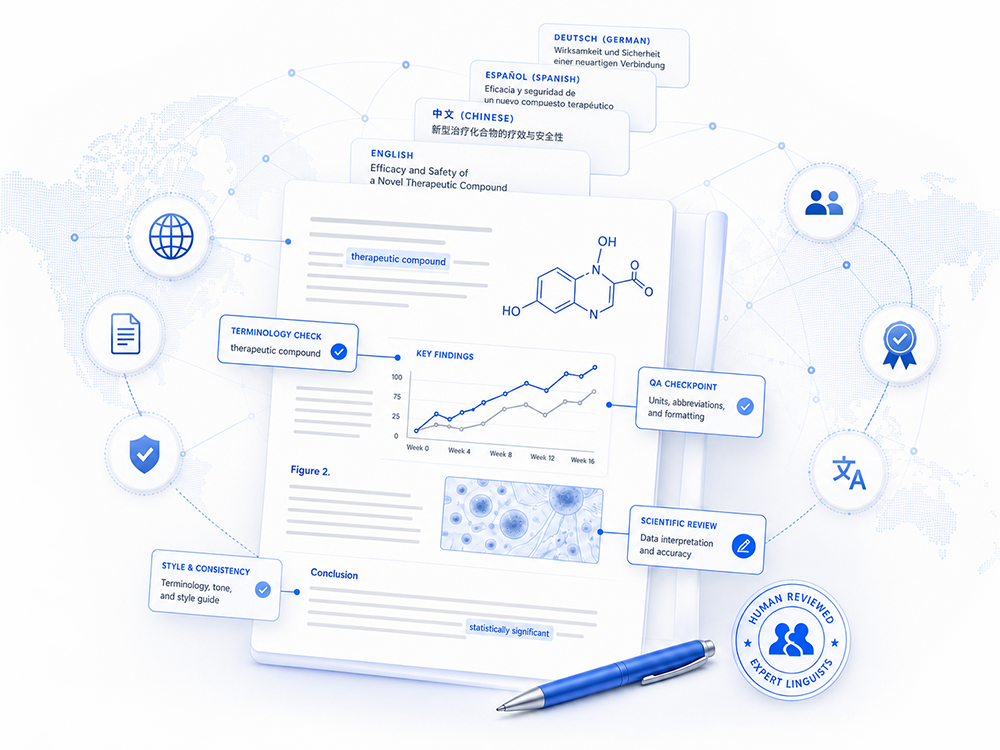
High-quality scientific translation requires control over the complete meaning, structure, data, and audience context of the source—not simply individual terms.
Mechanisms, methods, findings, comparisons, limitations, qualifications, interpretations, and conclusions must retain the same scientific relationships across languages.
Medical terminology, scientific vocabulary, product and compound names, abbreviations, acronyms, approved terminology, and organization-specific language need disciplined handling.
Numbers, measurements, units, percentages, statistical expressions, symbols, tables, figure labels, captions, references, and cross-references require structured QA.
Researchers, physicians, HCPs, technical teams, educators, collaborators, and selected patient audiences require different levels of terminology, explanation, and readability.
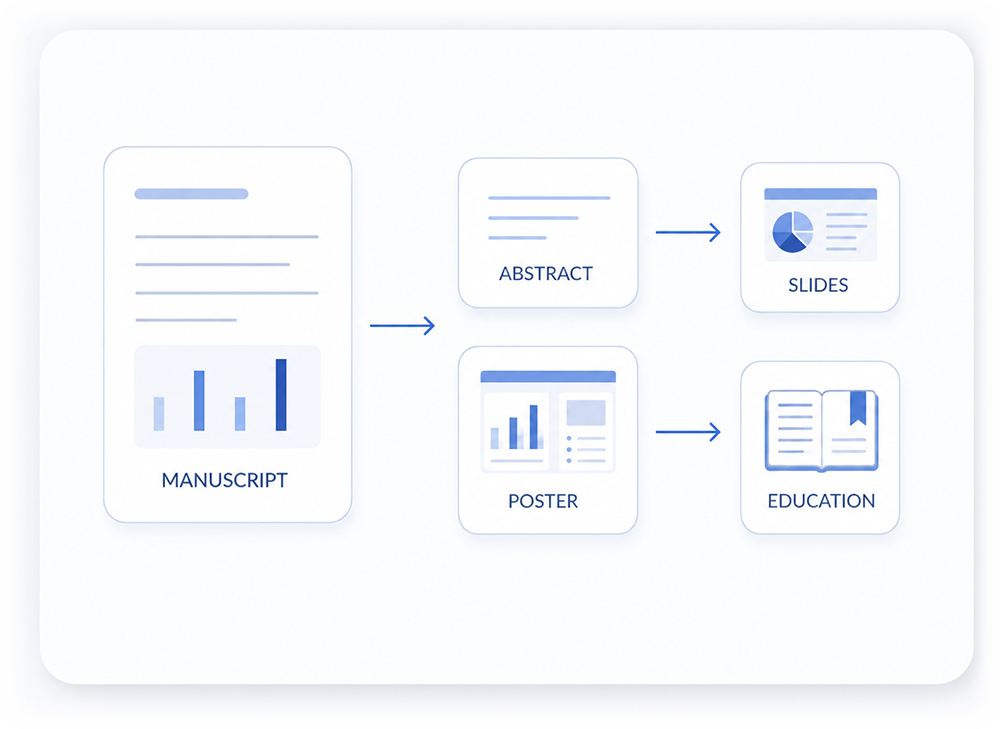
The same evidence may appear in a manuscript, abstract, poster, presentation, scientific summary, and educational resource. Terminology and scientific statements should remain aligned as content is reused.
Scientific knowledge evolves across a connected content lifecycle. Translation should support that continuity rather than treating every document as an isolated project.
Findings, laboratory documentation, R&D materials, methodologies, and technical reports.
Scientific analyses, summaries, narratives, and knowledge resources.
Manuscripts, journal articles, abstracts, and publication materials.
Posters, congress materials, scientific decks, and visual summaries.
HCP education, professional training, and scientific learning content.
Approved terminology, prior translations, reviewer decisions, and multilingual assets.
Research findings are often expressed through carefully qualified language, technical terminology, quantitative data, references, and visual evidence. Those elements need to remain aligned as scientific content moves into new languages and formats.
Approved reference materials, terminology resources, translation memory, previous translations, and reviewer decisions can help maintain continuity across related publications and future versions.
There is no single category of translator that is equally suited to every type of medical and scientific content. Sesen can build project teams around the actual science and communication requirements of the content.
Professional language expertise appropriate to the source and target languages.
Relevant understanding of the medical, scientific, therapeutic, or technical subject.
Experience suited to publications, reports, education, research documentation, presentations, or other specialized assets.
Awareness of the terminology and communication level expected by specialist readers.
Workflow and review requirements appropriate for how the translated content will be used.
Terminology & Reuse
A single program may generate publications, technical reports, slide decks, educational materials, research summaries, internal documentation, and repeated revisions across multiple languages. Structured terminology and content reuse help prevent those assets from drifting apart.
Explore Terminology Management & HarmonizationUse client glossaries, existing translations, scientific publications, product terminology, reference documents, style guidance, and reviewer feedback to build reusable language resources.
Identify and reuse previously translated and approved language where appropriate to improve continuity and reduce unnecessary retranslation.
Incorporate approved scientific, medical, or in-country reviewer feedback so decisions can be carried into subsequent content.
Leverage approved language as documents evolve while focusing review attention on changed or newly added content.
Evaluate terminology, numbers, units, formatting, consistency, omissions, and other potential issues through professional review and technology-assisted QA.
Different scientific documents carry different requirements. Sesen adapts translation and review according to content type, subject matter, intended audience, intended use, risk, and client requirements.
Review the source content, scientific field, audience, languages, intended use, formatting needs, existing terminology, and reference materials.
Select professional linguists based on the language combination and the medical, scientific, or technical requirements of the project.
Prepare relevant glossaries, prior translations, publications, style guidance, references, and approved terminology.
Translate with attention to scientific meaning, terminology, quantitative information, audience, style, and context.
When required by the workflow, a qualified second professional reviews linguistic accuracy, consistency, completeness, and appropriate scientific communication.
Use structured QA to support terminology, number, unit, formatting, consistency, and completeness checks.
For publications, posters, slide decks, and structured documents, review tables, figures, captions, labels, and multilingual presentation.
Review the completed content against project specifications and prepare it for delivery.
A research summary and a complex scientific manuscript do not necessarily require identical workflows. Sesen helps apply the right combination of expertise, review, technology, and quality control for each project.
Advanced translation technology can improve consistency, reuse, quality control, and workflow efficiency. Scientific judgment still requires qualified people.
Human linguists and reviewers remain responsible for scientific meaning, context, ambiguity, terminology decisions, nuance, audience appropriateness, readability, linguistic quality, and final professional judgment.
Technology can support terminology extraction, translation memory leverage, content reuse, consistency checks, numerical QA, completeness checks, formatting review, issue detection, and workflow efficiency.
The appropriate workflow depends on the scientific complexity, intended use, confidentiality requirements, quality expectations, and client preferences. Human oversight remains central for sensitive scientific content.
Sesen supports multilingual projects across a broad range of medical, scientific, therapeutic, and technical fields, with professional resources matched to project requirements.
Need support in another scientific field? Talk with Team Sesen about your content, terminology, audience, and language requirements.
Life Sciences Ecosystem
Pharmaceuticals · Biotechnology · Medical Technology · Diagnostics
CROs · Research Institutions · Scientific Organizations
R&D · Scientific Communications · Medical Affairs · Medical Education
Healthcare Organizations · Scientific Publishers · Medical Communications Organizations
Enterprise Scientific Programs
Scientific translation often begins before information is public. Programs may involve unpublished findings, proprietary research, pre-publication manuscripts, product-development information, internal scientific reports, and collaboration materials.
Focused translation and review for manuscripts, research reports, presentations, and specialized content.
Coordinated translation across global languages, markets, and related content sets.
Ongoing support for publications, research, education, presentations, and related assets.
Terminology governance, reusable language assets, structured workflows, quality oversight, and scalable translation management.
Specialized multilingual communication for pharmaceutical, biotechnology, medical device, CRO, healthcare, clinical, regulatory, and scientific environments.
Resources can be matched according to language combination, scientific domain, content type, audience, and intended use.
Terminology resources, translation memory, professional review, structured QA, and reviewer feedback support consistency across languages and related content.
Support can extend from an individual scientific document to recurring multi-language programs and reusable enterprise language assets.
Choose the Right Sesen Service
Some medical and scientific content moves into regulated or highly specialized workflows because of its submission context, patient impact, safety use, device labeling role, or validation requirements. Sesen provides dedicated services for those needs.
For protocols, informed consent forms, investigator materials, clinical study documents, patient-facing content, and multilingual trial operations.
For regulatory submissions, health authority correspondence, registration documentation, regulated dossiers, and other approval-related content.
For pharmaceutical programs spanning clinical development, regulatory submissions, labeling, safety, Medical Affairs, and commercialization.
For IFUs, labeling, software, technical documentation, regulated device content, training, and post-market communication.
For adverse-event content, safety narratives, ICSRs, SUSARs, DSURs, PSURs/PBRERs, risk-management materials, and drug-safety communication.
For organized Medical Affairs programs involving scientific exchange, publications, congresses, MSL enablement, advisory boards, KOL engagement, medical information, and HEOR/RWE.
For clinical outcome assessments, eCOA/ePRO instruments, patient questionnaires, symptom scales, and content requiring a structured validation workflow beyond standard translation.
Explore Sesen resources on life sciences translation, terminology governance, professional review, multilingual quality, content reuse, and responsible technology-enabled workflows.
These questions explain how specialized scientific translation differs from general translation and when a dedicated regulated Sesen workflow may be more appropriate.
Discuss Your Scientific Translation NeedsMedical and scientific translation is the specialized translation of content involving medicine, healthcare, research, life sciences, scientific knowledge, and technical subject matter. It can include scientific manuscripts, research reports, abstracts, posters, presentations, laboratory documentation, medical education, technical scientific content, and related materials. Unlike general translation, these projects often require subject-matter understanding, specialized terminology, careful handling of quantitative information, and awareness of the intended scientific or professional audience.
Sesen translates research manuscripts, journal articles, abstracts, scientific posters, presentations, research reports, laboratory documentation, R&D materials, technical scientific content, disease-state education, HCP materials, training resources, and other specialized life sciences communication. When content belongs to a more specialized clinical, regulatory, safety, medical-device, Medical Affairs, or linguistic-validation workflow, Sesen can route the project through the appropriate dedicated service.
Scientific translation requires more than linguistic fluency. Translators may need to understand specialized terminology, scientific concepts, mechanisms, methodology, quantitative information, abbreviations, nomenclature, data presentation, and the conventions of the target audience. The objective is to preserve the meaning and relationships within the underlying science, not simply produce fluent target-language text.
Sesen can match professional language resources according to the source and target languages, scientific subject, therapeutic or technical domain, document type, intended audience, intended use, and project requirements. This helps align translator and reviewer expertise with the actual content rather than relying on a one-size-fits-all definition of medical translation.
Yes. Sesen supports manuscripts, journal articles, abstracts, posters, slide decks, visual scientific materials, research summaries, and related assets. Where multiple materials are based on the same research, terminology resources, reference content, translation memory, and approved language can help maintain consistency between related multilingual documents.
Terminology management can incorporate client glossaries, previously approved translations, scientific publications, existing reference materials, product terminology, style guidance, and reviewer feedback. Approved terminology and translation memory can then be reused across related documents, languages, and future revisions where appropriate.
Sesen uses advanced translation technology and AI-assisted tools where appropriate to support terminology, content reuse, consistency checking, numerical QA, completeness, and workflow efficiency. Professional human expertise remains central to decisions involving scientific meaning, context, terminology, ambiguity, audience appropriateness, and final linguistic quality. The workflow can be adapted according to content complexity, intended use, confidentiality, risk, and client requirements.
Medical & Scientific Translation is the broader service for specialized scientific, research, technical, publication, and educational content across the life sciences. Medical Affairs Translation is designed specifically for organized Medical Affairs workflows such as scientific exchange, field medical communication, MSL materials, advisory boards, KOL engagement, medical information, publications programs, congress support, HEOR/RWE, and related global activities.
The translation workflow should reflect the content's primary use. Clinical trial documents are best handled through Clinical Trial Translation Services; regulatory submissions and health authority documentation through Regulatory Translation Services; device IFUs and labeling through Medical Device Translation Services; drug-safety content through Pharmacovigilance Translation Services; and patient-reported instruments requiring formal validation through Linguistic Validation Services.
Your scientific content represents research, expertise, evidence, and investment. Sesen combines specialized medical and scientific language expertise with terminology management, structured quality control, scalable multilingual workflows, and technology-assisted QA to help you communicate that knowledge clearly across languages.