Technical Precision
Product specifications, operating instructions, warnings, procedures, measurements, device functions, and technical concepts must remain accurate and understandable across languages.

Medical Devices
Sesen helps medical device companies translate and localize regulated content across the product lifecycle — from development and clinical evaluation through regulatory submission, product launch, software deployment, and post-market support.
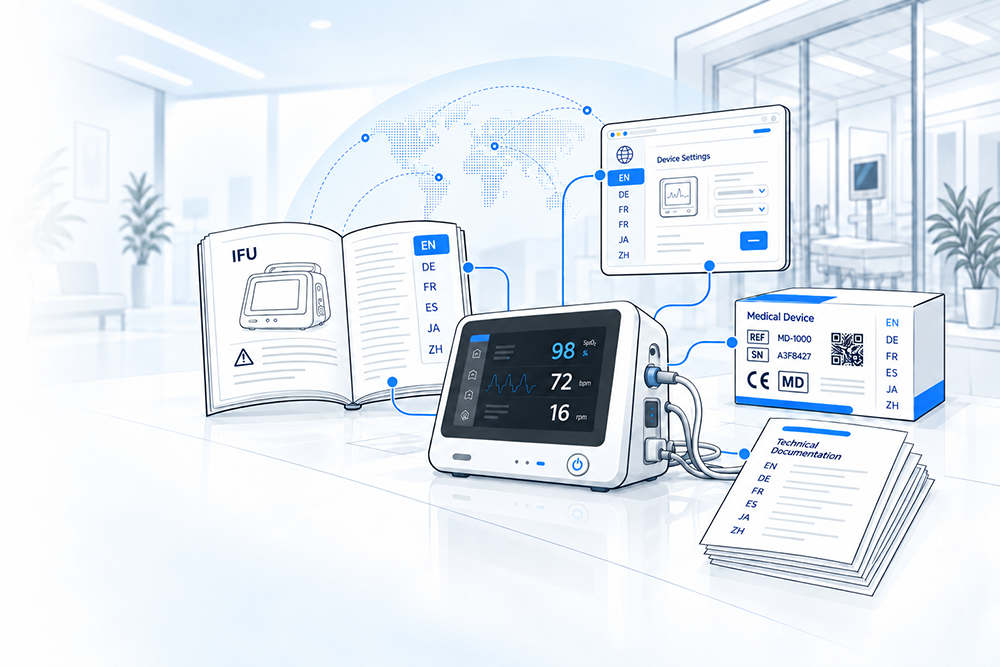
Our specialized medical device translation services support IFUs, labeling and packaging, technical documentation, regulatory materials, software and SaMD, clinical content, training, and post-market communications with terminology-controlled, quality-focused workflows built for global life sciences organizations.
Sesen supports multilingual content throughout medical device development, regulatory review, market authorization, commercialization, product use, and ongoing lifecycle management. Rather than treating each file as an isolated translation project, we help teams maintain terminology and content continuity across related documents, systems, product versions, and markets.
Accurate, readable IFUs help clinicians, patients, technicians, caregivers, and other users understand how a device is intended to be operated, handled, maintained, and used safely.
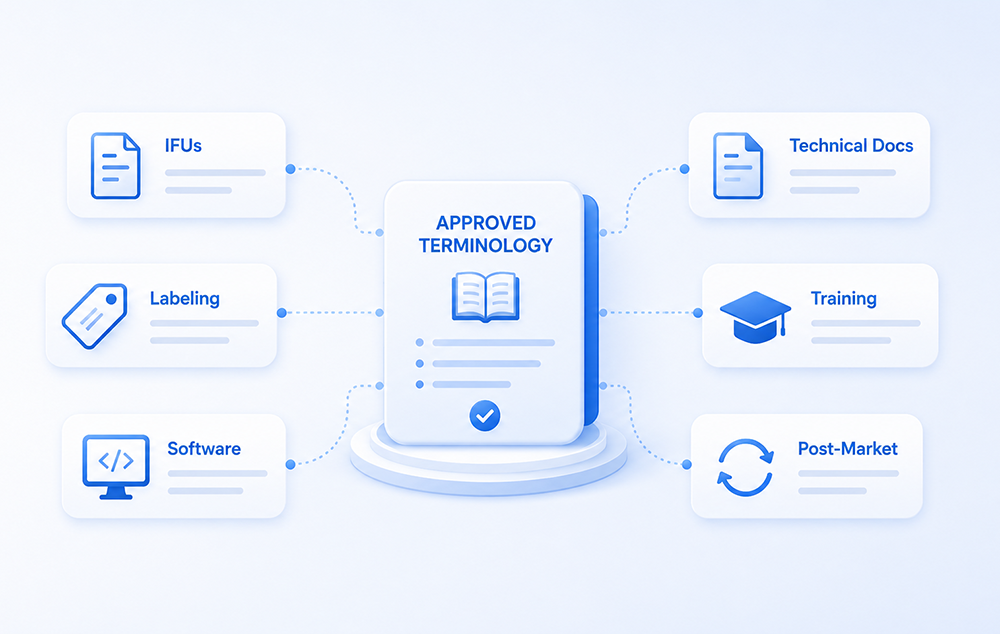
Sesen helps keep critical product information aligned with device documentation and approved terminology across tightly constrained multilingual layouts.
Support multilingual documentation across development, conformity assessment, registration, quality management, change control, and ongoing market support.
Localize software-driven device experiences while preserving context, terminology, interface constraints, and alignment with physical and digital product documentation.
Support evidence and documentation connecting device performance with intended users, clinical environments, product safety, and usability.
Extend approved product language into training and support materials used by healthcare professionals, technicians, service teams, and other device users.
Manage multilingual communication after launch as evidence, product information, software, labeling, and safety content evolve over time.
Lifecycle Continuity
Multilingual requirements do not begin with a final IFU and end at product launch. Device content evolves continuously as products move from development into clinical and regulatory programs, commercialization, and ongoing market support.
Build multilingual readiness early by establishing consistent product language before it spreads across downstream content.
Support the documentation used to evaluate, substantiate, document, and communicate device safety and performance.
Coordinate the multilingual content users and markets encounter when the product is commercialized.
Maintain multilingual consistency as products, evidence, requirements, and safety information evolve after launch.
IFUs, labeling, and device software are high-control environments where linguistic quality, regulatory context, usability, formatting, and version management must work together.
IFU Translation
IFUs combine technical procedures, safety information, device terminology, diagrams, measurements, tables, warnings, and user-facing instructions in a single controlled document.
Labeling & Packaging
Labels and packaging place critical information into highly constrained layouts where text expansion, symbols, product identifiers, market language, and artwork all interact.
Medical Device Software
A short source string can mean different things depending on the screen, workflow, user role, device state, or character limit. Software language must work in the interface and remain aligned with the product ecosystem.
Enterprise Content Control
Medical device content changes continuously. An IFU is revised. A warning is updated. A new software release introduces additional strings. Packaging changes. Reviewer feedback modifies approved language. A new product model reuses content from an existing family.
Without centralized terminology and translation assets, small changes can introduce inconsistencies across languages and documents. Sesen helps medical device organizations manage recurring multilingual content with structured terminology, translation memory, reviewer feedback, and controlled version workflows.
Create and maintain product-specific glossaries for device names, components, functions, procedures, warnings, UI terminology, technical concepts, and recurring regulated language.
Reuse previously translated and reviewed language across recurring content, product families, and future updates where appropriate.
Identify changed source content and focus translation and review on affected segments while protecting unchanged approved language.
Capture approved client and in-country reviewer decisions so they become reusable knowledge rather than isolated comments in individual files.
Medical device translation requires more than a final spell-check. Sesen combines specialized linguistic expertise, ISO-certified processes, terminology controls, professional review, automated QA, and project documentation to support regulated and safety-sensitive device content.
Our quality approach can be adapted to the content type, intended audience, project requirements, and level of risk.
Review source content, file formats, language requirements, terminology, translation memories, reference materials, timelines, and reviewer expectations.
Assign professional native-language linguists with relevant medical, scientific, technical, regulatory, or device-domain experience.
Extract, align, or confirm key terminology before translation, particularly for recurring product concepts and safety-sensitive language.
Translate using approved terminology, relevant references, translation memory, and appropriate technology.
Qualified reviewers evaluate accuracy, meaning, terminology, readability, consistency, and suitability for the intended audience and content type.
Quality checks help identify terminology, numbers, missing content, inconsistent translations, tags, formatting, and version discrepancies.
For IFUs, labels, software, packaging, and other layout-sensitive content, review can extend into the final environment.
Incorporate approved feedback, perform final checks, and deliver the required multilingual files and supporting project documentation.
Sesen's quality infrastructure supports multilingual life sciences programs with professional review, documented controls, secure infrastructure, and medical-device-relevant quality practices.
View Quality, Compliance & SecuritySesenGPT
AI can improve the efficiency and visibility of multilingual medical-device workflows — but regulated content requires judgment about where and how AI should be applied.
For suitable content, SesenGPT and related AI-enabled technologies can support translation, terminology, consistency checking, repetitive-content processing, and multilingual QA. The objective is not uncontrolled automation.
Sesen evaluates content type, risk, language pair, terminology maturity, translation history, intended use, and client requirements before determining how AI should be used.
Approved terminology, translation memory, product references, and existing multilingual assets can help guide AI-assisted output before professional review.
Professional medical linguists evaluate meaning, technical terminology, readability, warnings, instructions, contextual accuracy, and market-specific language.
Automated checks can help surface terminology inconsistencies, number mismatches, missing content, formatting issues, and cross-document differences.
Sesen provides translation and localization support across a broad range of medical-device technologies and product environments while maintaining the same core focus on controlled terminology, expert review, and lifecycle continuity.
IVD, laboratory and diagnostic systems, patient monitoring technologies, diagnostic imaging, ophthalmic devices, testing platforms, and related software and documentation.
Surgical systems, instruments, therapeutic equipment, procedural technologies, and related IFUs, labeling, technical content, software, and training.
High-sensitivity documentation for implantable, cardiovascular, orthopedic, and other device systems where precise terminology and user instructions are especially important.
SaMD, connected devices, digitally enabled medical technologies, applications, clinician interfaces, patient-facing software, and AI-enabled device ecosystems.
Whatever the product category, the underlying requirement is similar: the multilingual content should remain connected to the same approved product language throughout the lifecycle.
Global Program Delivery
Global medical device launches can involve dozens of languages, multiple document types, overlapping regulatory timelines, software releases, product variants, reviewers, and successive content updates.
Sesen provides centralized multilingual program support across 150+ languages, helping medical device organizations coordinate global and regional requirements without losing control of terminology, versioning, and quality.
Explore Life Sciences Translation ServicesSupport for established and emerging medical-device markets across Europe, the Americas, Asia-Pacific, the Middle East, and other regions.
Support appropriate regional terminology, language variants, market conventions, and approved client preferences.
Structure feedback from client teams, subject-matter experts, in-country reviewers, and other designated stakeholders.
Coordinate multiple languages and file types around launches, labeling updates, software releases, and post-market communications.
Maintain terminology, translation memory, reviewer history, and workflow knowledge across ongoing product families and content updates.
Program Proof
Two representative medical-device programs show how terminology governance, multilingual production, and in-context validation work in practice.
A global manufacturer of in-vitro diagnostic systems engaged Sesen to support a multilingual labeling program spanning 15 languages. The program included IFUs, carton labels, blister-pack content, and safety information across multiple product configurations.
The workflow aligned IFU and packaging content across markets while supporting coordinated multilingual delivery for the global product-line expansion.
Read the IVD Labeling Case StudyA U.S.-based MedTech company preparing an implantable cardiac device for European market authorization needed highly technical IFUs localized into 24 EU languages while maintaining terminology consistency across related product families and legacy documentation.
The resulting 24-language IFU package was delivered in submission-ready format, and the client's notified body approved the translations without revisions.
Read the Class III IFU Case StudyMedical-device organizations need more than language coverage. They need a multilingual partner that understands how regulated content connects across people, products, systems, and time.
Professional linguists and reviewers selected for medical, technical, scientific, regulatory, and device-related content.
Translation support from development and clinical evaluation through labeling, software deployment, launch, and post-market updates.
Structured terminology, translation memory, and reviewer feedback help maintain consistency across documents, languages, and product versions.
ISO-certified processes, professional review, QA, formatting checks, and project documentation support regulated multilingual operations.
SesenGPT, translation memory, terminology technology, and automated QA strengthen workflows while professional expertise remains central.
Centralized coordination across 150+ languages, file types, markets, reviewers, releases, and recurring content programs.
Answers to common questions about IFUs, labeling, software localization, terminology control, version management, AI-assisted workflows, quality, and global language support.
Medical device translation services cover the translation and localization of multilingual content used throughout the medical-device lifecycle. This can include Instructions for Use, labeling, packaging, software interfaces, technical documentation, clinical and regulatory materials, risk and safety content, training, and post-market communications. Unlike general technical translation, medical-device translation often requires specialized terminology, version control, professional review, formatting validation, and alignment across interconnected regulated content.
Yes. Sesen supports translation and localization of IFUs, DFUs, user manuals, device labels, packaging, package inserts, warnings, precautions, safety information, eIFUs, and related user documentation. Workflows can incorporate terminology management, translation memory, professional medical-device review, multilingual DTP, in-context QA, and version-controlled updates.
Yes. Sesen supports localization for embedded device interfaces, Software as a Medical Device, connected devices, mobile applications, clinician dashboards, patient apps, digital-health platforms, alerts, help content, and software release materials. Software localization can include terminology management, contextual review, character-limit considerations, linguistic QA, and alignment with corresponding terminology used in IFUs, labeling, and other product documentation.
Sesen can establish and maintain product-specific terminology resources that capture approved device names, components, functions, warnings, procedures, UI terms, and other recurring language. These resources work together with translation memory, client references, reviewer feedback, and QA processes to help keep terminology consistent across IFUs, labels, software, technical documentation, training, and post-market content.
For recurring content, Sesen can use translation memory and version-comparison workflows to identify source changes and reuse previously translated and approved content where appropriate. This delta-based approach helps teams focus translation and review effort on what has actually changed while reducing unnecessary variation in unchanged content. Reviewer feedback and updated terminology can also be incorporated into future versions.
Sesen applies AI-assisted translation selectively. Before determining the appropriate workflow, we consider content type, risk profile, language pair, existing terminology, translation history, client requirements, and intended use. For suitable content, SesenGPT and AI-assisted QA can help improve consistency and efficiency. Professional medical linguists review and validate content according to the agreed quality workflow. For regulated medical-device content, Sesen treats AI as controlled workflow technology rather than a replacement for qualified professional review.
Depending on project requirements, Sesen's workflows can include source-content analysis, terminology preparation, qualified linguist assignment, translation, professional review, linguistic QA, automated QA, formatting checks, in-context review, client reviewer coordination, and final validation. Sesen maintains ISO 17100, ISO 9001:2015, and ISO 13485:2016 certifications as part of its quality infrastructure for multilingual life sciences services.
Sesen supports medical-device translation and localization in 150+ languages, including multilingual programs spanning Europe, North America, Latin America, Asia-Pacific, the Middle East, and other global markets. For multinational programs, Sesen can coordinate language variants, terminology, reviewers, translation memories, file production, and simultaneous or phased releases through a centralized workflow.
From an early terminology strategy to a multilingual IFU release, a localized software interface, or a recurring global labeling program, Sesen helps medical device organizations manage multilingual content with the specialization, controls, and continuity regulated products demand.
Medical-device expertise · terminology governance · professional human review · ISO-certified quality processes · controlled AI-enabled workflows · scalable multilingual delivery