Nonclinical Evidence
Pharmacology, toxicology, pharmacokinetics, animal studies, and other findings that establish the scientific foundation for clinical investigation.

CLINICAL DEVELOPMENT DOCUMENTATION
Maintain scientific, safety, dosing, and product information consistently across languages as your Investigator’s Brochure evolves through clinical development.
Sesen provides specialized Investigator’s Brochure translation services for pharmaceutical, biotechnology, and clinical research organizations managing global studies. We combine life sciences linguists, controlled terminology, expert human review, AI-assisted quality controls, and multilingual version management to support reliable IB delivery from the first translated edition through subsequent amendments.
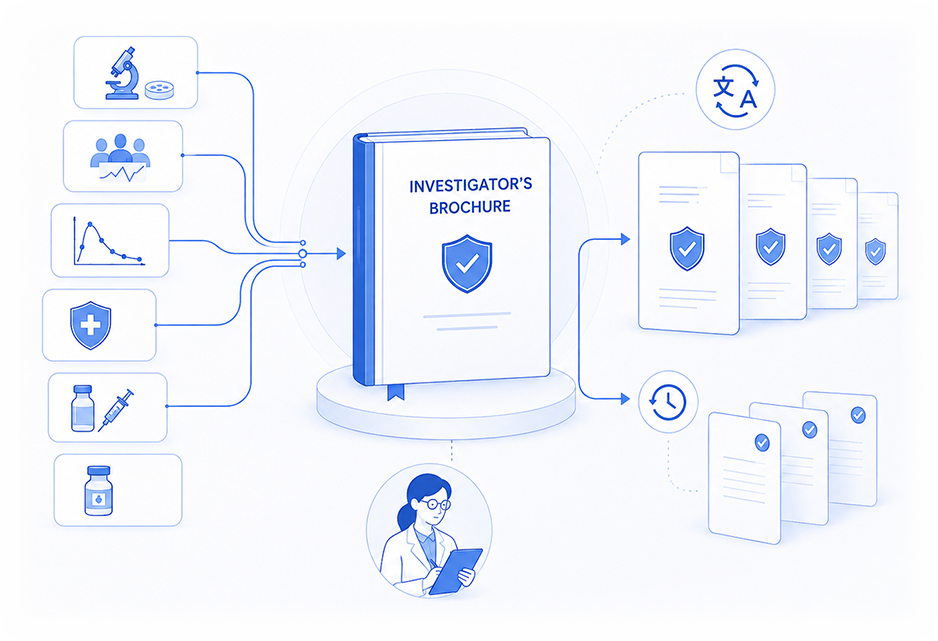
An Investigator’s Brochure is not one isolated body of text. It brings together the scientific information investigators and other study stakeholders need to understand the investigational product, the rationale for its use, and important considerations for administration and safety monitoring.
For multilingual studies, the challenge is therefore not simply translating one document accurately. The scientific relationships within the IB must remain intact across every required language and every subsequent version.
Pharmacology, toxicology, pharmacokinetics, animal studies, and other findings that establish the scientific foundation for clinical investigation.
Previous human exposure, clinical observations, efficacy findings, safety findings, dose-related experience, and evidence generated through development.
Mechanism of action, pharmacodynamics, pharmacokinetics, exposure, metabolism, dose-response information, and related scientific terminology.
Known and emerging safety findings, adverse reactions, risk information, safety monitoring considerations, and RSI where applicable.
Dose levels, schedules, routes of administration, treatment duration, dose modifications, instructions, and the clinical rationale behind them.
Product identity, pharmaceutical characteristics, formulation, physical properties, handling information where included, and related technical content.
A technically correct sentence can still create a problem if it does not align with information elsewhere in the Investigator’s Brochure.
A product term used in a nonclinical section may reappear in clinical pharmacology. A dose discussed in clinical evidence may need to match administration guidance. An adverse reaction described in one safety section may also appear in Reference Safety Information. Study identifiers, abbreviations, units, tables, and references can recur throughout the document.
Context determines whether a term describes an observed finding, a potential risk, a mechanism, a dosing instruction, or a product characteristic. Qualified wording and scientific distinctions must not be strengthened, weakened, or unintentionally generalized in another language.
SAFETY & RSI
Safety content deserves particular attention because an Investigator’s Brochure can change as additional exposure and clinical information become available.
Under ICH E6(R3), the IB or other current scientific information supports clinical-trial safety assessment and reporting, while Reference Safety Information in the IB provides an important reference for expectedness in expedited SUSAR reporting.
Multilingual IB safety content may include adverse reactions, known and potential risks, emerging safety findings, safety monitoring information, relevant medical terminology, Reference Safety Information, and safety-related revisions.
The rationale for a particular dose may originate in pharmacology or toxicology findings, develop through clinical experience, appear in dose-response information, and ultimately connect with administration and safety monitoring. Sesen helps maintain those relationships without reinterpreting the approved science.
These same concepts can also appear in the clinical trial protocol. When approved reference documents are available, Sesen can align critical terminology between the IB and related study content. Explore Protocol Translation Services
Every IB program has its own source history, language requirements, existing translations, terminology resources, review pathway, file formats, and release schedule. Sesen builds the workflow around those requirements while maintaining structured linguistic and quality controls.
Review the current IB, languages, locales, previous editions, existing translations, sponsor references, file formats, timelines, and delivery requirements.
Align product, medical, safety, pharmacology, dose, and study terminology with approved glossaries, translation memories, prior IBs, protocols, and authorized references.
Assign qualified linguists with relevant medical, pharmaceutical, scientific, or clinical research expertise for the language pair and content.
Review the translation against the source for scientific meaning, completeness, terminology, numerical content, and consistency.
Check critical terminology, doses, units, identifiers, tables, figures, section numbering, cross-references, references, and repeated content.
Preserve or recreate complex IB structures including tables, figures, headers, footers, numbered sections, references, and multilingual page layouts.
Complete final linguistic and production checks before delivery of the approved target-language files and agreed project documentation.
AI-ASSISTED QUALITY CONTROL
For suitable Investigator’s Brochure workflows, Sesen can combine translation memory, terminology governance, controlled AI assistance, AI-assisted validation, and qualified human review.
Technology-supported checks help reviewers find patterns and potential inconsistencies faster. Qualified life sciences linguists and reviewers remain responsible for evaluating context, scientific meaning, terminology, and final multilingual quality.
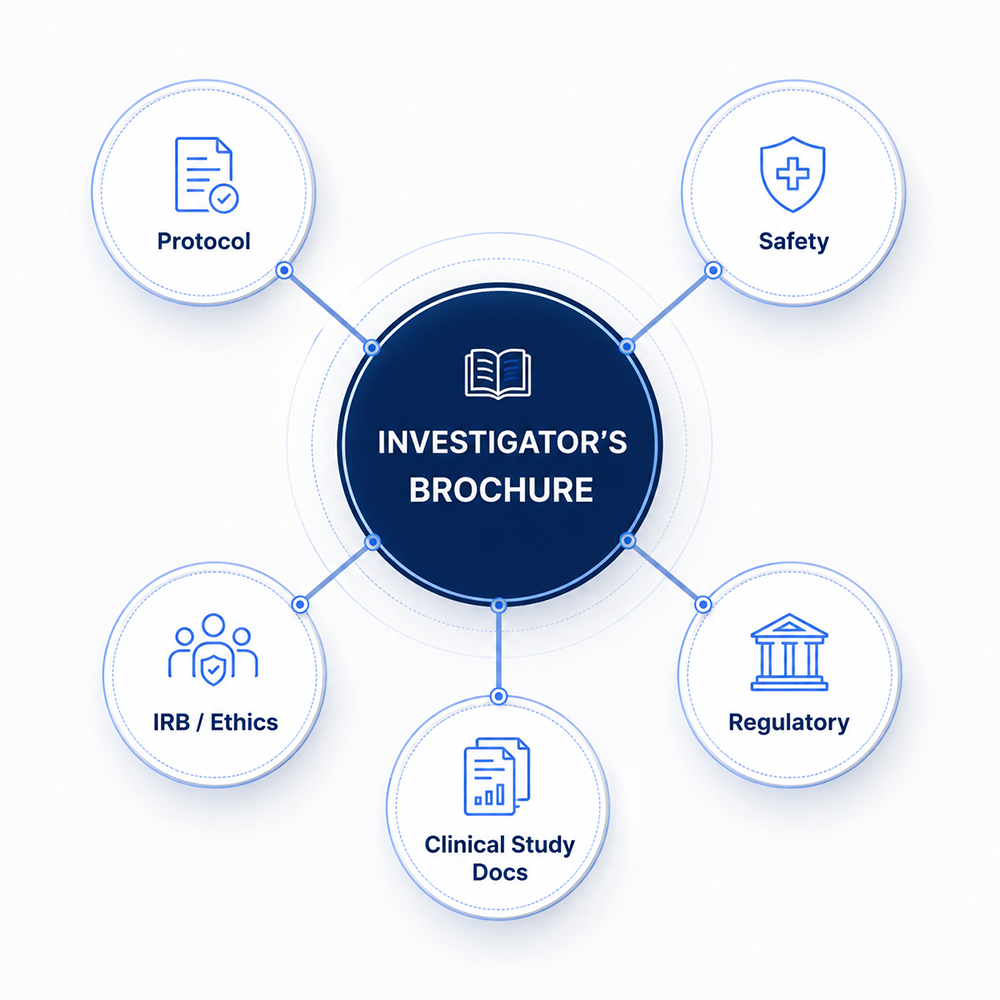
An Investigator’s Brochure does not operate independently from the rest of a clinical study.
Scientific concepts and approved terminology can move among protocols, safety documentation, regulatory materials, ethics submissions, consent updates, study manuals, and other clinical documentation. Managing those relationships helps reduce terminology drift as studies and documents evolve.
Product terminology, dose, administration, safety concepts, clinical rationale, and study-specific terms.
ExploreEvolving safety information can affect the IB and the broader safety-documentation ecosystem.
ExploreClinical and nonclinical evidence may also appear across submissions and supporting regulatory documentation.
ExploreCurrent IB versions and updates can form part of ongoing ethics-review documentation.
ExploreThe IB belongs within the broader multilingual documentation required throughout international studies.
ExploreLIFECYCLE MANAGEMENT
New nonclinical findings, clinical data, safety information, RSI changes, dosing experience, and product information can drive source IB revisions. ICH E6(R3) calls for the IB to be reviewed at least annually and revised as necessary, with more frequent revision potentially appropriate as important new information emerges. For multilingual studies, each source change can create a downstream version-management requirement.
Establish the current approved source and target-language versions as the basis for future updates.
Compare new source editions against previous versions to identify added, revised, moved, or removed content.
Translate affected content while preserving appropriate previously approved language in unchanged sections.
Reuse approved terminology, translation memory, sponsor preferences, and prior reviewer decisions across successive editions.
Coordinate required target languages so study teams can identify which release corresponds to the current approved source.
Verify version identifiers, dates, numbering, references, tables, figures, and formatting affected by the update.
For recurring programs, approved terminology, reviewer decisions, translation memories, reference documentation, and prior quality findings can carry forward so each new release starts from an established multilingual baseline rather than from zero.
Multinational clinical programs may involve one language, dozens of languages, simultaneous country launches, phased market activation, or recurring updates over several years.
Sesen supports single-language projects and coordinated multilingual IB programs, including country- and region-specific language variants where appropriate.
Investigator’s Brochures combine high-value scientific information with ongoing clinical and safety relevance. Sesen applies a quality framework built for regulated life sciences content and multilingual continuity.
Project teams are selected according to language pair, subject matter, therapeutic area, document type, and program requirements.
Where included in the workflow, a second qualified linguist reviews accuracy, completeness, terminology, scientific meaning, and consistency.
Sponsor glossaries, approved product terminology, translation memories, previous translations, and reviewer feedback can be maintained as reusable linguistic assets.
Structured checks support review of doses, concentrations, units, percentages, dates, study numbers, identifiers, tables, and repeated numerical information.
Document-level review covers hierarchy, tables, figures, cross-references, footnotes, references, pagination, headers, footers, and version information.
Qualified professionals retain responsibility for evaluating context, scientific meaning, terminology, and final multilingual quality before delivery.
Answers to common questions about IB scope, Reference Safety Information, amendments, protocol alignment, reviewer workflows, and long-term multilingual version management.
Investigator’s Brochure translation is the specialized translation of the clinical, nonclinical, pharmacology, safety, dosing, and investigational product information contained in an IB for multilingual clinical development. Because the document brings together multiple scientific disciplines and evolves over time, quality also depends on terminology consistency, numerical accuracy, internal relationships, document structure, and version control.
Sesen can translate complete Investigator’s Brochures as well as selected sections, revised content, appendices, tables, figures, safety information, Reference Safety Information, and subsequent editions. Scope can include summaries, product information, nonclinical studies, clinical experience, pharmacology, PK/PD, dosing and administration information, references, and other sponsor-provided source content.
Yes. Sesen translates approved Reference Safety Information and related safety terminology within Investigator’s Brochures and can maintain that terminology through subsequent multilingual updates. Expectedness, causality, medical evaluation, reportability, and other safety or regulatory determinations remain with the sponsor and responsible medical, pharmacovigilance, and regulatory teams.
Sesen can compare the new source edition with the previous version, identify changed content, translate affected sections, reuse approved terminology and translation memory where appropriate, perform linguistic and version-change QA, update formatting, and coordinate required target-language releases.
Yes. When relevant approved reference documents are available, Sesen can use protocol terminology, sponsor glossaries, previous translations, study-specific terminology, translation memories, and other authorized references to help maintain consistency between the Investigator’s Brochure, protocol, and related clinical documentation.
Yes. Authorized sponsor, medical, scientific, regulatory, CRO, or in-country reviewer feedback can be incorporated into the appropriate target-language versions. Approved terminology decisions and reviewer preferences can also be captured for reuse in subsequent IB editions and related clinical documentation.
Not necessarily. The appropriate verification approach depends on the sponsor’s requirements, study procedures, target market, document use, and agreed quality plan. Sesen can incorporate additional review methodologies when requested, while the core IB workflow can emphasize specialized forward translation, independent linguistic review, terminology control, document-level QA, version control, and final human quality checks.
Yes. Sesen can support ongoing IB programs in which the source document is revised as clinical, nonclinical, safety, dosing, or product information changes. Translation memories, approved terminology, prior language versions, reviewer decisions, and controlled source comparisons help maintain continuity from one edition to the next.
Continue into the clinical, safety, regulatory, and ethics services most closely connected with Investigator’s Brochure translation and lifecycle updates.
Whether you are preparing the first multilingual IB, adding new countries, updating Reference Safety Information, incorporating new clinical evidence, or coordinating the next edition across multiple languages, Sesen can build a controlled translation workflow around your program.
Services
Submissions, SOPs, audits, and regulated documentation.
ICFs, protocols, site documents, and patient materials.
COAs, PROs, patient questionnaires, and clinical instruments.
Medical, scientific, and technical life sciences content.
AE reports, DSURs, safety updates, and drug surveillance.
Regulated labeling and packaging for global product markets.
Instructions for Use translation for medical devices.
Device labeling for safety, compliance, and market access.
In-layout linguistic QA for packaging, IFUs, and labels.
Formatting and layout support for multilingual submissions.
Human-reviewed AI translation for regulated content.
Checks for terminology, numbers, formatting, and quality.
AI-assisted terminology extraction and consistency.
Routing, validation, terminology control, and human review.
Machine translation post-editing by medical linguists.
Clinical, medical, software, and digital health platforms.
Digital health apps, portals, and patient tools.
Video, training, voiceover, subtitling, and audiovisual content.
Multilingual voiceover and subtitles for training and communications.
Commercial, brand, and campaign translation for global markets.
Clinical, regulatory, labeling, safety, and commercialization support.
Research, genomics, gene therapy, biosimilars, and emerging therapeutics.
IFUs, labeling, software, technical documentation, and compliance content.
Clinical study operations, recruitment, site communication, and trial documents.
Patient-facing content, EHR documentation, telehealth, and care communication.
Health authority, public health, policy, and compliance-driven communication.
Public health programs, policy documents, and global health initiatives.
Digital health platforms, patient portals, eCOA, and clinical software.
Study startup, patient materials, clinical documentation, and global trials.
Submissions, labeling updates, safety documents, and compliance workflows.
Scientific exchange, publications, training, and medical communications.
Labeling, packaging, launch materials, updates, and commercialization.
Review clinical, regulatory, labeling, or AI-enabled workflow needs.
Structured multilingual workflows for regulated life sciences operations.
Multilingual support for global submissions, labeling, audits, and SOPs.
Translations for ICFs, protocols, site documents, and patient recruitment.
Specialized translations for AE/SAE reports, DSURs, and safety updates.
In-layout linguistic QA for packaging, IFUs, and labeling compliance.
Structured multilingual workflows for labeling translation, validation, and approval.
Component-based translation for IDMP, SPL, and XML content workflows.
Global communication and multilingual engagement programs.
Comprehensive support for launching products in international markets.
Culturally adapted outreach and multilingual trial communications.
Consistent scientific and brand language across markets.
Localized training for internal teams, HCPs, and external stakeholders.
Translation of websites, portals, and mobile health apps.
Sesen combines expert linguists, validation-driven review, and AI-assisted technologies to support global life sciences operations.
Proprietary AI, terminology, validation, and workflow systems for regulated multilingual content.
AI-assisted translation workflows built for regulated life sciences content.
Human-reviewed AI translation for quality, consistency, and scalability.
Automated checks for terminology, numbers, formatting, and compliance.
AI-assisted term extraction, harmonization, and reuse across global content.
Structured workflows for multilingual labeling translation, review, and validation.
AI-enabled workflows for clinical, regulatory, safety, and digital health teams.
AI-assisted multilingual support for ICFs, protocols, and patient materials.
Structured AI workflows for submissions, labeling, and compliance content.
AI-enabled workflows for AE reports, DSURs, safety updates, and drug surveillance.
AI-assisted localization for portals, apps, eCOA, and digital health platforms.
Coordinated multilingual workflows with AI routing and human review.
Start with a pilot that combines SesenGPT, professional native medical linguists, terminology control, and validation-driven QA.
Expert perspectives on AI, regulatory content, and multilingual life sciences communication.
Trends, analysis, and expert perspectives on multilingual life sciences communication.
Guidance on AI-enabled workflows, validation, terminology, and compliance.
Best practices for clinical trials, submissions, labeling, and global content operations.
Proof points, learning resources, and practical tools for multilingual content programs.
Examples of multilingual workflow support across life sciences organizations.
On-demand sessions and expert discussions on regulated multilingual operations.
Terminology resources for consistency across multilingual content programs.
Decision-support content for AI governance, quality, compliance, and translation strategy.
Detailed guidance on AI workflows, translation strategy, and global compliance.
Answers to operational, regulatory, and localization workflow questions.
Browse educational, technical, and customer-facing resources from Sesen.
Explore guidance on validation, terminology, structured content, and multilingual operations for life sciences organizations.
Mission, leadership, and values that guide Sesen’s life sciences localization work.
Regional footprint, partner ecosystem, and company updates across the industry.
A focused partner for high-stakes multilingual life sciences operations.
Sesen combines life sciences specialization, multilingual operations, and AI-enabled workflows for organizations that need quality, consistency, and scale.
Discuss enterprise translation, localization, or AI-enabled workflow needs.
Choose the right path for a new translation, localization, or AI-enabled workflow.
Get pricing and turnaround estimates for regulated multilingual content.
Speak with our team about clinical, regulatory, labeling, or AI-enabled workflows.
Evaluate SesenGPT workflows for multilingual regulated content.
Connect with Sesen for enterprise programs, partnerships, and ongoing support.
Specialized support for global life sciences teams managing regulated multilingual content.
For general inquiries, support, and company information.
Life Sciences Translation Company
Sesen helps life sciences teams manage clinical, regulatory, labeling, and AI-enabled translation workflows across 150+ languages.
Trusted by life sciences teams for regulated multilingual content across clinical, regulatory, labeling, and healthcare workflows.
Services
Life Sciences Language Services
Explore Sesen services for clinical, regulatory, labeling, medical device, software, multimedia, and global commercial content.
Featured Services
ICFs, protocols, site documents, and patient-facing materials.
Submissions, SOPs, audits, and regulated documentation.
Labeling, packaging, and product content for global markets.
Instructions for use and medical device documentation.
More Services
COA, PRO, questionnaire, and instrument workflows.
Specialized translation for medical and scientific content.
Software, portals, apps, and connected health interfaces.
Video, voiceover, subtitles, and training content localization.
Remote and onsite interpreting for life sciences settings.
Commercial, launch, and market access content for global audiences.
Need Help Choosing?
Discuss clinical, regulatory, labeling, or AI-enabled translation needs with a life sciences specialist.
Life Sciences
Life Sciences
Explore Sesen support for pharmaceutical, biotechnology, medical device, CRO, healthcare, public health, and regulated content teams.
Core Life Sciences Sectors
Healthcare & Public Sector
Specialized Domain Expertise
Study startup, patient materials, clinical documentation, and global trials.
Submissions, labeling updates, safety documents, and compliance workflows.
Scientific exchange, publications, training, and medical communications.
Labeling, packaging, launch materials, updates, and commercialization.
Trust & Compliance
Plan a Global Program
Connect with Team Sesen to review clinical, regulatory, labeling, or AI-enabled multilingual workflow needs.
Explore structured multilingual workflows for clinical, regulatory, labeling, commercial, training, and patient engagement programs.
Global submissions, labeling audits, SOPs, and regulated documentation.
ICFs, protocols, site documents, patient materials, and recruitment content.
Structured workflows for labeling translation, validation, and approval.
In-layout linguistic QA for packaging, IFUs, labeling, and compliance.
AE and SAE reports, DSURs, safety updates, and surveillance content.
Component-based translation for IDMP, SPL, and XML content workflows.
Support for launching products across international markets.
Culturally adapted outreach and multilingual trial communications.
Consistent scientific and brand language across global markets.
Localized training for internal teams, HCPs, and external stakeholders.
Websites, portals, mobile health apps, and digital patient experiences.
Sesen combines expert linguists, validation-driven review, and AI-assisted technologies to support global life sciences operations.
EXPLORE SESENGPTConnect with Team Sesen to discuss clinical, regulatory, labeling, commercial, or AI-enabled multilingual operations.
AI & Innovation
AI
Powered by SesenGPT workflowsExplore Sesen AI workflows for translation, terminology, validation, labeling, clinical trials, regulatory content, safety, and digital health localization.
Core AI Platform
AI-assisted translation workflows built for regulated life sciences content.
Human-reviewed AI translation for quality, consistency, and scalability.
Automated checks for terminology, numbers, formatting, and compliance.
AI-assisted term extraction, harmonization, and reuse across global content.
Structured workflows for multilingual labeling translation, review, and validation.
Operational AI Solutions
AI-assisted multilingual support for ICFs, protocols, and patient materials.
Structured AI workflows for submissions, labeling, and compliance content.
AI-enabled workflows for AE reports, DSURs, safety updates, and drug surveillance.
AI-assisted localization for portals, apps, eCOA, and digital health platforms.
Coordinated multilingual workflows with AI routing and human review.
Controlled AI Translation Program
Start with a pilot that combines SesenGPT, professional native medical linguists, terminology control, and validation-driven QA.
EXPLORE SESENGPTDiscuss AI Workflows
Connect with Team Sesen to discuss AI-assisted translation, terminology governance, multilingual QA, and regulated life sciences workflows.
Resources
Resources
Explore all resourcesAccess expert perspectives, proof points, learning resources, and practical tools for multilingual life sciences content programs.
Industry Insights
Trends, analysis, and expert perspectives on multilingual life sciences communication.
Guidance on AI-enabled workflows, validation, terminology, and compliance.
Best practices for clinical trials, submissions, labeling, and global content operations.
Customer & Operational Resources
Examples of multilingual workflow support across life sciences organizations.
On-demand sessions and expert discussions on regulated multilingual operations.
Terminology resources for consistency across multilingual content programs.
Strategic & Technical Resources
AI Translation Guidance
Review insights on validation, terminology, structured content, compliance, and multilingual operations for life sciences organizations.
Explore AI InsightsResource Center
Explore Sesen resources for clinical, regulatory, AI-enabled, quality, and multilingual content operations.
Learn about Sesen's mission, leadership, values, global footprint, partners, and commitment to life sciences localization excellence.
Company Foundation
Global Presence
Why Teams Work With Sesen
Sesen combines life sciences specialization, multilingual operations, and AI-enabled workflows for organizations that need quality, consistency, and scale.
Talk With Team Sesen
Connect with Team Sesen to discuss enterprise translation, localization, or AI-enabled workflow needs.
Contact
Contact
Talk with our teamChoose the right path for a new translation, localization, AI-enabled workflow, partnership, or existing project support need.
Start a Project
Get pricing and turnaround estimates for regulated multilingual content.
Speak with our team about clinical, regulatory, labeling, or AI-enabled workflows.
Evaluate SesenGPT workflows for multilingual regulated content.
Enterprise Engagement
Why Organizations Contact Sesen
General Contact Information
For general inquiries, support, and company information, connect with Team Sesen and we will route your request to the right team.