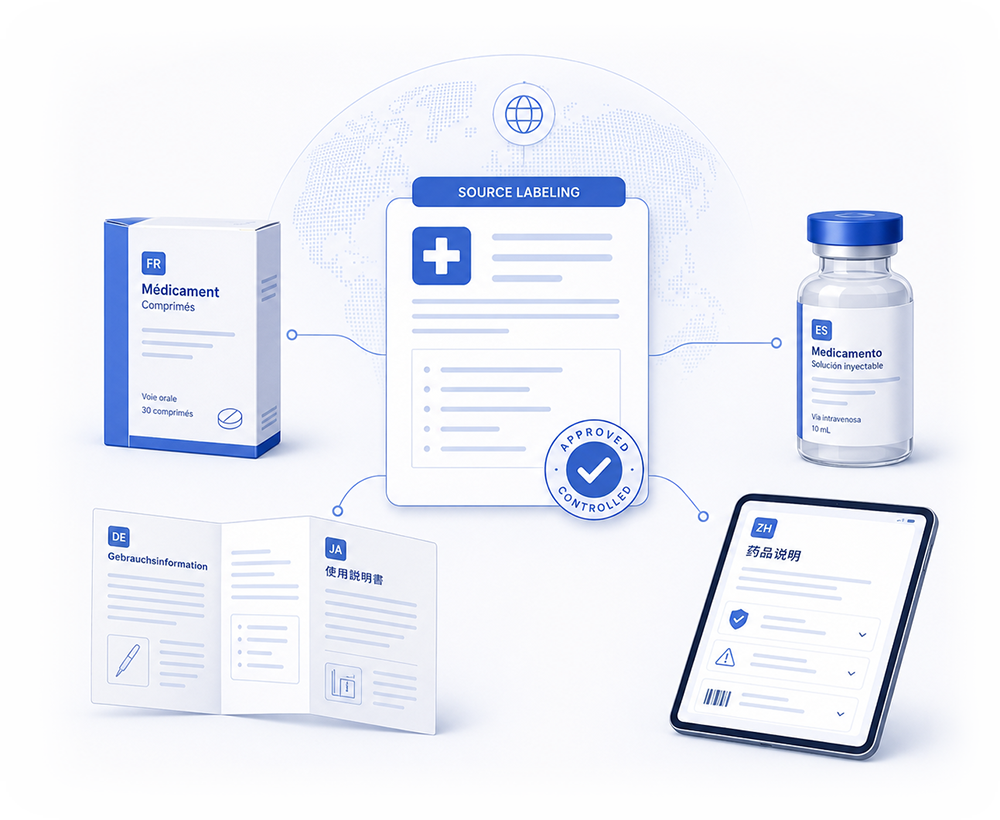
A Controlled Workflow from Source Content to Final Labeling
Regulated labeling translation requires more than linguistic fluency. It requires control over terminology, versions, safety-critical information, numbers, formatting, artwork, and related content.
Sesen adapts the workflow to the content type, product, languages, markets, file formats, client requirements, and intended downstream use.
01
Source & Version Review
We begin by understanding what is changing and how the translated content will be used. Source files, prior versions, references, artwork, target languages, markets, and delivery requirements are reviewed to establish the appropriate workflow.
For update projects, version-aware review helps identify changed content while preserving relevant previously approved material.
02
Terminology Alignment
Product terminology should remain consistent wherever it appears. Sesen can incorporate client-approved glossaries, existing translations, translation memories, product names, medical and regulatory terminology, safety language, style guides, and market preferences.
Terminology governance is especially valuable when the same concepts recur across product information, packaging, patient materials, IFUs, regulatory documents, and successive labeling updates.
03
Specialized Life Sciences Translation
Content is assigned to professional linguists suited to the language pair, subject matter, audience, and intended use, with attention to clinical and technical meaning, safety-critical language, readability, and approved references.
For regulated labeling, the goal is precise, controlled multilingual communication appropriate to the content and audience.
04
Independent Review & Quality Assurance
Structured review can address meaning, completeness, terminology, product names, numbers, units, warnings, repeated content, source-to-target correspondence, formatting, and client-specific requirements.
Sesen combines professional human review with technology-assisted QA to help reviewers focus on potential risk areas.
05
Multilingual Artwork & Formatting
A correct translation must also work inside the actual label, carton, leaflet, IFU, or digital format. Our multilingual production teams support localized layouts while accounting for text expansion, typography, tables, callouts, line breaks, page flow, and script-specific requirements.
The aim is to preserve hierarchy, readability, and production integrity across target-language formats.
06
In-Context Linguistic QA
Some issues only become visible after translated text is placed into its final layout. In-context review can help identify truncation, missing content, poor line breaks, misplaced language, inconsistent terminology, formatting shifts, and visual ambiguity.
This final-context perspective is particularly important for labels, cartons, packaging, IFUs, and other space-constrained or safety-sensitive materials.
07
Controlled Delivery & Update Support
Final files are prepared in the required formats for the client's review, regulatory, production, publishing, or market workflow.
For recurring programs, terminology assets, translation memories, approved references, and prior translations can support subsequent labeling revisions and language expansion.