Regulatory Accuracy
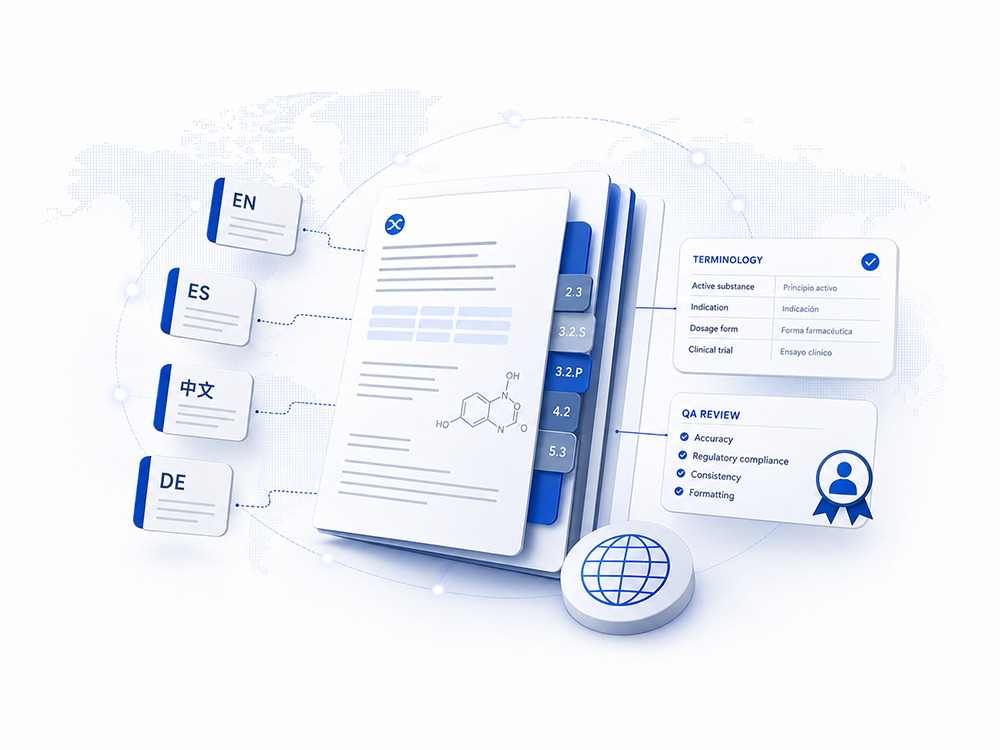
Scientific, medical, technical, and regulatory meaning must remain precise across languages. Numerical content, dosage information, references, claims, and safety-critical language require particular attention.

Support global submissions, health authority communication, labeling, quality systems, safety programs, and regulatory lifecycle updates with specialized life sciences translation across 150+ languages.
Sesen combines professional native life sciences linguists, controlled terminology, structured quality review, secure workflows, and AI-assisted technologies to help pharmaceutical, biotechnology, medical device, CRO, and healthcare organizations manage regulated multilingual content with greater consistency and control.
Regulatory content rarely exists as a single document. The same product, study, claim, safety statement, manufacturing term, or approved phrase can appear across submission modules, labeling, clinical documentation, quality systems, safety reports, and market-specific updates.
As that content moves across languages and regulatory cycles, translation quality depends on more than sentence-level accuracy. It requires control over terminology, references, versions, document relationships, and review decisions.
Scientific, medical, technical, and regulatory meaning must remain precise across languages. Numerical content, dosage information, references, claims, and safety-critical language require particular attention.
Product terminology, study language, CMC terms, adverse event terminology, approved labeling language, and recurring regulatory phrases should remain aligned across connected documents.
Drafts, revisions, amendments, reviewer comments, and country-specific adaptations need clear version awareness so multilingual content remains connected to the correct source.
Translation, review, QA, and formatting should reflect how the content will actually be used—whether for submission, authority response, labeling, inspection, quality operations, or post-approval maintenance.
REGULATORY LIFECYCLE
Global regulatory translation does not end when an application is submitted. Multilingual content evolves throughout development, authority review, approval, commercialization, safety monitoring, and ongoing product maintenance.
Build multilingual readiness with regulatory documentation, terminology resources, reference materials, target-language and market requirements, and review requirements.
Translate dossiers, CTD and eCTD content, applications, technical documentation, labeling components, and supporting materials.
Support health authority questions, requests for information, deficiency responses, attachments, meeting materials, and regulatory correspondence.
Prepare prescribing information, SmPCs, patient information, packaging, labels, IFUs, and country-specific approved product content.
Maintain SOPs, QMS documentation, validation materials, CAPA content, audits, training, and other controlled operational content.
Support pharmacovigilance, adverse event content, periodic safety reports, risk-management materials, and post-market safety communication.
Manage variations, amendments, labeling revisions, manufacturing changes, safety updates, product extensions, and recurring lifecycle content.
Sesen supports regulatory translation across pharmaceutical, biotechnology, medical device, clinical research, quality, and post-market environments. Workflows are adapted to the content type, target market, intended use, file format, risk level, and review requirements.
Regulatory submissions bring together scientific, clinical, quality, administrative, and product information that must remain aligned as one body of evidence.
For multilingual CTD and eCTD programs, quality depends not only on translating each document correctly, but also on maintaining terminology, references, study identifiers, product information, formatting, and prior translation decisions across interconnected modules and subsequent updates.
Region-specific administrative content, application materials, product information, forms, labeling, correspondence, and supporting documents.
Quality, nonclinical, and clinical overviews and summaries with terminology aligned to the detailed evidence presented elsewhere in the dossier.
Drug substance and drug product information, manufacturing processes, specifications, analytical procedures, validation, stability, and related quality documentation.
Pharmacology, pharmacokinetic, toxicology, and other nonclinical documentation used within the submission package.
Clinical study documentation and supporting evidence with attention to study terminology, endpoints, safety language, references, and cross-document consistency.
Submission is often the beginning of an ongoing review process. Regulatory affairs teams may need to respond to questions, requests for additional information, deficiencies, clarification requests, labeling comments, or other authority communication—sometimes under demanding timelines and across multiple internal and regional stakeholders.
Using established glossaries, translation memory, prior submission content, product references, and reviewer decisions helps responses remain aligned with the multilingual documentation that preceded them.
Regulatory Affairs Translation ServicesTerminology, references, study identifiers, product language, and reviewer decisions should remain consistent as authority interactions create new multilingual content.
Product information must communicate approved content accurately while meeting the linguistic and operational requirements of each target market. Sesen helps life sciences organizations maintain consistency across interconnected labeling components while supporting review, formatting, and recurring updates.
Prescribing information, SmPCs, patient information leaflets, package inserts, medication guides, warnings, contraindications, approved safety statements, and product-information updates.
Carton and container text, package labels, artwork text, symbols and accompanying language, layout-sensitive content, and market variants. In-context review can help identify truncation, misplaced text, formatting inconsistencies, and other layout issues.
Instructions for use, device labels, warnings and precautions, technical documentation, packaging content, software-related user content, and recurring product updates.
Multilingual revisions supported through translation memory, terminology assets, reference materials, version-aware workflows, and review processes that distinguish new content from previously approved language.
Regulatory translation extends beyond submissions and product labeling. Life sciences organizations rely on controlled documentation every day to manage processes, training, manufacturing, quality events, audits, inspections, and continuous improvement.
When those operations span countries and languages, internal documentation needs the same discipline applied to external regulatory content.
SOPs, work instructions, process documents, policies, manuals, and related controlled materials with consistent procedural terminology.
Quality manuals, QMS procedures, CAPAs, deviations, investigations, change controls, and corrective or preventive actions.
Validation protocols and reports, manufacturing documentation, specifications, process instructions, and controlled technical content.
Audit materials, inspection-related documents, findings, responses, evidence packages, and quality records requiring accurate multilingual communication.
Regulated training materials aligned with the underlying procedures, terminology, and operational instructions used by employees and partners.
Drug safety content presents a distinct set of multilingual challenges. Case narratives may be time-sensitive. Periodic safety reports recur across the product lifecycle. Medical terminology must remain consistent, and new information may need to be incorporated without changing the meaning of prior safety language.
Adverse event reports, serious adverse event reports, individual case safety reports, SUSAR-related documentation, CIOMS forms, case narratives, follow-up information, and case updates.
DSURs, PSURs, PBRERs, annual safety reports, line listings, safety summaries, and benefit-risk updates.
Risk management plans, risk-minimization materials, safety variations, signal-related documentation, post-marketing surveillance content, and safety data exchange documentation.
Safety information for health authorities, healthcare professionals, affiliates, investigators, partners, and other stakeholders with controlled terminology and narrative accuracy.
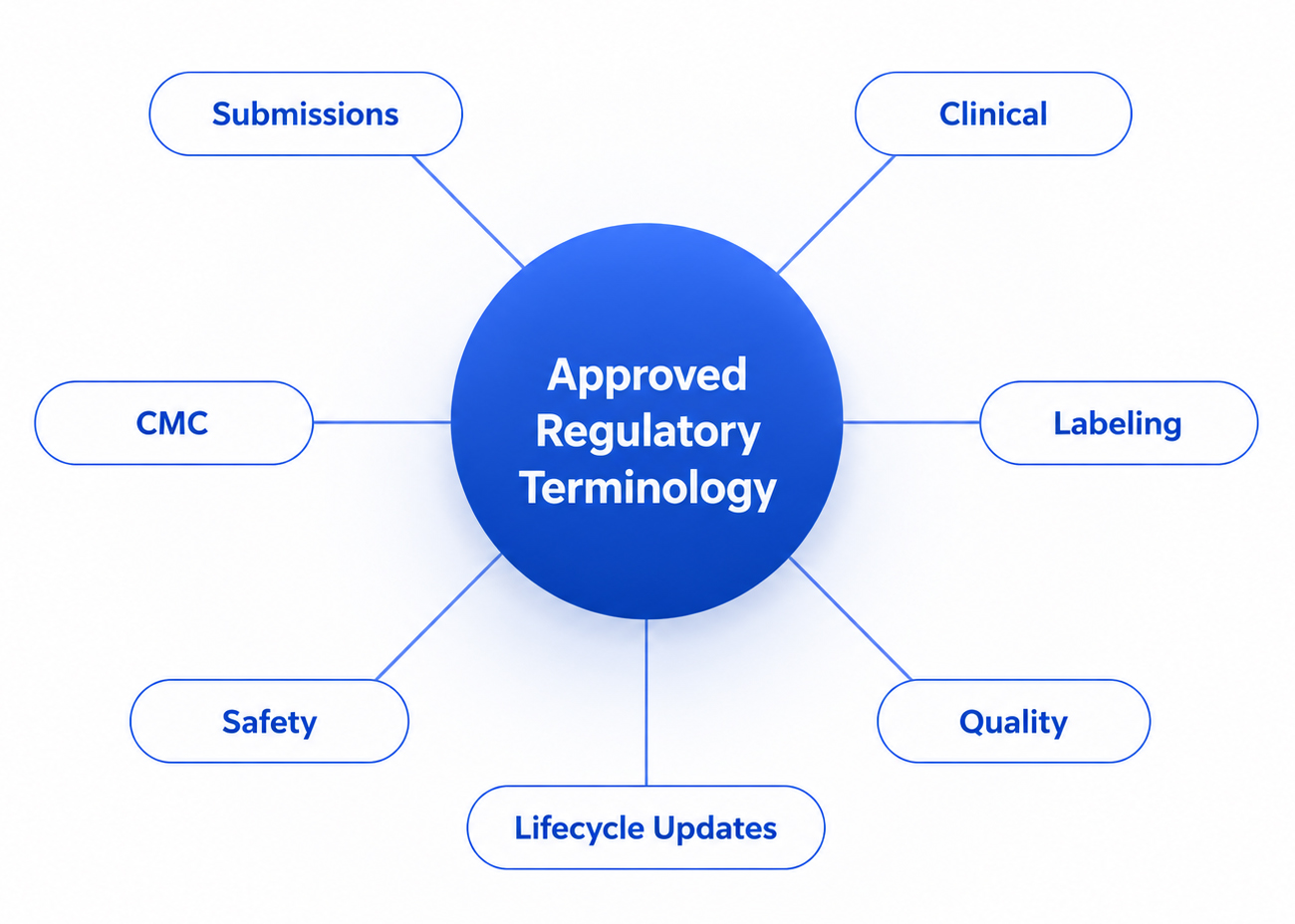
Keep product, clinical, CMC, labeling, safety, and quality terminology consistent as regulated content moves across documents, languages, markets, and revisions. A regulatory program may involve hundreds or thousands of interconnected content elements, with the same approved terms recurring across submissions, clinical documents, labeling, safety reports, quality systems, and post-approval updates.
Sesen treats terminology as a managed regulatory asset rather than a project-by-project afterthought.
Every regulatory translation program is different, but disciplined execution follows a common principle: quality controls should begin before translation and continue through final delivery.
Review content types, intended use, target languages and markets, regulatory context, source files, references, timelines, expected updates, and review requirements.
Integrate client glossaries, prior approved translations, product terminology, translation memory, style guides, submission references, labeling references, and market-specific preferences.
Professional native linguists are selected according to language, subject-matter experience, document type, and intended use, with approved terminology and translation memory integrated into the workflow.
Translated content is reviewed for accuracy, completeness, terminology, grammar, consistency, context, references, and adherence to project instructions.
Technology-assisted checks help identify potential issues involving terminology, numbers, units, dates, tags, formatting, repeated content, omissions, and cross-document inconsistencies.
Files are prepared for the required delivery environment, including layout-sensitive content where applicable, followed by final QA against the approved content and project requirements.
HUMAN EXPERTISE + TECHNOLOGY
AI can accelerate how multilingual content is processed, checked, reused, and managed at scale. For regulated life sciences content, however, speed alone is not the objective.
Scientific meaning, regulatory context, approved terminology, document relationships, patient and product safety, and final quality still require professional judgment. Sesen combines professional life sciences expertise with SesenGPT-enabled workflows, translation memory, terminology intelligence, automated QA, and structured human review.
Explore SesenGPT150+ LANGUAGES
Global regulatory programs rarely follow a single-language, single-market path. Sesen provides translation and localization support across 150+ languages for regulatory submissions, product information, authority communication, quality documentation, safety content, and lifecycle updates.
Coordinate multiple target languages through centralized project management and shared quality controls.
Manage market-specific language preferences without losing alignment with core approved content.
Support Chinese, Japanese, Korean, and other Asian languages with appropriate linguistic and formatting expertise.
Manage Arabic, Hebrew, and other right-to-left content with attention to document presentation and layout.
Support translated tables, graphics, structured files, publishing formats, and layout-sensitive regulated documentation.
Incorporate affiliate, in-country, or client reviewer feedback into controlled workflows and reusable linguistic assets.
Regulatory teams need confidence not only in the translated words, but also in the process surrounding them. Sesen combines ISO-certified quality processes, regulated-content controls, professional native life sciences linguists, secure project handling, terminology governance, and documented QA workflows.
Structured translation-service processes incorporating qualified linguists, translation, independent review, project management oversight, and quality control.
Quality management principles applied across project intake, resource management, workflow control, issue management, communication, and continuous improvement.
Quality practices relevant to multilingual medical device documentation including IFUs, labeling, packaging, software, safety content, and regulated product documentation.
Sesen uses controlled access and secure handling for sensitive life sciences documents, references, and project materials, supported by AWS-hosted infrastructure.
Defined QA stages, reviewer accountability, version control, and delivery records give organizations visibility into how regulated multilingual content was produced and reviewed.
Shared language assets, approved terminology, reference materials, and version-aware workflows help maintain continuity across recurring regulatory content.
Sesen supports organizations across the life sciences ecosystem with translation workflows aligned to the content they create and the markets they serve.
Translation across drug development, submissions, CMC, labeling, pharmacovigilance, quality operations, and lifecycle maintenance.
Specialized support for complex scientific, clinical, regulatory, and product content involving novel therapies and evolving development programs.
Translation for regulatory documentation, technical files, labeling, IFUs, quality systems, software, safety information, and product updates.
Scalable multilingual support across sponsor programs, clinical documentation, regulatory activity, safety content, site communication, and submission workflows.
Translation and localization for regulated healthcare, clinical, software, and compliance-related content across global environments.
Specialized multilingual support for regulatory, scientific, healthcare, and public-health communication where precision and controlled terminology matter.
Regulated multilingual programs require subject-matter expertise, repeatable controls, and the ability to maintain language decisions across documents and over time.
Sesen is built around pharmaceutical, biotechnology, medical device, CRO, healthcare, and other regulated life sciences content—not general-purpose translation alone.
Linguists are selected according to target language, subject expertise, document type, and project requirements.
Glossaries, translation memory, product references, style guides, and client-specific linguistic rules help maintain consistency across connected regulatory content.
Translation, independent review, QA, project oversight, and final delivery are managed through defined quality processes appropriate for regulated content.
Sesen supports projects ranging from individual regulatory documents to complex, recurring programs involving multiple content streams, countries, and languages.
Professional linguistic expertise is supported by SesenGPT, terminology intelligence, translation memory, automation, and AI-assisted QA—not displaced by them.
When your program requires deeper support in a particular regulatory workflow, Sesen provides specialized services across the regulatory content lifecycle.
Dossiers, applications, supporting documentation, amendments, response packages, and global regulatory filings.
Explore service →Translation across CTD modules, structured submission content, terminology, references, revisions, and lifecycle updates.
Explore service →Support for regulatory affairs teams managing submissions, authority communication, labeling updates, safety documentation, and lifecycle activity.
Explore service →Translation for controlled compliance, quality, audit, inspection, and regulated operational content.
Explore service →Technical formatting and document preparation to support multilingual regulatory submission workflows.
Explore service →Specialized translation for Chemistry, Manufacturing, and Controls documentation used across pharmaceutical regulatory programs.
Explore service →Prescribing information, SmPCs, PILs, package inserts, packaging, and regulated product information.
Explore service →Adverse event content, safety narratives, periodic reports, risk-management materials, and global safety communication.
Explore service →Medical device instructions for use, safety information, product documentation, and multilingual market requirements.
Explore service →Answers to common questions about regulatory translation workflows, document coverage, quality controls, terminology, AI-assisted processes, and global language support.
Regulatory translation services support the multilingual translation, review, and management of content used in regulatory submissions, product approvals, health authority communication, labeling, quality systems, inspections, safety reporting, and ongoing product lifecycle activities. Because related regulatory documents frequently reuse scientific, medical, product, and safety terminology, effective regulatory translation also requires terminology governance, version awareness, cross-document consistency, and structured quality review.
Sesen supports CTD/eCTD content, regulatory applications and dossiers, IND/NDA/BLA/ANDA/MAA materials, clinical and nonclinical documentation, CMC content, health authority correspondence, drug labeling, IFUs, SOPs, QMS documentation, validation materials, audit and inspection content, pharmacovigilance documentation, and other regulated life sciences materials.
Yes. Sesen supports translation across CTD and eCTD content, including regional and administrative materials, summaries, CMC documentation, nonclinical reports, clinical documentation, labeling, and related submission-support content. Workflows can incorporate terminology management, translation memory, reference alignment, version control, formatting support, linguistic review, and QA across interconnected submission documents.
Yes. Sesen supports both planned submission content and subsequent multilingual regulatory communication, including authority questions, requests for information, deficiency responses, clarification packages, supporting attachments, and related correspondence. Prior approved translation, terminology, and reference materials can help maintain continuity between the original submission and later responses.
Sesen uses client-approved glossaries, terminology databases, translation memory, style guides, product references, legacy translations, reviewer feedback, and project-specific linguistic rules. These resources can be applied across submissions, CMC content, clinical documents, labeling, quality documentation, safety content, and subsequent updates so recurring terminology remains controlled throughout the program.
Yes. Sesen supports SOPs, work instructions, quality manuals, QMS documentation, CAPAs, deviations, change controls, validation materials, audits, inspections, training, and other controlled quality and compliance content. Version-aware workflows and translation memory can also support recurring revisions.
Yes. Sesen translates prescribing information, SmPCs, patient information leaflets, package inserts, medication guides, labels, packaging, warnings, device labeling, IFUs, and other regulated product information. Sesen can also support layout-sensitive review and recurring multilingual updates.
Yes. Sesen supports pharmacovigilance and drug safety content including AE and SAE documentation, ICSRs, SUSAR-related content, case narratives, DSURs, PSURs, PBRERs, RMPs, safety communications, and post-marketing materials.
Sesen uses AI-assisted technologies to support appropriate translation workflows, terminology identification, content reuse, and quality checks. For regulated content, AI operates within a controlled workflow that includes professional human expertise. Qualified linguists and reviewers remain responsible for evaluating context, meaning, terminology, and final linguistic quality.
Yes. Sesen can structure project management, translation, review, and QA around urgent, rolling, and recurring regulatory requirements. The appropriate workflow depends on document type, volume, language combination, intended use, deadline, and required quality controls.
Sesen supports regulatory translation in more than 150 languages, including major European, Asian, Latin American, Middle Eastern, and other global market languages.
Yes. Sesen supports multilingual document formatting and technical preparation for regulatory content, including layout-sensitive files, structured documents, tables, graphics, and other formats where translated content must remain usable within the intended regulatory workflow.
Regulatory Submission FormattingWhether you are preparing a submission, responding to health authority questions, updating product labeling, managing quality documentation, supporting drug safety operations, or maintaining multilingual content across the product lifecycle, Sesen can help you build the right regulatory translation workflow.
Bring together professional life sciences linguists, controlled terminology, translation memory, structured review, secure workflows, and AI-assisted quality technologies in one multilingual program designed around your content, markets, and regulatory needs.