Controlled Processes
Defined translation, review, QA, approval, and delivery steps help make multilingual work repeatable across products, sites, languages, and document revisions.

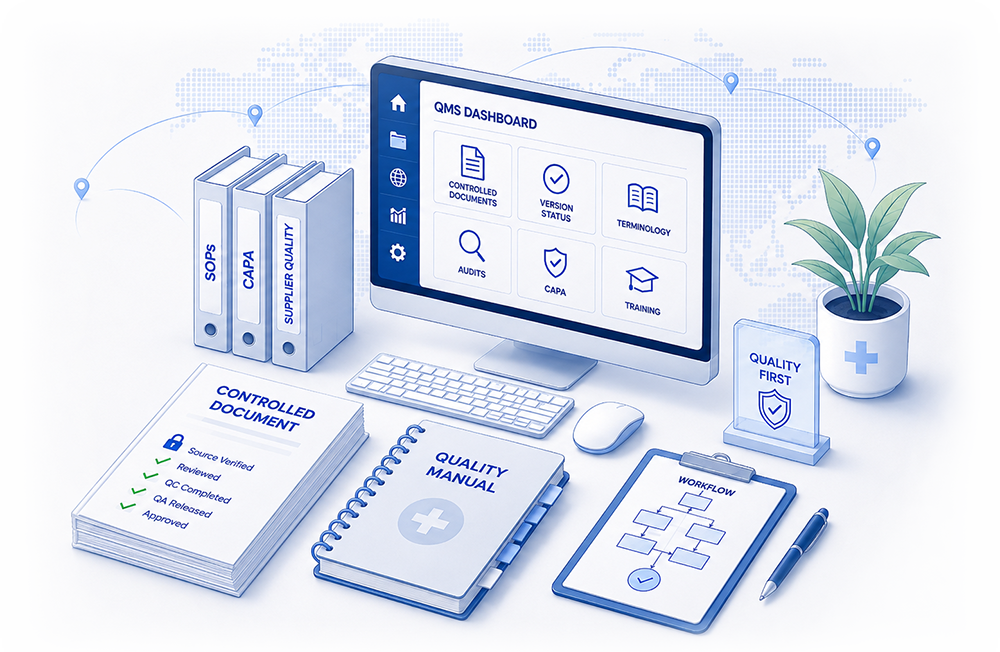
ISO 13485 is the internationally recognized quality management system standard developed specifically for medical devices. It establishes requirements for organizations involved in the design, production, installation, servicing, and related activities surrounding medical devices.
That distinction matters when evaluating a translation provider. ISO 13485 is not a translation standard. It provides the medical device quality-management framework within which controlled processes, suppliers, records, documentation, and risk-based activities may be managed.
ISO 17100 is the international standard specifically focused on translation services. It addresses the processes, resources, and other aspects involved in delivering professional translation services that meet applicable specifications.
Medical device quality systems depend on controlled processes, qualified suppliers, accurate records, consistent procedures, and the ability to manage change over time. When multilingual content forms part of that environment, translation should be managed with the same attention to process discipline and documentation expected of other specialized external services.
Defined translation, review, QA, approval, and delivery steps help make multilingual work repeatable across products, sites, languages, and document revisions.
QMS content often combines quality terminology with technical, manufacturing, regulatory, or product-specific language. Resources should fit the subject matter and intended use.
Translations should remain clearly associated with the correct source files, revisions, language versions, references, and project records.
Translation workflows can be configured according to document purpose, intended audience, regulatory significance, target markets, and client quality requirements.
Quality and procurement teams may need information about certifications, processes, resource qualifications, security controls, and documentation practices.
Teams can maintain visibility into what was translated, which source revision was used, what review occurred, and which version was ultimately delivered.
Sesen supports multilingual quality management system content across medical device organizations, manufacturing operations, supplier networks, and global quality teams.
Maintain clear and consistent quality-system requirements across facilities, teams, and languages.
Support accurate multilingual communication around investigations, corrective actions, and quality events.
Help communicate quality expectations throughout increasingly global medical device supply chains.
Keep controlled content aligned as procedures, products, manufacturing processes, and quality requirements evolve.
Translate quality-related documentation associated with product development, verification, validation, and risk-management activities.
Support consistent procedures across manufacturing sites, service teams, distributors, and global operations.
Help global teams understand, apply, and demonstrate quality-system requirements consistently.
Need broader support for IFUs, labeling, software, technical documentation, regulatory content, or post-market communication? Explore Sesen's comprehensive medical device translation services.
Medical Device Translation ServicesQuality-system translation requires more than transferring words from one language to another. Sesen can configure workflows around controlled source documentation, approved terminology, qualified resources, independent review, quality assurance, and version-aware delivery.
Identify the document, source revision, target languages, reference materials, prior translations, and delivery requirements before multilingual production begins.
Apply approved QMS terminology, product language, glossaries, style guidance, translation memory, and relevant reviewer decisions.
Assign professional linguists according to language pair, document type, technical subject matter, and agreed workflow requirements.
Where included in the workflow, a qualified independent reviewer evaluates accuracy, completeness, terminology, clarity, and consistency against the source.
Check terminology, numbers, units, completeness, repeated text, headings, warnings, references, formatting, and file structure as appropriate.
Incorporate approved client, quality-team, subject-matter, or in-country feedback and retain useful terminology decisions for future revisions.
Prepare final multilingual files with agreed naming, structure, formatting, and project documentation so teams can identify the correct translated version.
The translation of a controlled document is rarely a one-time event. An SOP may move from Rev. C to Rev. D. A manufacturing instruction may change after process validation. A CAPA may introduce updated terminology. A supplier procedure may be standardized across additional facilities.
Sesen supports recurring QMS translation programs with workflows designed to maintain continuity as controlled documents change.
Keep translated files associated with the appropriate controlled source version so current and superseded content remain distinguishable.
Where source files and formats permit, identify changed content so approved existing translations can be reused while new or modified text receives focused review.
Retain previously translated and approved segments for controlled reuse across recurring updates and related content.
Maintain approved product, quality, manufacturing, and procedural terminology in centralized glossaries and termbases.
Capture accepted client-review decisions and apply them to future revisions instead of recreating the same terminology discussion each cycle.
Help keep approved terms aligned across SOPs, work instructions, training, supplier documents, and related quality content.
ISO 13485 has become even more central to the U.S. medical device quality landscape. FDA's Quality Management System Regulation, or QMSR, became effective on February 2, 2026 and incorporates ISO 13485:2016 by reference as the international quality-management-system standard for medical devices.
The change brings FDA's medical device current good manufacturing practice requirements into closer alignment with the internationally recognized ISO 13485 framework.
This does not mean every medical device translation automatically becomes an “ISO 13485 translation,” nor does it create a blanket requirement that every translation be separately ISO 13485 certified. Instead, it reinforces the importance of the quality systems within which medical device organizations manage processes, documentation, suppliers, records, and regulated activities.
Different standards address different aspects of quality. Understanding those differences helps medical device organizations evaluate translation suppliers more accurately.
Provides the medical-device-specific quality environment relevant to controlled processes, documentation, supplier oversight, risk, and regulatory requirements.
Addresses professional translation processes, qualified resources, revision, project management, and service delivery against applicable specifications.
Provides a broader organizational framework for consistent processes, management responsibility, and continuous quality improvement.
Medical device clients need more than linguistic fluency. They need a language partner that understands the regulated quality environment surrounding the content as well as the professional processes required to translate it accurately. Sesen's quality framework combines medical-device quality-system awareness, professional translation-process controls, and broader organizational quality management.
Selecting a medical device translation provider often involves more than evaluating language capabilities. Quality assurance, supplier quality, procurement, regulatory, information security, and localization teams may each need different information before a supplier can be approved.
Sesen supports enterprise onboarding and supplier qualification with relevant quality and operational information based on client requirements.
Current information related to applicable Sesen ISO certifications can be provided for supplier review.
Clients can review relevant information about translation, independent review, quality assurance, terminology management, project management, and controlled delivery processes.
Sesen can explain how professional linguists and reviewers are selected based on language, subject matter, experience, and project requirements.
Sesen can support applicable supplier-quality and vendor onboarding questionnaires within established client qualification procedures.
For programs requiring additional process visibility, relevant workflow information can be provided based on agreed project scope and quality requirements.
Enterprise onboarding can include discussion of secure file handling, access, confidentiality, data requirements, and client-specific workflow expectations.
Where required or requested, project documentation can be configured to support the agreed translation, review, quality, and delivery requirements.
ISO-certified translation processes and certified translation deliverables describe different concepts. Understanding the distinction helps quality and regulatory teams request the right workflow and documentation for each project.
Best when the primary need is translation of quality-system content or a language provider operating within an ISO-certified medical device quality environment.
Best when a recipient, submission process, client procedure, or project specification calls for certification documentation.
Best for broader programs involving regulated and user-facing medical device content across the product lifecycle.
A multilingual quality system is not simply a collection of translated files. A change to a manufacturing procedure can affect a work instruction. A CAPA can introduce a new corrective process. A supplier requirement can trigger updated training. A product change can require revised validation documentation.
Sesen helps medical device organizations maintain multilingual consistency across connected quality processes—not just translate individual documents in isolation.
Quality documentation stays more coherent when terminology, revisions, and reviewer decisions are managed across the system rather than file by file.
Quality manuals, policies, procedures, and controlled forms establish the system.
Qualification procedures, agreements, audit materials, and supplier actions extend the system into the supply chain.
Risk documentation, verification, validation, and design controls connect the QMS to product development.
Manufacturing, installation, inspection, maintenance, and service procedures put controlled requirements into practice.
Investigations, corrective actions, deviations, and remediation feed quality findings back into the system.
Audits assess the system, while training helps teams understand and apply updated requirements.
Document revisions and controlled changes connect every part of the quality system over time.
Sesen specializes in life sciences translation and supports medical device organizations with specialized linguistic expertise, ISO-certified quality processes, terminology technology, human review, and scalable multilingual program management.
Projects are matched with professional native linguists and reviewers whose experience fits medical device, quality, technical, engineering, regulatory, manufacturing, or related subject matter.
Sesen maintains quality processes supported by ISO 13485:2016, ISO 17100, and ISO 9001:2015 certification for regulated multilingual content.
Qualified human expertise remains central to medical device translation. Independent linguistic review and quality assurance can be configured according to content type and project requirements.
Approved glossaries, translation memory, style guides, reference documents, product terminology, and reviewer decisions help maintain continuity across recurring QMS programs.
Version-aware workflows help teams manage updates to SOPs, work instructions, manufacturing procedures, training, and other controlled documents without losing previously approved multilingual knowledge.
AI and automation can support terminology alignment, consistency review, and pre-delivery quality checks where appropriate, complementing qualified human expertise.
Sesen supports controlled project workflows for confidential quality documentation, supplier information, product records, unpublished technical content, and other sensitive materials.
With support across more than 150 languages, Sesen helps organizations extend controlled QMS documentation across global manufacturing sites, quality teams, suppliers, and service operations.
Choose the service that best matches your document type, workflow, and certification requirement. Sesen can coordinate related needs within a broader medical device translation program.
Comprehensive multilingual support for medical device IFUs, labeling, software, technical documentation, regulatory content, training, and post-market communications.
Explore Medical Device TranslationCertificates of Accuracy, translator qualifications, certification documentation, and traceable translation deliverables where required or requested.
Explore Certified TranslationSpecialized translation and update management for medical device instructions for use and related user documentation.
Explore IFU TranslationMultilingual device labels, packaging, warnings, safety information, and market-specific labeling updates.
Explore Device LabelingSpecialized translation for submissions, authority communication, product documentation, and global regulatory workflows.
Explore Regulatory TranslationAnswers to common questions about ISO 13485, medical device QMS translation, supplier qualification, FDA QMSR, translation certification, terminology, and controlled document updates.
ISO 13485:2016 is the internationally recognized quality management system standard specifically developed for medical devices. It establishes requirements intended for organizations involved in medical device design, production, installation, servicing, and related activities. The standard can also be relevant to suppliers and external parties providing products or quality-management-system-related services to medical device organizations. ISO 13485:2016 remains the current edition and was confirmed by ISO in 2025.
No. ISO 13485 is a medical device quality management system standard. ISO 17100 is the international standard specifically addressing professional translation-service processes and resources. For medical device organizations, the standards are complementary: ISO 13485 addresses the regulated medical device quality environment, while ISO 17100 addresses the professional translation process.
The term generally describes translation services for medical device organizations where ISO 13485-related quality expectations, QMS documentation, or controlled medical device processes are relevant. For Sesen, this includes translation of SOPs, work instructions, CAPA records, supplier quality documents, audit materials, manufacturing procedures, validation documentation, and controlled revisions through ISO-certified quality processes. It does not mean an individual translation itself becomes ISO 13485 certified.
ISO 13485 does not establish a blanket requirement that every medical device document must be translated. Language requirements can depend on the document, intended users, markets, regulatory requirements, contractual requirements, manufacturer procedures, and other applicable obligations. ISO 13485 matters because multilingual content may exist within the broader controlled quality environment of a medical device organization—not because ISO 13485 is itself a universal translation mandate.
There is no universal rule stating that every medical device translation provider must hold ISO 13485 certification. Medical device manufacturers establish supplier controls according to applicable requirements, risk, their quality systems, and the products or services being supplied. Working with an ISO 13485-certified language partner can provide additional alignment for organizations that want their translation supplier to operate within a quality-management framework specifically relevant to medical devices.
ISO 13485 focuses on quality management systems for medical devices. ISO 17100 focuses on professional translation services. In practical terms, ISO 13485 helps establish the quality environment surrounding medical device processes, documentation, suppliers, and regulatory responsibilities, while ISO 17100 addresses how professional translation services are resourced, managed, translated, revised, and delivered.
Sesen supports quality manuals, SOPs, work instructions, CAPA documentation, nonconformance records, supplier quality agreements, supplier audit materials, change-control documentation, risk and validation records, manufacturing and inspection procedures, installation and service procedures, audit materials, training content, controlled forms, and related QMS documentation. Broader medical device content such as IFUs, labeling, software, regulatory documentation, and post-market communication is covered through Sesen's Medical Device Translation Services.
FDA's Quality Management System Regulation became effective on February 2, 2026. The revised 21 CFR Part 820 incorporates ISO 13485:2016 by reference and brings FDA's device current good manufacturing practice framework into closer alignment with the international medical-device QMS standard. This makes ISO 13485 especially relevant to medical device quality systems in the United States, but it does not mean every medical device translation must be separately ISO 13485 certified.
Sesen can use version-aware workflows, translation memory, approved terminology, reference content, and reviewer feedback to support recurring controlled-document updates. Where appropriate, existing approved translations can be reused while changed source content receives focused translation and review, helping maintain consistency across revisions and reduce unnecessary retranslation of unchanged material.
Client-approved terminology can be managed through glossaries, termbases, translation memory, style guidance, product references, previous approved translations, and documented reviewer decisions. These resources help maintain consistent terminology across SOPs, work instructions, manufacturing procedures, training materials, supplier documentation, and related quality content.
No. ISO 13485 certification relates to a quality management system. It does not automatically turn an individual translation into a formally certified translation. When a client, authority, legal process, or recipient requires certification documentation, Sesen can provide appropriate supporting documentation, such as a Certificate of Accuracy, based on the applicable project requirements.
Yes. Sesen can support supplier onboarding with relevant information concerning applicable ISO certifications, translation and QA processes, resource qualification methodology, security practices, and workflow documentation based on client requirements. Quality questionnaires and project-specific documentation can also be reviewed as part of enterprise supplier qualification where applicable.
Yes. Certificates of Accuracy and related certification documentation can be provided when required or requested as part of an agreed project scope. Certification needs vary by authority, market, submission, recipient, document type, and client procedure, so Sesen can align the deliverable to the specific requirement.
Quality systems change. Procedures are revised. Suppliers are added. CAPAs introduce new controls. Manufacturing processes evolve. Sesen helps medical device organizations translate and maintain SOPs, work instructions, supplier quality documentation, CAPA records, audits, validation materials, manufacturing procedures, and other controlled content through specialized expertise and ISO-certified quality processes.