Paper Case Report Forms
Translate and format paper-based CRFs while maintaining clear form structure, field relationships, instructions, and usability for the intended study environment.

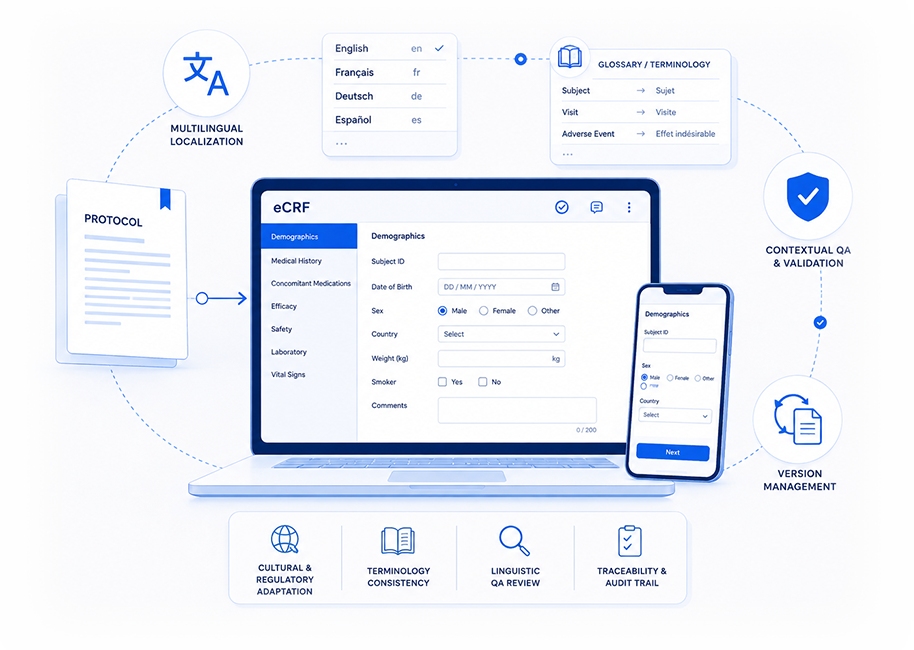
Connected Clinical Content
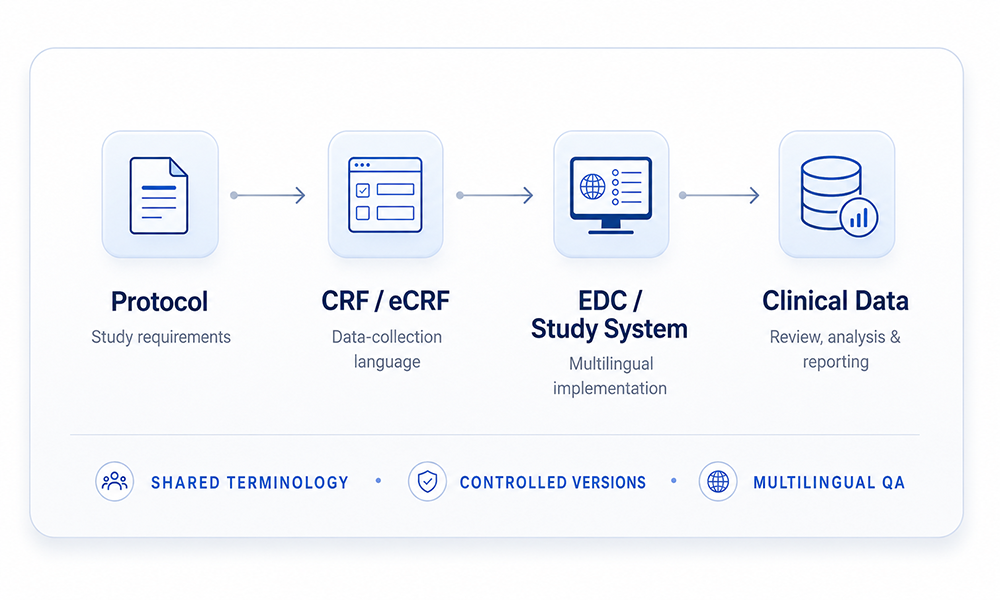
A clinical trial protocol defines what a study evaluates, which procedures and assessments are performed, and what information needs to be collected. The Case Report Form turns those requirements into structured fields, questions, response options, instructions, and other data-entry content used throughout the study.
For global studies, translating that content requires more than converting individual strings from one language to another. The language presented in a CRF or eCRF needs to remain aligned with the study protocol, approved terminology, field context, response structure, and multilingual implementation requirements.
Sesen connects these requirements through a controlled CRF translation workflow designed for multilingual clinical data collection.
Sesen supports paper and electronic Case Report Form translation across a wide range of clinical study designs, therapeutic areas, and multilingual deployment models.
Translate and format paper-based CRFs while maintaining clear form structure, field relationships, instructions, and usability for the intended study environment.
Localize user-facing eCRF content for electronic data capture workflows, including field-level language supplied through structured files, exports, or other agreed localization packages.
Maintain consistent terminology across visits, forms, sections, assessments, and other navigational or contextual labels designated for translation.
Translate clinical questions and data-entry prompts with attention to protocol context, therapeutic terminology, intended response, and surrounding fields.
Localize user-visible response text while respecting the controlled codes, values, and data structures established by the study.
Translate field instructions, explanatory notes, tooltips, completion guidance, and other content that helps investigators, site personnel, or authorized users enter study data correctly.
Support user-facing language within CRF sections used to collect adverse event, serious adverse event, medication, medical history, and other safety-related study information.
Pharmacovigilance Translation ServicesTranslate CRF completion instructions, data-entry guidance, supporting manuals, and related materials used to help study teams apply consistent completion practices.
Where localization is required, support designated text within annotated CRFs, CRF specifications, field inventories, and other supporting materials used by clinical and data-management teams.
Structured Localization
An eCRF can contain both language intended for localization and technical elements that form part of the study's controlled data structure. A strong CRF localization workflow starts by identifying the difference.
The exact localization scope varies by study. Sesen establishes translation rules before production begins so linguists know what to translate, what to reference, and what to protect. This is especially valuable when CRF content follows sponsor-defined clinical data standards, CDISC/CDASH conventions, or other structured data-collection models.
From the first source package through subsequent study amendments, Sesen manages CRF translation as a connected clinical workflow.
Review the study context using the clinical protocol, CRF specifications, existing forms, sponsor glossaries, approved terminology, previous translations, style requirements, and related clinical documentation as applicable.
Establish the meaning behind the fields before multilingual production begins.Identify the content intended for localization and separate it from technical or reference-only elements, including forms, sections, labels, questions, response text, instructions, repeated strings, and identifiers.
Define a controlled localization scope early and reduce ambiguity downstream.Organize study terminology using sponsor references, protocol language, therapeutic-area terminology, approved translations, translation memories, and project-specific glossaries.
Keep the same clinical concept consistent across forms and study files.Qualified life sciences linguists translate designated content with attention to clinical meaning, field context, terminology consistency, response relationships, and interface constraints where applicable.
Professional human review provides an independent quality layer.Return approved translations in the agreed structure for implementation by the sponsor, CRO, clinical data management group, or eClinical technology team.
Support structured spreadsheets, string tables, localization files, system exports, and other agreed exchange formats.Where contextual materials are available, review implemented multilingual content through screenshots, test environments, exports, or other agreed review formats.
Check truncation, ambiguity, response consistency, terminology, string placement, completeness, formatting, and display.Compare revised CRF content with previously translated versions, isolate changes, reuse approved language, and translate only the content that requires updating.
Translation memories and terminology resources support continuity from one version to the next.Prepare finalized multilingual content for rollout and support subsequent protocol-driven revisions, new countries, additional languages, new forms, updated fields, and study extensions.
Build a translation workflow for the life of the study—not a one-time handoff.Electronic Case Report Form translation introduces requirements that are different from conventional document translation. Sesen works with the language layer of eCRF and electronic data capture workflows while helping clinical teams preserve the structured relationships needed for implementation.
Sesen prepares organized multilingual content for sponsor, CRO, clinical data management, and technology teams to implement within their established systems and governance.
Translate content supplied through spreadsheets, string tables, exports, localization packages, or other agreed structured formats while protecting identifiers and nontranslatable system elements.
Keep questions, labels, instructions, response text, and related field content aligned as multilingual versions are created.
Where character limits, text expansion, field dimensions, or other display constraints are provided, translations can be reviewed with the target interface in mind.
Return organized multilingual content to sponsor, CRO, data-management, or technology teams in the agreed implementation structure.
Review implemented translations against available interface context to identify issues that cannot always be detected in a source spreadsheet alone.
A CRF does not exist in isolation. The same clinical concepts may appear in the protocol, amendments, safety materials, site documentation, study instructions, digital trial tools, and other content used throughout the clinical program.
Defines procedures, assessments, endpoints, visit schedules, study treatments, and other terminology that informs downstream CRF content.
Protocol Translation ServicesApplies approved terminology consistently across forms, fields, prompts, response options, and completion instructions.
Keeps drug names, medical history terms, adverse-event concepts, treatments, and other safety terminology aligned with related pharmacovigilance content.
Pharmacovigilance Translation ServicesIdentifies terminology dependencies while maintaining the appropriate translation or linguistic-validation methodology for eCOA, ePRO, ClinRO, ObsRO, and PerfO content.
eCOA Translation ServicesExtends approved study language through translation memories, glossaries, and governed terminology across related clinical materials.
Clinical Trial Translation ServicesA protocol amendment may change a visit, assessment, procedure, eligibility requirement, safety requirement, or other study element. Those changes can flow into one or more CRFs and then into every required language.
Sesen helps teams manage those updates as controlled deltas rather than treating each revised CRF as an entirely new translation project.
Human Expertise + Technology
Clinical translation requires accountable human expertise. Sesen combines professional life sciences linguists with translation memory, terminology management, automation, and AI-assisted quality checks to create more controlled multilingual workflows.
Identify and reuse previously approved translations where appropriate to support consistency across repeated CRF language and recurring study versions.
Use technology to identify terminology, repeated concepts, preferred language, and inconsistencies across large or highly structured CRF content sets.
Help flag terminology, numbers, formatting, missing content, repeated strings, and cross-language consistency issues for human review.
Identify modified content between CRF versions and focus translation and review resources on the appropriate delta.
Professional clinical linguists remain responsible for evaluating meaning, terminology, clinical context, and final linguistic quality.
Quality & Governance
CRFs support structured clinical data collection, so their multilingual content benefits from documented quality processes, specialized linguists, terminology controls, secure infrastructure, and traceable project management.
Projects are assigned to qualified native-language translators and reviewers with relevant clinical, medical, and therapeutic-area experience.
Translated content can receive independent professional review as part of a controlled translation workflow.
Study-specific terminology, glossaries, translation memories, preferred terms, and sponsor-approved language help maintain consistency across forms and versions.
Linguistic, formatting, completeness, terminology, and technical checks are matched to the content and project requirements.
Sesen’s certified frameworks include ISO 17100 and ISO 9001:2015 for translation and quality management, plus ISO 13485:2016 for medical-device quality management.
Controlled access, secure infrastructure, documented project handling, and confidentiality practices support multilingual work involving sensitive clinical information.
Right-Sized Review
Not every CRF requires the same translation methodology. For many operational CRF and eCRF projects, an appropriate workflow may include professional translation, independent review, contextual QA, and final quality control.
Where a sponsor, CRO, SOP, study methodology, or project requirement calls for additional controls, Sesen can configure the workflow accordingly. Back translation is an available methodology—not an automatic requirement for every CRF.
For outcome-assessment validation needs, explore eCOA Translation ServicesSesen works across the clinical study ecosystem, helping the teams responsible for CRF content move multilingual language from source development through study deployment.
Centralize CRF translation across studies, countries, languages, therapeutic areas, and amendment cycles while maintaining sponsor terminology and approved language assets.
Coordinate multilingual CRF requirements alongside study startup, country rollout, site operations, clinical documentation, and recurring study updates.
CRO Translation ServicesTranslate user-facing CRF content while preserving the field structures, identifiers, terminology rules, and implementation requirements established for the study.
Receive organized multilingual content prepared for implementation and support linguistic QA after translations are placed into the target study environment.
Sesen brings clinical trial specialization, structured localization, professional linguistic expertise, and controlled multilingual operations together around the needs of evolving CRF programs.
CRF projects benefit from expertise and terminology that extend across the broader clinical content lifecycle.
Study protocols, glossaries, reference documents, sponsor terminology, and approved language can inform CRF translation from the start.
Work with field-based and structured source content rather than forcing every eCRF project into a conventional document translation process.
Translation memories, terminology resources, version comparison, and delta workflows help keep evolving CRFs manageable across study amendments.
Support CRFs within a broader multilingual program spanning protocols, amendments, safety content, clinical software, and study documentation.
Support regional and global clinical studies through centralized language management across more than 150 languages.
Answers to common questions about multilingual Case Report Forms, eCRF localization, EDC-ready content, terminology, version control, and review methodology.
Case Report Form translation is the translation and localization of user-facing CRF content for multilingual clinical studies. This can include form titles, section headings, field labels, questions, prompts, response-option display text, instructions, help text, and CRF completion guidance. CRF translation should account for the clinical protocol, study terminology, field context, and the structured environment in which the content is used.
A paper CRF is typically presented as a formatted physical or printable form, while an electronic CRF presents study data-entry content within an electronic data capture environment. Both require accurate clinical language and terminology consistency. eCRF translation can introduce additional requirements involving structured strings, field identifiers, UI constraints, implementation files, text expansion, and in-context linguistic QA.
The localization scope depends on the study and EDC configuration. User-facing elements such as form names, field labels, questions, response display text, instructions, and help content may require translation. Technical elements such as variable names, field IDs, internal codes, programming logic, mappings, and database identifiers may need to remain unchanged. Sesen establishes project-specific translation rules so each content type is handled appropriately.
Often, no. These elements may form part of the controlled technical structure of the study or EDC system. They should generally remain unchanged unless the sponsor, data-management team, or technology provider specifically designates them for localization. Sesen can protect nontranslatable technical elements while translating the corresponding user-facing content.
Yes. Sesen can support structured eCRF content supplied through spreadsheets, string tables, system exports, localization packages, and other agreed exchange formats. The workflow can preserve identifiers and field relationships needed by the sponsor, CRO, clinical data management team, or eClinical provider for subsequent implementation.
Where a sponsor uses CDISC/CDASH conventions or another structured clinical data model, Sesen can align the localization workflow with the study's provided terminology, naming conventions, controlled elements, and localizable display content. Sesen's role is to preserve the intended language within the established study structure rather than redefine the underlying clinical data standard.
Sesen can use the protocol, amendments, CRF specifications, sponsor glossaries, translation memories, existing translations, and related study references to establish terminology before and during translation. Approved terminology can then be maintained across forms, fields, languages, and subsequent study versions.
When a CRF changes, Sesen can compare the revised source against previously translated versions, identify new and modified content, reuse approved translations where the source remains unchanged, and translate the required delta. Terminology resources and translation memories help maintain consistency across amendment cycles.
Not automatically. The appropriate translation methodology depends on the sponsor's requirements, SOPs, intended use, content type, and study workflow. Many operational CRFs can be managed through professional translation, independent review, contextual QA, and final quality control. Back translation and reconciliation can be added when specifically required.
CRFs and eCRFs are structured tools used to collect clinical study data. eCOA and ePRO systems contain clinical outcome assessment instruments designed to measure patient, clinician, observer, or performance outcomes. COA instruments may require formal linguistic-validation methodologies designed to demonstrate conceptual equivalence across languages and cultures. These requirements are not automatically applicable to every CRF.
eCOA Translation ServicesYes, when suitable contextual materials or system access are available. Sesen can perform in-context linguistic QA using screenshots, review environments, exports, or other agreed materials to identify translation, truncation, terminology, placement, and display issues that may only become visible after implementation.
Yes. Sesen supports clinical translation in more than 150 languages. Centralized project management, terminology governance, translation memories, structured QA, and version control help multinational study teams maintain consistency as CRFs are deployed across countries and updated during the study.
Yes. Sesen can translate user-facing CRF fields used to collect adverse events, serious adverse events, concomitant medications, medical history, and related safety information. Broader pharmacovigilance requirements—such as individual safety cases, safety narratives, aggregate reports, signal and risk content, and post-market safety communication—are supported through Sesen's dedicated pharmacovigilance workflow.
Pharmacovigilance Translation ServicesFrom the first translated form through protocol amendments, new countries, and subsequent CRF versions, Sesen helps clinical teams connect protocol terminology, CRF/eCRF translation, EDC-ready content, contextual QA, and version management through one specialized life sciences language partner.