
Customer Story · Medical Device

24-Language IFU Localization for a Class III Cardiac Device

How a U.S.-based medical device manufacturer shortened its multilingual QA cycle by 30% and completed notified-body review without translation-related revisions while preparing a Class III implantable cardiac device for European market entry.

30% shorter client QA cycle through terminology harmonization, independent professional review, multilingual DTP, and final-context QA.

Headline Results

30% Shorter Client QA Cycle

By resolving terminology earlier and validating language inside final IFU layouts, the program reduced downstream review effort rather than pushing correction to the client’s regulatory team.

0 Translation-Related Revisions During notified-body review
24 Localized IFUs Delivered within the planned regulatory schedule
01 · The mandate

A High-Risk Device. A Fixed European Timeline.

For a Class III medical device, the IFU is not ancillary marketing content. It carries technical and safety information that intended users rely on to understand appropriate device use, warnings, precautions, contraindications, and procedures.

The client, a U.S.-based MedTech manufacturer specializing in implantable cardiac devices, was preparing a new device for European market entry. Its English IFU needed to become a coordinated 24-language document set supporting planned markets and applicable MDR and national language requirements.

The assignment was therefore much larger than translating one document 24 times. Sesen had to help the client create a controlled multilingual content system in which technical meaning, safety language, terminology, document structure, and final presentation stayed aligned through a time-sensitive regulatory program.

01

Safety-critical meaning

Warnings, precautions, contraindications, procedural instructions, and device-handling information had to remain precise across every target language. Small wording differences could create unnecessary review questions or change how technical information was understood.

02

Fragmented terminology

The content environment included legacy IFUs, related product families, prior translations, internal terminology, and work completed by multiple language vendors. The new multilingual set needed a controlled vocabulary rather than 24 independent translation decisions.

03

Translation and layout under one deadline

The regulatory schedule left little room for late-stage correction. Translation, bilingual review, multilingual DTP, and final-context validation had to operate as one coordinated production system instead of a series of handoffs.
02 · The turning point

One Device Vocabulary Before 24 Translations

Instead of allowing each language to inherit every inconsistency in the existing content estate, Sesen treated terminology as an upstream control. Legacy IFUs, product language, client-approved terms, and safety terminology were reconciled into a shared foundation before variation could multiply.

01Legacy IFUs
02Product terminology
03Client-approved language
04Regulatory & safety language
CONTROLLED FOUNDATION One device vocabulary

Preferred terminology is resolved before variation can multiply across the program.

24 Localized IFUs aligned to one terminology system

03 · The intervention

One Controlled Workflow From Source IFU to Submission-Ready Files

Sesen connected terminology preparation, specialist translation, independent linguistic review, multilingual desktop publishing, and final-context QA into one controlled production sequence. The goal was to catch problems where they originated rather than asking the client to discover them at the end.

01 Source IFU Review the source, references, legacy translations, structure, and terminology dependencies.
02 Terminology harmonization Establish preferred medical, technical, device, and safety language before multilingual production scales.
03 Specialist translation Native-language professionals with relevant medical-device and life-sciences expertise translate from controlled resources.
04 Independent review A second professional linguist checks meaning, completeness, terminology, readability, numbers, and higher-risk content.
05 Multilingual DTP Layouts are rebuilt and adjusted for expansion, tables, warnings, numbering, callouts, and language-specific behavior.
06 In-context QA The team reviews language and layout together in final or near-final IFUs.
07 Submission-ready delivery Completed language packages are prepared to the client’s delivery structure and regulatory schedule.

Where Quality Becomes Visible

Quality Checked in the Final IFU, Not Just the Translation File

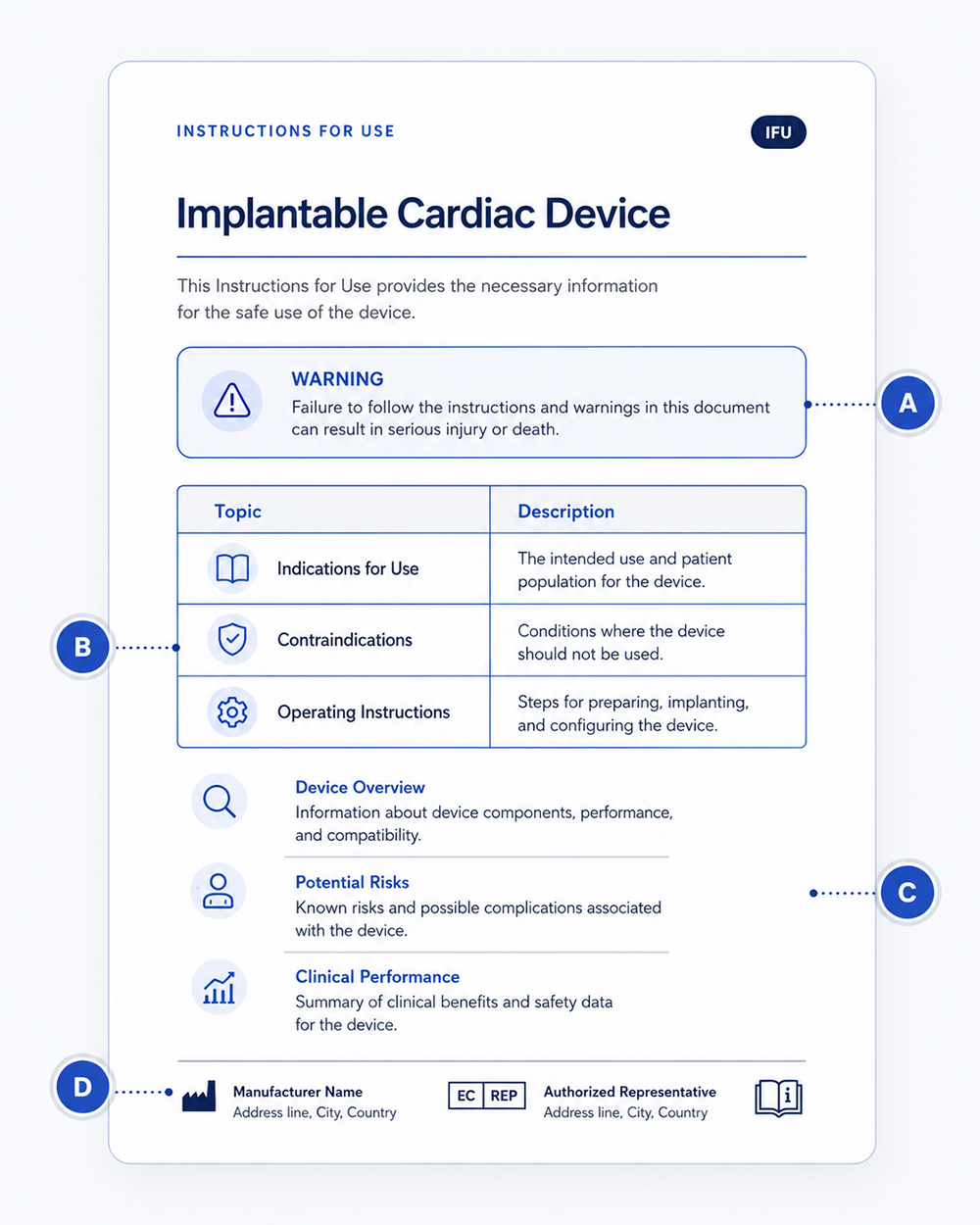
A linguistically correct sentence can still fail inside a finished medical-device document. Text expansion can change pagination, a warning can wrap differently, a table can become crowded, or a cross-reference can become disconnected from the information it identifies. Final-context QA evaluates the communication asset the reviewer will actually see.

Annotated IFU specimen used to illustrate final-context quality assurance
A

Warnings & cautionsPlacement, wrapping, emphasis, completeness

B

Tables & numbersMeasurements, units, row integrity, references

C

Cross-referencesNumbering, symbols, headings, page relationships

D

Final renderingExpansion, truncation, line breaks, pagination

The Quality Model

Professional Judgment Stayed in Control

Technology strengthened the review process by surfacing patterns and potential inconsistencies, while specialist linguists remained responsible for interpreting context and making the linguistic decisions.

Expert decisions

Specialist medical-device translators and independent professional reviewers assessed meaning, terminology, readability, and higher-risk content in context.

Medical-device and life-sciences expertise Independent bilingual review Context-sensitive terminology decisions Focused attention to warnings, precautions, numbers, and procedural content

Automated quality signals

AI-assisted and automated QA helped surface potential terminology, numerical, completeness, and structural inconsistencies for professional evaluation.

Terminology consistency checks Numbers, units, and structured-content comparison Potential missing or duplicated content Cross-file visibility across a 24-language program

04 · The outcome

Less Downstream Review. A Submission-Ready Multilingual IFU Set.

The multilingual program reached its planned delivery point with translation, review, formatting, and final-context validation coordinated across all 24 languages. By resolving recurring issues upstream, Sesen reduced the burden transferred to the client’s own quality and regulatory teams.

The final IFU package completed notified-body review without translation-related revisions and supported the manufacturer’s targeted European submission schedule.

30%
Shorter client QA cycle Less downstream review effort after terminology and final-context controls.
24
Languages delivered One coordinated multilingual program rather than independent document streams.
0
Translation-related revisions During notified-body review of the multilingual IFU package.
On time
Regulatory timeline maintained Files delivered in support of the planned European submission milestone.
“Sesen’s localization team demonstrated deep regulatory knowledge and exceptional linguistic precision. The structured workflow, proactive communication, and in-context quality checks gave our regulatory team full confidence in the submission package.”
Regulatory Affairs Manager
U.S. Medical Device Manufacturer

The Lasting Value

A Stronger Foundation for Future IFU Updates

The immediate result was a submission-ready 24-language IFU set. The longer-term value was a more controlled multilingual foundation for the device program.

Terminology decisions, reviewed language, and validated multilingual files can be carried forward as the IFU evolves, helping future revisions begin from aligned content rather than recreating the same decisions release after release.

Approved terminology can carry forward into future IFU and labeling revisions.
Reviewer decisions become reusable project knowledge rather than one-time corrections.
Validated multilingual content provides a stronger baseline when source text changes.
Future releases can focus review attention on what changed instead of repeatedly rechecking what did not.

Planning a Multilingual IFU or Medical Device Program?

Talk with Sesen about terminology harmonization, regulated medical-device translation, multilingual DTP, final-context QA, or an upcoming international submission.