
Life Sciences Specialization
Regulated clinical, quality, manufacturing, and device content
Professional Review
Specialized translation, bilingual review, and QA support
Version-Aware Workflows
Continuity across revisions and approved language assets
Global Program Support
Coordinated multilingual delivery across sites and teams
Beyond Document Translation
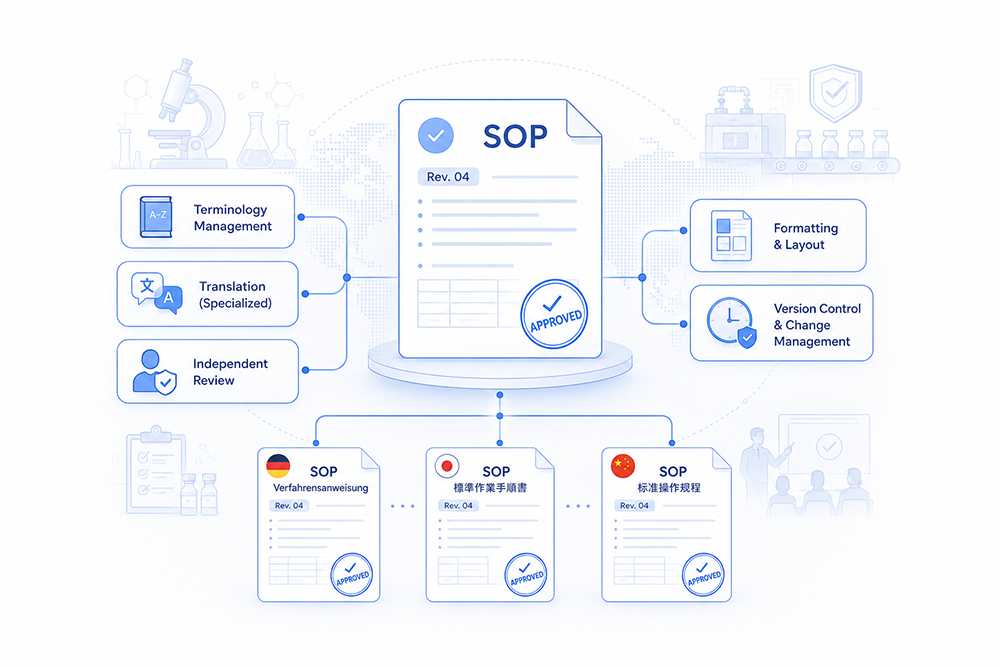
SOP Translation Is Controlled-Document Translation
Standard Operating Procedures define how critical work is performed. They establish responsibilities, processes, controls, sequence, acceptance criteria, documentation requirements, and other instructions teams rely on to execute work consistently.
A translated SOP therefore needs to preserve more than sentence-level meaning. Roles, steps, terminology, warnings, conditions, references, forms, and revision information must remain aligned with the approved source content.
Roles and responsibilities
Procedural sequence
Technical terminology
Warnings and conditions
Forms and references
Revision information
A Multilingual SOP Lifecycle
8-Stage Workflow
01Source SOP
02Terminology
03Translation
04Review
05Formatting
06Change Control
07Approval Support
08Multilingual Rollout
SOP Translation Across Regulated Workflows
SOPs extend across nearly every regulated life sciences function. Sesen supports controlled procedures used throughout development, manufacturing, clinical research, quality systems, laboratories, medical devices, and safety operations.
Pharmaceutical & Biopharmaceutical
Manufacturing and production procedures
Cleaning, sanitation, and equipment operation
Quality assurance and quality control
Laboratory procedures and environmental monitoring
Deviation, CAPA, and change-control procedures
Material handling, storage, release, and distribution
Medical Devices & IVD
QMS, document, and record-control procedures
Design, development, and supplier controls
Production, inspection, and testing procedures
CAPA, complaint handling, and change control
Servicing and post-market processes
Laboratory, assay, and equipment procedures
Clinical Research & CRO Operations
Clinical study and site-management procedures
Monitoring and investigational product handling
Data-management and safety-reporting workflows
Essential-document and TMF processes
Vendor oversight and clinical quality procedures
Study-team responsibilities and operating processes
Quality, Compliance & Safety
Document control and records management
Internal audit and training procedures
CAPA, deviation, and quality-event management
Supplier qualification and validation workflows
Pharmacovigilance case and escalation procedures
Safety review, reconciliation, and reporting processes
Connected Controlled Content
An SOP Rarely Stands Alone
Controlled-document structures vary by organization, but the relationships are familiar. A policy can define what is required. An SOP explains how a process is carried out. Work instructions add task-level detail. Forms and checklists capture execution. Records document what happened. Training helps personnel understand the procedure.
When terminology changes in an SOP but remains different in related content, multilingual users can encounter unnecessary inconsistency. Sesen helps maintain approved language across connected documentation rather than treating each file as an isolated translation.
The objective is linguistic continuity across the documentation system: consistent roles, equipment names, warnings, process terms, and procedural language wherever they reappear.
Common Documentation Chain
01Policy
02SOP
03Work Instruction
04Form / Checklist
05Record
06Training
From Approved Source to Multilingual Rollout
Every SOP program has its own languages, formats, terminology resources, reviewers, and approval processes. Sesen configures the linguistic workflow around those requirements while maintaining structured translation and quality controls.
01
Source SOP Review
Review the SOP type, subject matter, source format, current revision, existing translations, terminology resources, related documents, target languages, reviewer requirements, and rollout needs.
02
Terminology Preparation
Apply approved terminology for products, processes, equipment, departments, roles, quality concepts, warnings, abbreviations, and defined terms using client references and reusable language assets.
03
Specialized Translation
Professional life sciences linguists preserve procedural meaning, sequence, responsibilities, conditions, technical terminology, warnings, numerical content, defined terms, and cross-references.
04
Independent Review
Bilingual review focuses on accuracy, completeness, terminology, procedural consistency, numerical content, references, readability, and source-to-target alignment.
05
Formatting & Reconstruction
Maintain usable multilingual structure across headings, numbering, tables, callouts, warnings, forms, appendices, headers, footers, revision information, and cross-references.
06
Version & Change Management
Align translation updates to source revisions, reuse previously approved language where appropriate, and focus linguistic effort on new or changed content.
07
Client Review & Approval Support
Organize linguistic comments, terminology decisions, reviewer feedback, query resolution, and final language updates while the customer retains formal document approval and release control.
08
Multilingual Rollout & Maintenance
Coordinate finalized language versions across countries, facilities, laboratories, clinical teams, departments, suppliers, and future revision cycles.
Terminology Governance
Procedural Accuracy Starts With Terminology Consistency
An SOP may use the same technical term dozens of times—and that term may also appear across work instructions, forms, training, quality records, product documentation, and future revisions.
Sesen can apply client-approved language resources to help recurring terminology remain consistent across related multilingual content.
Client glossaries
Terminology databases
Translation memory
Style guides
Product references
Legacy translations
Reviewer decisions
Consistency within one SOP matters. Continuity across SOP families, sites, languages, and revisions matters even more.
Version Control for SOP Translation and Updates
Controlled procedures evolve. When the source SOP changes, multilingual teams need to understand what changed without introducing unnecessary differences into content that did not.
Sesen can align the revised source with previous source content, existing translations, approved terminology, and translation memory within a structured update workflow.
Translate the change without losing the history.
REV. 03Approved language
REV. 04Source changes
REV. 05Multilingual update
Unchanged content
Changed source content
Review & QA
Preserve Approved Language
Reuse appropriate previously translated content where the source meaning remains unchanged.
Focus Review on Changes
Direct linguistic attention toward new and revised source content.
Maintain Terminology Continuity
Carry approved terminology and reviewer decisions into future versions.
Coordinate Languages
Manage multiple target languages against the same approved source revision.
Build Better Language Assets
Capture approved translations and terminology for future SOPs and related content.
Enterprise Multilingual Delivery
Consistent SOPs Across Sites, Teams, and Languages
Global SOP programs quickly become more complex than a collection of files. Each additional language, reviewer, site, document relationship, and source revision introduces another point that needs to remain aligned.
Sesen supports both individual SOP projects and recurring multilingual programs with centralized workflows designed around approved terminology, reusable language assets, structured review, and ongoing maintenance.
The goal is a multilingual program that becomes more consistent and manageable as the documentation lifecycle continues.
Multiple Languages
Coordinate target languages through shared terminology, translation memory, project management, and quality processes.
Multiple Documents
Maintain linguistic continuity across SOP families and connected controlled documentation.
Multiple Reviewers
Organize feedback and preserve approved terminology decisions for future reuse.
Multiple Sites
Support global and regional teams while maintaining alignment with approved source content and terminology.
Recurring Updates
Carry translation memory, terminology, and approved decisions forward as procedures evolve.
From Procedure to Practice
Connect Approved SOP Language With Workforce Training
SOPs often become source or reference content for onboarding, GMP and GxP training, refresher courses, site training, job aids, eLearning, assessments, procedural videos, and competency materials.
When SOP terminology and training terminology diverge, multilingual employees may encounter different language for the same process. Coordinated language assets help maintain continuity from controlled procedure to learning content.
eLearning & Training Translation ServicesControlled Knowledge Flow
01Approved SOP
02Training Content
03Localized Learning Assets
04Workforce Use
Regulated Operating Context
SOP Translation for GMP, GxP, Clinical, and Quality Environments
Life sciences SOPs can operate within pharmaceutical GMP, clinical GCP, medical-device quality systems, company-specific QMS requirements, and other regulated frameworks.
Sesen supports translation workflows used within these environments without treating translation as a substitute for the customer's regulatory, quality, document-control, or approval responsibilities.
Relevant Context May Include
GMP and other GxP environments
FDA quality requirements
EU GMP documentation
FDA QMSR (21 CFR Part 820)
ISO 13485 quality systems
ICH Good Clinical Practice (GCP)
Company-specific QMS requirements
Market- and site-specific operational needs
The appropriate translation workflow depends on the content, intended use, audience, languages, and your quality requirements. Sesen tailors the linguistic workflow to those needs without substituting for your organization’s regulatory or quality decisions.
Professional Expertise + Smarter Workflows
Human Expertise Remains Central to Controlled SOP Translation
Qualified linguists and reviewers evaluate meaning, terminology, context, and linguistic quality. Technology supports those professionals by helping manage repeated content, approved terminology, version changes, and quality checks across larger multilingual programs.
SesenGPT and other AI-enabled technologies support appropriate parts of the workflow; they do not replace the professional judgment required for controlled life sciences content.
Language Assets
Translation memory, terminology management, approved-content reuse, style guidance, and reviewer decisions.
Workflow Support
Version comparison, repeated-content identification, structured review, and multilingual coordination.
Quality Support
Terminology checks, numeric checks, missing-content checks, and automated linguistic QA.
AI-Assisted Capabilities
Appropriate translation and quality support within a professional human review workflow.
Specialized Translation for Controlled Life Sciences Content
Sesen combines life sciences expertise, controlled terminology, professional review, reusable language assets, and enterprise multilingual workflows to support SOP content throughout its lifecycle.
Life Sciences Specialization
Expertise across pharmaceutical, biotechnology, medical device, IVD, clinical research, quality, manufacturing, and safety content.
Controlled-Content Expertise
Support for SOPs and the work instructions, forms, QMS content, CAPA records, deviations, validation materials, and training that connect to them.
Cross-Document Terminology
Approved language can stay consistent across SOP families, related documents, languages, sites, departments, and future revisions.
Structured Quality Workflows
Specialized translation, independent review, terminology controls, automated QA support, formatting, and organized client review.
Version-Aware Translation
Previously translated content and terminology can be carried forward as SOPs change, preserving continuity through successive revisions.
Human Expertise + Technology
Professional linguistic expertise supported by translation memory, terminology management, automation, SesenGPT, and appropriate AI-assisted quality processes.
Quality and Global Delivery
Certified quality systems and multilingual life sciences support.
ISO 17100
Translation-service quality processes
ISO 9001:2015
Quality management systems
ISO 13485:2016
Medical device quality expertise
150+ Languages
Global life sciences coverage
SOP Translation FAQs
SOP translation services translate Standard Operating Procedures from one language into another while preserving procedural meaning, technical terminology, responsibilities, conditions, warnings, document structure, references, and other controlled content. For life sciences organizations, the workflow may also include terminology management, bilingual review, formatting, translation memory, version-aware updates, reviewer feedback, and coordination across related controlled documents.
Sesen supports SOPs across pharmaceutical, biotechnology, medical device, IVD, clinical research, laboratory, quality, manufacturing, pharmacovigilance, and other life sciences operations. Examples include manufacturing procedures, laboratory SOPs, equipment procedures, quality-control processes, CAPA, change control, document control, supplier-quality procedures, clinical operations, safety workflows, complaint handling, and training procedures.
Yes. Sesen supports SOP translation for pharmaceutical manufacturing, laboratories, quality systems, clinical operations, and other environments operating under GMP and broader GxP frameworks. The workflow can incorporate specialized linguists, approved terminology, translation memory, independent review, automated QA, formatting, customer review, and recurring update support according to project requirements.
Sesen can apply customer-approved glossaries, terminology databases, translation memories, style guides, product references, legacy translations, reviewer feedback, and project-specific linguistic rules. These resources help recurring terminology remain consistent across SOP families, work instructions, forms, training content, quality documentation, languages, and future revisions.
Yes. Sesen supports version-aware SOP translation workflows. Existing source and target content can be compared so new or changed material receives appropriate translation and review while previously translated content can be reused where the source remains unchanged and reuse is appropriate. Translation memory, terminology resources, reviewer feedback, and approved translations can also be carried forward.
Yes. Sesen translates SOPs together with connected controlled and training content, including work instructions, policies, forms, checklists, quality documentation, training materials, and eLearning. Coordinated terminology helps multilingual users encounter consistent language as they move from the governing procedure to task-level instructions, documentation, and training.
Yes. Sesen can coordinate programs involving multiple languages, facilities, departments, reviewers, and rollout schedules. Centralized terminology, translation memory, reviewer feedback, language assets, project management, and quality controls help maintain consistency as controlled content moves across global operations.
The appropriate workflow depends on the document and intended use, but SOP projects can include specialized translation, independent bilingual review, terminology verification, automated QA, formatting review, project oversight, and customer review support. Final internal document approval and release remain part of the customer's own document-control and quality processes.
Professional life sciences linguists and reviewers remain the foundation of controlled SOP translation. AI-assisted technologies can support appropriate parts of the workflow, including terminology identification, content reuse, translation assistance, version comparison, and quality checks. Translation memory, terminology management, automation, and SesenGPT can help manage recurring multilingual content more efficiently within a professional review workflow.
Sesen can support commonly used business and technical document formats, including editable office documents, PDFs, tables, and layout-sensitive files. The optimal workflow depends on whether the source is editable, how the SOP is structured, whether formatting needs to be recreated, and how the translated content will return to the customer's document-management or quality workflow.
Certified translation documentation can be provided when required for the intended use and project scope. Because certification requirements vary by organization, authority, country, and use case, Sesen can review the specific requirement and determine the appropriate certification or supporting documentation for the project.
Sesen supports life sciences translation across 150+ languages. Multi-language SOP programs can be coordinated through shared terminology, translation memories, centralized project management, structured quality review, and version-aware workflows.
Keep Multilingual SOPs Controlled Through Every Revision
Whether you are translating one critical procedure, deploying an SOP family across international sites, or maintaining multilingual documents through recurring revisions, Sesen brings together specialized life sciences linguists, controlled terminology, structured review, multilingual formatting, version-aware workflows, and intelligent language technologies.
Terminology continuity
Version-aware updates
Professional review
Global rollout support