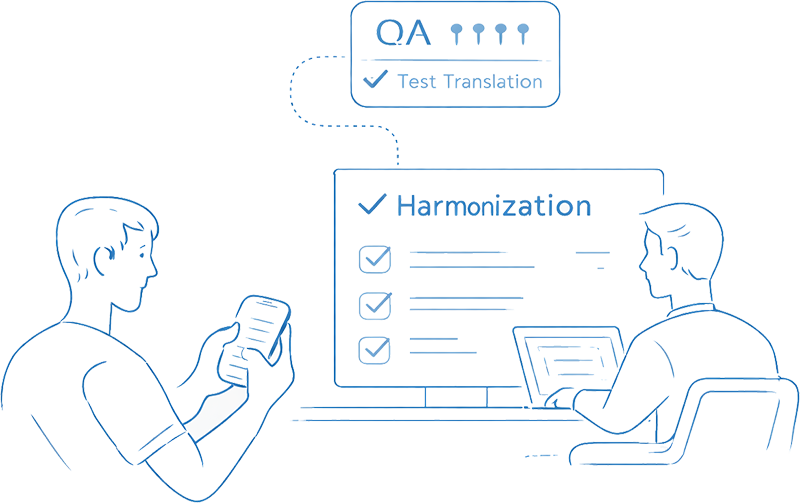
Why Multilingual eCOA and ePRO Translation Demands Technical Precision

eCOA and ePRO instruments introduce technical, linguistic, and usability constraints that differ significantly from traditional clinical document translation.

Unlike static PDFs, electronic clinical outcome assessments are deployed inside structured software environments. Text is embedded within defined screen space, linked to programmed response scales, and integrated into logic-driven workflows that support regulated data capture. In many global studies, these instruments contribute directly to primary or secondary endpoints.

Because of this, translation quality influences more than readability. It affects patient comprehension, response behavior, statistical consistency, and regulatory defensibility.

Even minor truncation, scale misalignment, or conceptual drift across languages can introduce data variability that may be questioned during submission review.

How eCOA and ePRO Translation Differs from Traditional Clinical Translation

Electronic instruments are not simply translated documents. They are validated digital tools used to collect structured patient data across multiple markets.

Key implementation differences include:

  • Screen-based text display rather than print formatting
  • Character and pixel-based UI limitations
  • Fixed response scale formatting
  • Branching logic dependencies
  • Device responsiveness across smartphones and tablets
  • Linguistic validation and cognitive debriefing requirements
  • Harmonization across 20 to 60 language deployments

These constraints require collaboration between clinical linguists, UX reviewers, validation specialists, and eCOA platform teams.

Treating eCOA translation as a technical implementation workflow rather than a standalone linguistic task reduces reprogramming cycles, prevents truncation errors, preserves conceptual equivalence, and supports audit readiness.

The following sections outline execution-level best practices aligned with real-world platform deployment and regulatory expectations in global clinical research.

Screen Constraints and UI Display Limitations in Multilingual eCOA Systems

Electronic screens introduce spatial and functional limitations that do not exist in paper-based clinical instruments.

In printed questionnaires, layout flexibility allows text to expand across lines or pages. In contrast, eCOA and ePRO platforms rely on predefined UI containers, fixed field lengths, and programmed display logic. Text is constrained by both character count and pixel width, which may vary depending on device resolution, font rendering, and system configuration.

These technical constraints must be evaluated before translation begins.

Multilingual deployment introduces several high-risk display variables:

  • Fixed character limits within question stems
  • Pixel-based text boxes that limit visible space
  • Button truncation risk for response options
  • Non-scrollable screen designs
  • Dynamic text resizing inconsistencies
  • Tablet versus smartphone rendering differences
  • Landscape versus portrait orientation changes
  • Right-to-left language display challenges

Because many languages expand relative to English, these constraints can significantly impact readability and usability. Even small display changes may affect how patients interpret question severity, frequency, or intensity.

If UI review is not integrated into the translation workflow:

  • Question stems may wrap incorrectly or truncate mid-sentence
  • Response scale anchors may lose critical qualifiers
  • Buttons may cut off intensity descriptors
  • Visual hierarchy may shift between devices
  • Patient comprehension may decrease
  • Data comparability across sites may be compromised

In endpoint-driven trials, these issues can influence response behavior and introduce unintended variability into collected data.

Effective multilingual eCOA implementation requires technical validation before and after translation.

Sponsors and CROs should:

  • Perform pseudo-translation expansion testing prior to UI finalization
  • Confirm maximum character allowances within the platform
  • Conduct linguistic fit checks inside the staging or live system
  • Validate all response options for truncation across devices
  • Review scale anchors in full context rather than in isolation
  • Test right-to-left languages independently for layout alignment
  • Capture screenshots for QA documentation

Pseudo-translation testing is particularly valuable. By artificially expanding source text during early design phases, teams can identify layout vulnerabilities before instrument programming is locked.

In-context linguistic QA is equally critical. Reviewing text only in spreadsheets or translation memory systems does not reveal real-world display behavior. Final validation must occur inside the configured eCOA platform.

UI review is not merely a usability concern. It is a compliance and data integrity issue.

If truncation alters the meaning of a severity descriptor or scale anchor, conceptual equivalence may be compromised. For instruments tied to primary or secondary endpoints, such deviations may raise regulatory questions.

UI review must therefore be integrated into the structured linguistic workflow, not performed as an afterthought during late-stage deployment.

When screen constraints are proactively managed, sponsors reduce reprogramming cycles, protect patient comprehension, and maintain conceptual consistency across all language versions.

Managing Character Limits and Text Expansion in eCOA and ePRO Systems

Language expansion is one of the most common sources of implementation risk in multilingual eCOA and ePRO translation.

On average, many European languages expand 15 to 35 percent compared to English. German, Russian, and certain Eastern European languages frequently exceed standard UI field limits. Romance languages may expand moderately. Some Asian languages, such as Chinese or Japanese, may contract in character count but introduce spacing, punctuation, and line-break formatting differences that affect screen rendering.

Unlike traditional document translation, electronic clinical outcome assessments operate within fixed UI containers. Text fields are often defined by strict character limits, pixel constraints, or non-scrollable display windows. Response buttons and scale descriptors may have even tighter limitations.

If character limits are not reviewed and validated early in the workflow, the following risks may occur:

  • Text truncation within question stems or response options
  • Loss of critical medical qualifiers or severity descriptors
  • Altered meaning due to forced abbreviation
  • Reduced readability on smaller devices
  • Increased cognitive burden for patients
  • Inconsistent response scale interpretation
  • Data capture variability across markets

In regulated clinical trials, even minor differences in scale phrasing can influence how patients interpret symptom intensity, frequency, or severity. That variability may ultimately affect statistical analysis and endpoint reliability.

Effective character limit management requires structured planning before translation begins.

Sponsors and CROs should:

  • Confirm character and pixel limits with the eCOA technology vendor during project initiation
  • Identify fields with non-expandable UI constraints
  • Clarify whether dynamic resizing or scrolling is permitted
  • Provide translators with visibility into maximum character allowances
  • Flag high-risk response scale elements for special review
  • Conduct pseudo-translation expansion testing in staging environments

When space restrictions are unavoidable, controlled linguistic adaptation may be necessary. However, any condensed phrasing must preserve conceptual equivalence and response intent.

All condensed language decisions should be:

  • Reviewed by senior clinical linguists
  • Validated for conceptual accuracy
  • Logged for harmonization consistency
  • Documented for audit traceability

This documentation is particularly important when instruments support primary or secondary endpoints, as regulatory reviewers may request justification for linguistic deviations from the source.

Managing text expansion within eCOA platforms requires collaboration between:

  • Clinical translation teams
  • UX and interface designers
  • eCOA system configuration teams
  • Quality assurance reviewers
  • Validation specialists

Translation cannot occur in isolation from the technical environment. Linguists must understand UI constraints before finalizing phrasing, and platform teams must allow structured review before deployment.

When character limit validation is built into the workflow, sponsors reduce reprogramming cycles, prevent late-stage truncation fixes, and protect conceptual equivalence across all language versions.

Cognitive Debriefing and Conceptual Equivalence in Multilingual eCOA and ePRO Translation

For patient-facing eCOA and ePRO instruments, translation alone is not sufficient. Conceptual equivalence must be demonstrated through structured linguistic validation methodologies.

Electronic Patient-Reported Outcome measures often support primary or secondary endpoints in global clinical trials. Because patient responses directly influence data analysis, translated instruments must preserve the same conceptual meaning, response intent, and interpretive clarity across all languages.

Literal translation is not the objective. The objective is conceptual consistency.

A compliant multilingual ePRO translation workflow typically includes:

  • Forward translation by professional native clinical linguists
  • Independent second forward translation where required
  • Reconciliation to align terminology and phrasing
  • Back translation into the source language
  • Clinical or subject matter expert review
  • Cognitive debriefing interviews with representative patients
  • Cross-language harmonization review
  • Final proofreading and validation sign-off

Each step supports traceability, conceptual consistency, and regulatory defensibility.

Back translation identifies major deviations from the source text. However, it does not confirm patient comprehension. That confirmation occurs during cognitive debriefing.

Cognitive debriefing interviews are conducted with participants from the target population to confirm that translated questions are:

  • Clearly understood
  • Interpreted consistently with the source intent
  • Culturally appropriate
  • Not ambiguous or misleading
  • Aligned with response scale expectations

During interviews, participants are typically asked to paraphrase questions, explain their interpretation, and describe how they selected their responses. Any confusion, hesitation, or misinterpretation is documented and analyzed.

For electronic instruments, usability in digital context must also be considered. Screen size, scrolling behavior, button placement, and scale visibility may influence comprehension and response behavior. Cognitive testing should therefore reflect the device environment in which the instrument will be deployed.

When eCOA or ePRO instruments contribute to primary or key secondary endpoints, regulators expect clear documentation of the linguistic validation process.

Regulatory reviewers may request:

  • Documentation of forward and back translation methodology
  • Interview summaries from cognitive debriefing sessions
  • Evidence of conceptual equivalence across languages
  • Harmonization records across global markets
  • Version control history

Failure to demonstrate validated conceptual equivalence can result in regulatory questions, delayed approvals, or data comparability concerns.

Sponsors and CROs that integrate structured linguistic validation into their multilingual eCOA strategy protect endpoint integrity, strengthen submission readiness, and reduce compliance risk in multinational trials.

Instrument Harmonization Across Languages in Global eCOA Deployment

Large multinational clinical trials frequently deploy eCOA and ePRO instruments across 20 to 60 languages, sometimes more. In these environments, maintaining conceptual equivalence across all language versions becomes a governance issue, not just a linguistic one.

Even when individual translations are accurate, subtle variations in phrasing, response scale interpretation, or medical terminology can accumulate across markets. Over time, these differences may weaken conceptual alignment and introduce cross-cultural variability into collected data.

Harmonization ensures that each language version reflects the same clinical intent, response meaning, and interpretive framework.

Without structured cross-language harmonization:

  • Terminology drifts across markets
  • Response scales vary subtly in intensity or tone
  • Severity descriptors shift meaning
  • Cultural adaptation becomes inconsistent
  • Conceptual equivalence weakens
  • Statistical comparability may be questioned

For instruments used in primary or key secondary endpoints, these risks are significant. Inconsistent scale anchoring across languages can influence how patients interpret frequency or severity, which may ultimately affect pooled data analysis.

Regulatory reviewers may also examine whether multilingual instruments were governed through a harmonized validation methodology.

Effective harmonization requires centralized oversight and documented processes.

Sponsors and CROs should implement:

  • Centralized terminology governance across all language versions
  • Master glossaries aligned to clinical and endpoint definitions
  • Master concept definition sheets clarifying source intent
  • Cross-language harmonization review meetings led by senior linguists
  • Comparative review of response scales across all target languages
  • Version-controlled translation memory systems
  • Change logs documenting any scale or phrasing adjustments

Harmonization reviews typically occur after initial forward translation and reconciliation. Senior reviewers compare key constructs, severity anchors, frequency descriptors, and culturally adapted terms across languages to confirm consistent interpretation.

For digital instruments, harmonization must also account for UI constraints, ensuring that any condensed phrasing remains conceptually aligned across all markets.

Cross-market statistical comparability depends on patients interpreting questions and response scales in equivalent ways. If severity anchors in one language imply a stronger or weaker intensity than in another, outcome measurements may shift unintentionally.

Structured harmonization protects:

  • Conceptual equivalence across markets
  • Endpoint data integrity
  • Cross-cultural measurement consistency
  • Regulatory defensibility
  • Submission readiness

When harmonization governance is integrated into multilingual eCOA workflows, sponsors reduce variability risk and strengthen confidence in pooled global data.

Harmonization is not a final proofreading step. It is a structured, centralized quality control discipline that preserves cross-market data integrity in multinational clinical trials.

eCOA Platform Integration and In-Context Linguistic QA

In multilingual eCOA and ePRO deployment, implementation risk often occurs during system integration rather than during translation itself.

Even accurately translated content can introduce errors when imported into the electronic data capture environment. Text is typically transferred through structured files, configuration interfaces, or vendor-specific upload processes. During this stage, formatting, encoding, and logic alignment issues may arise.

Because eCOA systems are tightly programmed environments, minor integration errors can affect instrument functionality, patient experience, and data integrity.

Typical implementation risks in multilingual eCOA systems include:

  • Text pasted into incorrect UI fields
  • Question stems assigned to wrong screen containers
  • Formatting corruption during file conversion
  • Diacritic encoding errors affecting accented characters
  • Missing character rendering in non-Latin scripts
  • Logical branch misalignment within programmed skip patterns
  • Scale anchor order inconsistencies
  • Truncated buttons or response labels after system upload

For example, a misaligned branch condition could display an incorrect follow-up question. A missing diacritic may subtly alter medical meaning. A corrupted character in a non-Latin language may reduce readability or appear unprofessional to study participants.

These errors do not originate from linguistic quality. They originate from system configuration and integration workflows.

Effective multilingual eCOA implementation requires in-context review inside the configured platform.

Sponsors and CROs should:

  • Conduct in-context linguistic review within the staging or validation environment
  • Review each screen in its programmed sequence
  • Confirm branching logic functions as intended in every language
  • Validate response scale alignment across devices
  • Perform device testing across smartphones, tablets, and desktop environments
  • Test both portrait and landscape orientations
  • Validate right-to-left language behavior independently
  • Capture screenshot-based QA evidence for documentation

Reviewing translation files in isolation is insufficient. Linguists must see the content exactly as patients will experience it.

In-context review identifies truncation, spacing issues, formatting inconsistencies, and display anomalies that cannot be detected in spreadsheets or translation memory systems.

Multilingual eCOA deployment also requires careful attention to character encoding standards.

Platforms should support full Unicode compatibility to prevent:

  • Diacritic loss
  • Special character corruption
  • Script rendering inconsistencies
  • Symbol display errors

Technical QA teams must confirm that imported files preserve original linguistic formatting and that no transformation errors occurred during system upload.

For instruments supporting primary or secondary endpoints, QA documentation must be structured and traceable. Sponsors should maintain:
  • Screenshot-based QA records
  • Validation logs documenting platform review
  • Confirmed resolution of identified issues
  • Version-controlled integration records
  • Sign-off documentation from linguistic and technical reviewers
Regulators may request evidence that translated instruments were validated within the operational platform. Audit-ready documentation strengthens regulatory confidence and reduces compliance risk.

Translation and technical QA must be treated as a single integrated workflow.

Multilingual eCOA deployment involves collaboration between:

  • Clinical translation teams
  • Platform configuration specialists
  • UX reviewers
  • Quality assurance professionals
  • Validation leads

When linguistic expertise and platform validation operate in parallel, sponsors reduce deployment delays, prevent data inconsistencies, and protect endpoint integrity across global markets.

In-context QA is not an optional enhancement. It is a critical control point in compliant eCOA and ePRO implementation.

Risk Management in AI-Assisted eCOA and ePRO Translation

AI-assisted translation technologies can improve efficiency in multilingual clinical trial workflows when applied within structured validation frameworks. However, digital clinical outcome instruments carry higher regulatory and data integrity risks than general content. As a result, AI integration must be carefully governed.

eCOA and ePRO instruments often support primary or key secondary endpoints. Translation errors in these instruments can influence patient interpretation, response behavior, and statistical comparability across markets. Because of this, uncontrolled AI deployment introduces measurable compliance and data risks.

Without structured oversight, AI-assisted translation may introduce:

  • Terminology inconsistency across languages
  • Concept drift within symptom or severity descriptors
  • Contextual errors within response scales
  • Over-literal phrasing that ignores UI constraints
  • Failure to respect character limits
  • Inconsistent scale anchoring
  • Reduced cultural appropriateness
  • Regulatory exposure during submission review

Large language models are not inherently aware of endpoint criticality, scale sensitivity, or programmed logic dependencies within electronic instruments. Even minor phrasing shifts in intensity anchors such as “moderate” versus “somewhat severe” may influence patient response selection.

In digital instruments tied to statistical endpoints, such variability cannot be treated as a minor stylistic issue.

When AI is incorporated into multilingual eCOA workflows, it should operate within a defined Hybrid Translation model that integrates human clinical expertise and structured QA controls.

A risk-managed AI framework should include:

  • Risk-level assessment based on instrument endpoint importance
  • Clear classification of content as high, medium, or low risk
  • Mandatory human expert review by professional native clinical linguists
  • Structured reconciliation and harmonization steps
  • Validated terminology alignment using approved glossaries
  • In-context platform review before final deployment
  • Traceable QA documentation and version control

For instruments contributing to primary or key secondary endpoints, full linguistic validation including cognitive debriefing may still be required regardless of AI involvement.

AI-assisted translation may be appropriate for:

  • Low-risk informational screens
  • Non-endpoint instructional text
  • Operational or administrative elements
  • Preliminary draft preparation prior to human validation

However, AI should not replace structured linguistic validation for:

  • Primary endpoint instruments
  • Response scales and severity anchors
  • Symptom frequency or intensity measures
  • Conceptually sensitive constructs
  • Regulatory submission materials

Digital instruments require higher validation rigor than low-risk content because their outputs directly influence analyzable clinical data.

Regulatory agencies increasingly scrutinize the methodology used to generate multilingual patient-reported outcome instruments. Sponsors must be able to demonstrate:

  • Defined AI governance policies
  • Human oversight procedures
  • Documented review workflows
  • Conceptual equivalence validation
  • Harmonization controls
  • Audit-ready traceability

A transparent, risk-managed AI framework strengthens regulatory defensibility and reduces submission uncertainty.

AI-assisted translation is not inherently risky. Uncontrolled AI use in endpoint-driven instruments is.

When integrated into a structured Hybrid Translation model with expert human oversight, validated terminology controls, harmonization governance, and in-context QA, AI can support operational efficiency without compromising conceptual equivalence or regulatory readiness.

For multilingual eCOA and ePRO implementation, risk management must lead technology adoption, not follow it.

Regulatory Considerations for Multilingual eCOA and ePRO Translation

Multilingual eCOA and ePRO instruments used in global clinical trials are subject to regulatory and ethics review, particularly when they support primary or key secondary endpoints.

Regulatory authorities, ethics committees, and Institutional Review Boards may examine not only the translated content itself, but also the methodology used to produce and validate each language version.

Because electronic patient-reported outcome data may contribute directly to labeling claims or regulatory submissions, documentation standards must meet the same rigor applied to other critical clinical materials.

During regulatory submission or inspection, authorities may request documentation demonstrating:

  • Structured validation methodology
  • Defined linguistic validation processes
  • Certification statements confirming translation accuracy
  • Forward and back translation records
  • Cognitive debriefing interview summaries
  • Evidence of conceptual equivalence
  • Cross-language harmonization documentation
  • Version history and change traceability
  • Platform integration validation logs
  • Documentation of AI governance, if applicable

Ethics committees may also assess whether translated instruments are culturally appropriate and comprehensible for the intended patient population.

Inconsistent documentation or unclear validation procedures may raise questions regarding endpoint data reliability.

Regulatory expectations for multilingual patient-reported outcomes are shaped by international guidance and best practices related to:

  • Conceptual equivalence
  • Measurement comparability
  • Linguistic validation methodology
  • Documentation traceability
  • Risk-based quality management

While not all instruments require full linguistic validation, those contributing to endpoint analysis typically require documented evidence of structured translation and validation workflows.

Failure to demonstrate methodological rigor can lead to regulatory queries, submission delays, or requests for additional validation.

Sponsors should maintain comprehensive, audit-ready documentation packages for each language version of an eCOA or ePRO instrument.

A complete documentation set may include:

  • Final approved translated instrument
  • Linguistic validation report
  • Cognitive debriefing summary report
  • Back translation documentation
  • Reconciliation and harmonization records
  • QA review and sign-off logs
  • Version control history
  • Certification statements
  • Integration validation records

These materials should be organized in a manner that supports rapid retrieval during regulatory review or audit.

Multilingual eCOA and ePRO translation is not solely a linguistic task. It is a regulated component of global clinical development.

When sponsors implement structured validation methodologies, centralized harmonization governance, and audit-ready documentation controls, they strengthen regulatory confidence in:

  • Endpoint integrity
  • Cross-market comparability
  • Data reliability
  • Submission readiness

Regulatory alignment should be embedded into the translation workflow from project initiation through final deployment, rather than retrofitted at the time of submission.

Frequently Asked Questions About Multilingual eCOA and ePRO Translation

Not always. The requirement for linguistic validation depends on the role of the instrument within the clinical trial.

If the eCOA or ePRO instrument supports a primary endpoint or a key secondary endpoint, full linguistic validation is typically expected. This includes forward translation, reconciliation, back translation, cognitive debriefing, harmonization, and documented validation reporting.

For lower-risk instruments used for exploratory or non-endpoint data collection, a reduced validation scope may be appropriate under a structured risk-based framework.

Sponsors should align validation decisions with endpoint criticality, regulatory submission strategy, and internal SOP requirements.

No. Back translation alone is not sufficient to validate an ePRO instrument.

Back translation helps identify major discrepancies between the source and target text, but it does not confirm whether patients interpret the translated instrument as intended.

Conceptual equivalence must be verified through cognitive debriefing interviews conducted with representative participants in the target population. Cognitive testing evaluates comprehension, cultural appropriateness, and response scale interpretation.

Back translation is a quality control step. Cognitive debriefing is a conceptual validation step. Both serve different purposes within a structured linguistic validation workflow.

Timelines vary based on several factors, including:

  • Number of target languages
  • Instrument length and complexity
  • Endpoint criticality
  • Required validation scope
  • Cognitive debriefing sample size
  • Regulatory documentation requirements

For fully validated ePRO instruments across multiple languages, timelines may range from several weeks to several months depending on interview coordination and harmonization processes.

Early planning, defined character limit review, and coordination with the eCOA platform vendor significantly reduce reprogramming cycles and prevent avoidable delays.

Yes. Regulatory agencies and ethics committees may review translated eCOA and ePRO instruments, particularly when they support primary endpoints, labeling claims, or submission packages.

Authorities may request documentation demonstrating:

  • Structured linguistic validation methodology
  • Cognitive debriefing evidence
  • Conceptual equivalence across languages
  • Harmonization controls
  • Version history and traceability
  • QA and integration validation records

Well-documented validation workflows strengthen regulatory confidence and reduce submission risk in multinational clinical trials.

Related Clinical Trial Translation Resources

Multilingual eCOA and ePRO implementation is one component of a broader clinical trial translation strategy. Sponsors and CROs managing global studies must align digital instrument translation with regulatory documentation, patient-facing materials, and compliance governance.

The following resources provide deeper guidance on related areas of clinical trial translation and validation.

Comprehensive support for global clinical development programs, including protocol translation, investigator-facing materials, regulatory submissions, patient recruitment materials, and endpoint-driven instruments. This page outlines structured workflows, quality controls, and risk-based validation models for multinational trials.

Informed Consent Form translation requires regulatory accuracy, legal clarity, and patient comprehension. This guide explains certification requirements, back translation considerations, ethics committee expectations, and best practices for protecting participant rights across global markets.

A detailed comparison of back translation and full linguistic validation methodologies. This resource clarifies when back translation alone is insufficient and when cognitive debriefing is required to preserve conceptual equivalence in patient-reported outcome measures.

Translation processes in clinical research must align with Good Clinical Practice principles. This resource explains how structured workflows, documentation traceability, quality management controls, and audit-ready reporting support regulatory compliance in multinational trials.

Beyond eCOA and ePRO instruments, global studies require accurate translation of protocols, case report forms, investigator brochures, safety documentation, and regulatory submissions. This page outlines best practices for managing complex documentation in multi-country research environments.

By integrating multilingual eCOA translation within a broader clinical translation governance framework, sponsors strengthen regulatory defensibility, protect endpoint integrity, and ensure consistency across all study materials.

Implementation Imperative for Global eCOA and ePRO Deployment

Multilingual eCOA and ePRO translation is a technical implementation discipline, not a standard document translation task.

Electronic clinical outcome instruments operate within regulated digital ecosystems where translation decisions directly influence patient comprehension, response behavior, data comparability, and regulatory defensibility. Unlike traditional clinical document translation, digital instruments require alignment between linguistic expertise, software constraints, validation methodology, and cross-market governance.

Sponsors that integrate linguistic validation, harmonization oversight, UI constraint management, and in-context platform QA into a unified workflow significantly reduce regulatory and operational risk.

A structured multilingual eCOA strategy should include:

  • Risk-based validation planning tied to endpoint importance
  • Early character limit and screen constraint review
  • Controlled linguistic adaptation within defined UI parameters
  • Cross-language harmonization governance
  • In-context platform validation prior to deployment
  • Audit-ready documentation and traceability controls
  • Clear governance around AI-assisted translation

When these elements operate together, sponsors protect:

  • Conceptual equivalence across markets
  • Statistical comparability of patient-reported data
  • Regulatory submission readiness
  • Global study timelines
  • Patient comprehension and usability

In multinational clinical trials, digital instruments are no longer peripheral tools. They are data-generating assets that require structured governance.

Treating multilingual eCOA and ePRO translation as an integrated implementation discipline strengthens endpoint integrity, supports regulatory confidence, and enhances the overall quality of global clinical development programs.

If you would like to evaluate a structured Hybrid Translation framework for an upcoming clinical program, explore Sesen’s Clinical Trial Translation Services to understand how compliance-driven workflows support multilingual study execution.

Speak with a Sesen clinical language solutions expert about your trial’s multilingual strategy, regulatory requirements, or localization workflows.