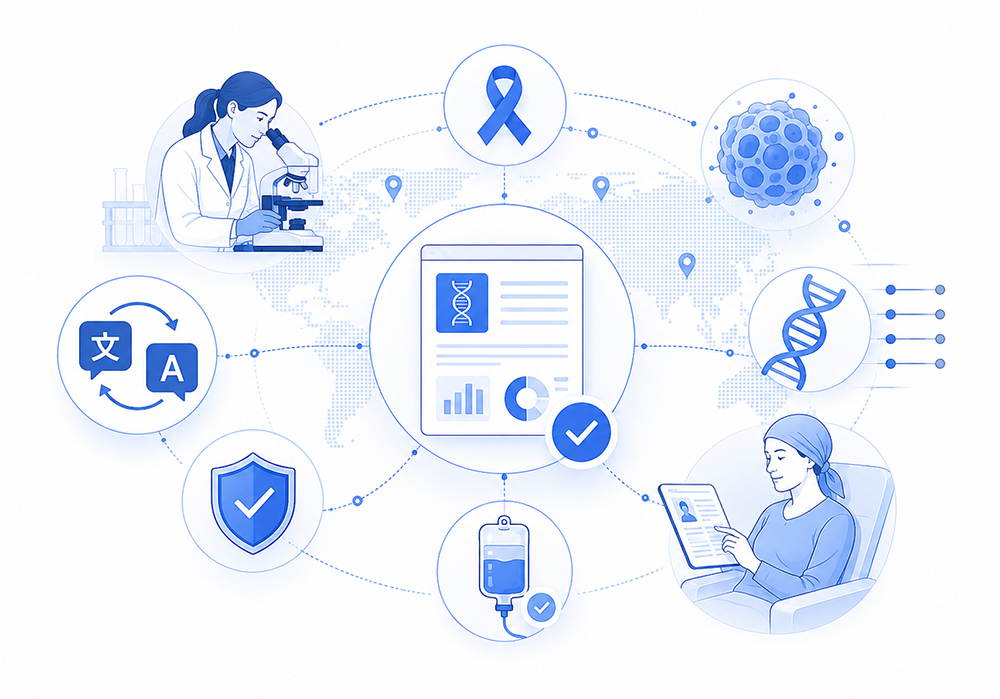
Oncology Language Solutions

Oncology Translation Services for Global Drug Development

Advance global oncology programs—from biomarker-driven clinical trials and precision therapeutics to increasingly individualized treatment approaches—with specialized translation and localization for clinical research, regulatory submissions, patient-facing content, safety communication, medical affairs, and the evolving science of cancer care.

Sesen combines professional life sciences linguists, oncology terminology management, structured human review, secure workflows, and advanced language technology to help pharmaceutical companies, biotechnology organizations, CROs, and clinical teams communicate complex oncology information accurately across languages and markets.

150+ Languages
Global multilingual support
ISO-Certified Quality
ISO 17100 · ISO 9001 · ISO 13485
Life Sciences Expertise
Professional medical and scientific linguists
Terminology Control
Across studies, documents, and versions
Secure Workflows
For sensitive clinical and regulatory content

Oncology Language Is as Complex as Oncology Science

Cancer research and treatment are becoming increasingly precise. The language surrounding that science must remain equally precise across scientific, clinical, regulatory, and patient-facing content.

Precision & Biomarker Complexity

Cancer populations may be defined by molecular characteristics rather than only tumor location. Terminology can influence patient selection, study design, treatment strategy, clinical interpretation, and regulatory evidence.

EGFR · HER2 · KRAS · BRAF · ALK · BRCA · PD-L1 · ctDNA · neoantigens

Rapidly Evolving Therapies

Oncology now includes targeted therapies, immuno-oncology, ADCs, bispecific antibodies, cellular therapies, gene-based approaches, radiopharmaceuticals, and personalized mRNA and neoantigen therapies alongside other emerging modalities.

Complex Clinical Trial Designs

Basket, umbrella, platform, multi-cohort, biomarker-defined, and adaptive study structures create interconnected content, endpoints, versions, and country-specific requirements.

Multiple Critical Audiences

Scientists, regulators, investigators, ethics committees, study sites, patients, caregivers, and medical professionals need the same science communicated appropriately for very different purposes.

Multilingual Support Across the Oncology Development Lifecycle

Scientific concepts and approved language move through an interconnected lifecycle—from research and clinical study design to regulatory submission, patient communication, launch, and post-approval activities.

01

Research & Translational Science

  • Biomarkers
  • Genomics
  • Preclinical documentation
  • Scientific reports
02

Clinical Development

  • Protocols
  • IBs
  • ICFs
  • CRFs/eCRFs
  • COA/eCOA
  • CSRs
03

Global Trial Operations

  • IRB/EC materials
  • Site content
  • Training
  • Recruitment
  • Safety updates
04

Regulatory Submission

  • IND/CTA content
  • CTD/eCTD
  • Clinical summaries
  • Authority responses
05

Approval & Launch

  • Labeling
  • Product information
  • Patient education
  • Medical information
06

Post-Approval

  • Pharmacovigilance
  • Medical Affairs
  • RWE/HEOR
  • Publications
  • Label updates

One Oncology Program. An Interconnected Multilingual Content Ecosystem.

A biomarker, endpoint, dose description, or safety concept may recur across many documents and audiences. Sesen helps oncology teams manage these relationships with specialized translation, terminology governance, translation memory, reference management, and structured review.

Clinical & Scientific Documentation

Translate the scientific and clinical foundation of oncology development with terminology appropriate to the indication, study phase, intended audience, and regulatory use.

  • Clinical trial protocols and amendments
  • Protocol synopses
  • Investigator's brochures
  • Clinical study reports
  • Clinical narratives
  • Tables, listings, and figures
  • Statistical and scientific content
  • Research reports, abstracts, posters, and publications

Patient-Facing & Clinical Outcome Content

Preserve clinical meaning while helping patients understand study participation, treatment requirements, symptoms, assessments, and other important information.

  • Informed consent and assent
  • Re-consent materials
  • Patient information sheets
  • COA, PRO, ePRO, and eCOA content
  • Symptom questionnaires
  • Quality-of-life instruments
  • Patient diaries
  • Treatment instructions

Site & Clinical Operations Content

Give investigators and trial sites consistent multilingual information for study setup, execution, and ongoing management.

  • CRFs and eCRFs
  • Investigator and site manuals
  • Pharmacy and laboratory manuals
  • Study startup documentation
  • Site initiation materials
  • Investigator training
  • Clinical operations communications
  • Recruitment and retention materials

Regulatory & Safety Documentation

Support controlled oncology communication for health authorities, safety teams, regulatory professionals, and other stakeholders.

  • Regulatory submissions
  • CTD and eCTD modules
  • Health authority responses
  • Safety narratives
  • Adverse-event documentation
  • SAE and SUSAR-related content
  • DSUR-related and risk-management content
  • Product labeling and safety communications

Medical Affairs & Scientific Communication

Extend consistent oncology terminology into post-development and professional communication.

  • Medical Affairs materials
  • Medical information
  • Scientific presentations
  • Congress materials
  • KOL communications
  • Publications
  • Training materials
  • Patient education and digital medical content

Precision Oncology Requires Precision Language

Modern oncology increasingly connects molecular information with clinical decisions. A genomic alteration may help define a study population, a biomarker may determine eligibility, and a molecular target may shape an investigational treatment strategy. Those concepts can then recur across study documentation, patient communication, data collection, regulatory evidence, and approved product information.

Biomarker Terminology

Maintain consistent terminology for molecular markers, diagnostic concepts, expression levels, genomic alterations, assay-related language, and biomarker-defined patient populations.

Disease & Molecular Classification

Support terminology involving tumor types, histologies, stages, molecular subtypes, disease states, treatment lines, resistance mechanisms, and related clinical characteristics.

Treatment & Target Terminology

Control names and descriptions associated with molecular targets, mechanisms of action, investigational therapies, combination regimens, dosing, and treatment strategies.

Endpoint & Response Terminology

Maintain consistent language for oncology endpoints, response criteria, progression, survival, disease status, symptoms, functioning, and treatment experience.

Patient-Appropriate Language

Preserve the underlying medical concept while using language appropriate for informed consent, questionnaires, treatment instructions, recruitment, and other patient communications.

From Tumor Biology to Product Information
Tumor Biology
Biomarker & Genomic Profile
Patient Population
Investigational Therapy
Protocol & Clinical Endpoints
Patient-Facing Content
Clinical Evidence
Regulatory Submission
Product Information

Terminology Governance

One Source of Oncology Terminology Across the Program

In oncology development, terminology is infrastructure. A key term introduced during protocol development can reappear across dozens of documents, systems, languages, and study stages. When terminology changes—or when a preferred translation is approved—that decision may affect multiple downstream assets.

  • Sponsor-approved terminology
  • Study-specific glossaries
  • Product and compound naming
  • Biomarker terminology
  • Disease and indication terminology
  • Clinical endpoint terminology
  • Translation memories
  • Previous approved translations
  • Style guidance
  • Reference content
  • Language-specific decisions
  • Terminology QA checks
Protocol
Investigator's Brochure
Informed Consent
CRF / eCRF
COA / eCOA
Controlled Oncology Terminology
Safety Documentation
Clinical Study Report
CTD / eCTD
Labeling
Medical Affairs

Language Expertise for a Rapidly Evolving Oncology Landscape

From established systemic treatments to highly targeted and individualized approaches, cancer therapeutics continue to diversify—bringing new scientific concepts, mechanisms, diagnostics, manufacturing models, patient pathways, and development strategies into oncology communication.

Targeted Therapies

Molecular targets, driver alterations, signaling pathways, biomarker selection, resistance mechanisms, treatment combinations, and target-defined patient populations.

Immuno-Oncology

Immune checkpoints, tumor immune response, immunotherapy combinations, response assessment, immune-mediated adverse events, and related clinical concepts.

ADCs & Bispecifics

Specialized terminology connecting target selection, antibodies, payloads, linkers, binding mechanisms, dosing, efficacy, safety, and treatment strategy.

Cell & Gene Therapies

Complex therapeutic concepts involving engineered cells, genetic modification, individualized workflows, manufacturing, administration, monitoring, and long-term follow-up.

Therapeutic Radiopharmaceuticals

Radionuclides, targeting mechanisms, dosimetry, administration, radiation safety, dose optimization, imaging, and treatment response.

Personalized mRNA & Neoantigen Therapies

Tumor sequencing, neoantigen identification, computational selection, individualized therapeutic design, manufacturing, immune response, and the clinical evidence surrounding personalized mRNA oncology programs.

Personalized mRNA Oncology

Sequence-Driven Cancer Therapies Create a New Multilingual Content Chain

Personalized mRNA cancer vaccines have reached Phase 3 oncology development, increasing the need for language workflows that can connect patient-specific genomic information with individualized therapeutic design, manufacturing, clinical operations, patient communication, and regulatory evidence. The field also illustrates a broader shift toward programmable, information-driven therapeutics, where biological sequence data increasingly becomes part of treatment design itself.

01
Tumor Sequencing & Biomarker Data Patient-specific genomic information, tumor mutations, biomarker results, assays, and source scientific terminology establish the individualized treatment context.
02
Neoantigen Selection & Therapeutic Design Computationally selected neoantigens, sequence-driven design decisions, product terminology, and mechanism-of-action language require precise cross-functional alignment.
03
Individualized Manufacturing & Clinical Delivery Manufacturing, chain-of-custody, dosing, administration, laboratory, site, and operational content must stay connected to the correct patient and treatment pathway.
04
Clinical, Patient & Regulatory Evidence Protocols, informed consent, safety content, outcomes, clinical reports, submissions, and medical communication need consistent terminology as evidence moves across markets.

For multilingual teams, the challenge is not simply translating “mRNA.” It is maintaining controlled terminology across tumor-specific mutations, neoantigens, assays, manufacturing, dosing, informed consent, safety, outcomes, and regulatory documentation as one individualized oncology program moves across languages and markets.

Built for the Complexity of Global Oncology Clinical Trials

Cancer clinical trials can be among the most operationally and linguistically demanding studies to manage globally. Sesen's oncology clinical trial translation services are designed around the realities of modern study execution.

Biomarker-Defined Patient Populations

Eligibility may depend on tumor characteristics, biomarker expression, genomic alterations, previous treatments, disease progression, laboratory findings, or other study-specific criteria.

Basket, Umbrella & Platform Studies

Complex master-protocol structures may evaluate multiple therapies, molecular targets, tumor types, or patient populations within connected study frameworks.

Combination Therapies

Maintain consistent terminology for treatment sequences, dosing, schedules, comparators, combination regimens, safety information, and study procedures.

Complex Oncology Endpoints

Support language for survival, response, progression, recurrence, symptoms, tolerability, functioning, quality of life, biomarkers, and other endpoints.

Multicountry Execution

Centralize multilingual support across sponsors, CROs, affiliates, ethics committees, investigators, laboratories, study sites, vendors, patients, and caregivers.

Patient Experience

Preserving Scientific Accuracy While Communicating Clearly with Patients

For patients considering or participating in oncology clinical trials, language is part of the study experience. They may need to understand an unfamiliar diagnosis, investigational treatment, biomarker test, randomization, biopsy, treatment schedule, possible adverse effects, symptom assessment, and the implications of participation.

Scientific accuracy remains essential—but accuracy alone is not enough. Sesen helps oncology teams communicate complex medical information in language appropriate for patients and participants while preserving the meaning of the source.

Common patient communication concepts
Treatment options Biomarker testing Biopsies Dose schedules Adverse events Quality of life Genetic information Participation choices

Informed Consent & Re-Consent

Translate study purpose, treatment, procedures, risks, potential benefits, alternatives, privacy, sample use, genetic testing, optional research, withdrawal, and other participation considerations.

Patient Information & Education

Support multilingual information that helps patients and caregivers understand study participation, treatment requirements, visits, procedures, safety considerations, and related care.

Recruitment & Retention

Localize outreach materials, recruitment communications, pre-screening content, study information, participant reminders, and retention materials.

PRO, ePRO & eCOA

Translate symptom scales, quality-of-life measures, patient diaries, digital assessments, instructions, reminders, interfaces, and other outcome-related content.

Clinical Outcomes

Oncology COA & eCOA Linguistic Validation

Patient-facing outcome measures require more than word-for-word translation. Multilingual COA and eCOA content must preserve the intended clinical concept while remaining understandable, culturally appropriate, and consistent for the target respondent population.

Sesen supports structured linguistic validation for oncology outcome assessments, patient questionnaires, symptom scales, quality-of-life measures, diaries, and digital instruments used in global clinical trials.

01
Source & Concept ReviewClarify instrument concepts, response scales, instructions, study context, and terminology before multilingual adaptation.
02
Forward Translation & ReconciliationDevelop and reconcile target-language wording around conceptual meaning, patient comprehension, and cultural appropriateness.
03
Back Translation & ReviewCompare the reconciled meaning with the source and resolve potential concept shifts or ambiguity.
04
Cognitive Debriefing SupportEvaluate patient understanding when respondent testing is required for the instrument and study.
05
Harmonization & Final DocumentationAlign multilingual decisions, proofread final content, and prepare documented deliverables for study use.
PRO
Patient-Reported Outcomes
ePRO
Electronic Patient-Reported Outcomes
ClinRO
Clinician-Reported Outcomes
ObsRO
Observer-Reported Outcomes
PerfO
Performance Outcomes

Clinical Program Experience

25

target languages supported for a global oncology Clinical Outcome Assessment linguistic validation program.

GLOBAL CRO · ONCOLOGY CLINICAL TRIAL

Global Oncology Linguistic Validation in 25 Languages

A global CRO engaged Sesen to support linguistic validation of a Clinical Outcome Assessment for an oncology clinical trial across 25 target languages.

Because the instrument collected patient-facing outcome data, standard translation alone was not sufficient. Each language version needed to preserve the intended clinical concepts, remain understandable to patients, support cultural appropriateness, and maintain cross-language consistency.

Sesen applied a structured linguistic validation workflow incorporating source review, professional life sciences translation, reconciliation, back translation, documented review, and terminology control.

Source review Forward translation Reconciliation Back translation Documented review Terminology control
Explore the Oncology COA Case Study

Version Continuity

When the Protocol Changes, the Language Ecosystem Changes with It

A new cohort may open. Eligibility criteria may change. Dosing may be revised. New safety information may emerge. A biomarker strategy may be refined. When the protocol changes, the impact can extend far beyond the protocol itself.

  • Reuse approved language where appropriate while isolating changed content for focused review.
  • Maintain shared study terminology across documents, countries, and languages.
  • Distinguish current versions from superseded content through structured project workflows.
  • Support recurring amendments, safety updates, re-consent, and site communications throughout the study.
Protocol Amendment
Informed Consent & Re-Consent
CRFs & eCRFs
Site Manuals
Investigator Training
Laboratory & Pharmacy Content
COA & eCOA
Safety Communications
IRB / Ethics Committee Materials
Patient Communications

From Clinical Evidence to Regulatory Decision-Making

Oncology development produces large volumes of scientific evidence that must remain clear and consistent as information moves from clinical research into regulatory evaluation, safety management, and post-approval communication.

Regulatory Submission

  • CTD and eCTD content
  • Clinical summaries
  • Regulatory submission documents
  • Health authority questions and responses
  • Regional submission materials
  • Supporting scientific documentation

Safety & Pharmacovigilance

  • Adverse-event documentation
  • SAE and SUSAR-related content
  • Safety narratives
  • DSUR-related content
  • Risk-management materials
  • Post-market safety information

Clinical Evidence & Reporting

  • Clinical study reports
  • Clinical narratives
  • Tables, listings, and figures
  • Trial results
  • Plain-language summaries
  • Manuscripts and scientific publications

Human Expertise First

Expert Oncology Translation, Strengthened by Language Technology

Oncology content is too consequential for quality to depend on technology alone. Sesen combines professional human expertise with language technology designed to improve consistency, efficiency, and quality control throughout multilingual workflows.

01

Content & Risk Assessment

Review content type, audience, therapeutic context, intended use, languages, reference materials, formatting requirements, and project risk.

02

Oncology Terminology Preparation

Prepare sponsor terminology, study glossaries, previous approved translations, translation memory, product references, and other language assets.

03

Specialized Human Translation

Assign professional native-language life sciences linguists with relevant oncology, clinical, scientific, regulatory, or patient-facing expertise.

04

Independent Review

Evaluate accuracy, completeness, terminology, consistency, readability, and appropriate language use according to the required workflow.

05

AI-Assisted Quality Assurance

Use technology to surface potential omissions, terminology inconsistencies, numerical discrepancies, formatting issues, and other items for human attention.

06

Final Human Quality Control

Qualified professionals remain responsible for the final linguistic and contextual assessment before delivery.

Technology Supports the Workflow

  • Terminology matching
  • Translation memory
  • Reference retrieval
  • Repetitive-content reuse
  • Numerical checks
  • Consistency checks
  • Potential omission detection
  • Cross-document comparison
  • Version comparison
  • Automated QA

Humans Remain Responsible for Meaning

  • Scientific interpretation
  • Oncology terminology
  • Clinical context
  • Patient readability
  • Regulatory nuance
  • Ambiguity resolution
  • Reviewer judgment
  • Final quality decisions

Therapeutic Breadth

Oncology Translation Across Solid Tumors and Hematologic Malignancies

Sesen supports multilingual oncology content across a broad range of cancer research and treatment programs, including solid tumors, hematologic malignancies, biomarker-defined indications, tumor-agnostic approaches, combination therapies, and emerging treatment modalities.

The appropriate linguistic team and workflow are selected according to the specific indication, document type, study requirements, target audience, and language.

  • Breast cancer
  • Lung cancer
  • Melanoma
  • Colorectal cancer
  • Prostate cancer
  • Ovarian cancer
  • Pancreatic cancer
  • Renal cell carcinoma
  • Bladder cancer
  • Liver cancer
  • Gastric and gastroesophageal cancers
  • Head and neck cancers
  • Brain and central nervous system tumors
  • Leukemias
  • Lymphomas
  • Multiple myeloma
  • Other solid and hematologic malignancies

Oncology Translation in 150+ Languages

Global cancer research depends on participation from diverse patient populations and clinical sites. Sesen helps sponsors, biotechnology companies, CROs, and research organizations manage multilingual oncology content through a centralized workflow supported by professional native-language expertise.

North America

English, Canadian French, U.S. Spanish, and other languages required by diverse patient populations and study sites.

Europe

Multilingual support across major EU and EEA markets, the United Kingdom, Switzerland, and other European study locations.

Asia-Pacific

Translation for major clinical research and commercial markets across East Asia, Southeast Asia, South Asia, Australia, and New Zealand.

Latin America

Spanish and Portuguese localization adapted for relevant countries, clinical environments, regulatory uses, and patient populations.

Middle East & Africa

Language support for expanding clinical research networks and diverse patient populations across regional markets.

Why Oncology Teams Choose Sesen

A specialized oncology language program should combine subject-matter expertise, controlled terminology, human-led quality, global scale, and disciplined life sciences workflows.

Life Sciences Specialization

Dedicated support for pharmaceutical, biotechnology, CRO, healthcare, medical device, and digital health organizations.

Oncology & Clinical Expertise

Professional linguists selected according to language, subject matter, document type, target audience, and intended use.

Study-Level Terminology Control

Glossaries, translation memories, approved terminology, style guidance, product references, and study-specific language assets.

Human-Led Quality

Qualified professionals remain central to scientific interpretation, clinical context, patient readability, and final quality decisions.

Global Program Scalability

Support for individual documents, recurring studies, and multilingual programs spanning countries, languages, content types, and development stages.

ISO-Certified Workflows

Quality processes supported by ISO 17100, ISO 9001:2015, and ISO 13485:2016 certifications.

Oncology Translation Services — Frequently Asked Questions

Common questions about oncology translation, global clinical trial support, patient-facing content, linguistic validation, terminology governance, protocol amendments, emerging therapies, and AI-assisted quality workflows.

Oncology translation is the specialized translation and localization of scientific, clinical, regulatory, safety, medical, and patient-facing content associated with cancer research, clinical development, treatment, and post-approval communication. It often requires detailed knowledge of cancer biology, biomarkers, genomic terminology, treatment modalities, clinical endpoints, patient-reported outcomes, study design, regulatory documentation, and rapidly evolving therapeutic approaches.

Sesen translates oncology clinical trial protocols, amendments, investigator's brochures, informed consent forms, CRFs and eCRFs, COAs and eCOAs, PROs and ePROs, patient materials, site manuals, training content, safety documentation, clinical study reports, CTD and eCTD content, regulatory submissions, labeling, Medical Affairs materials, publications, and other scientific and clinical content.

Sesen can establish and maintain study-specific language assets including approved glossaries, biomarker terminology, product terminology, disease terminology, translation memory, previous approved translations, reference content, and style guidance. These resources help keep key concepts consistent as they move between interconnected study and regulatory documents.

Yes. Sesen provides multilingual clinical trial translation across 150+ languages and can support studies involving multiple countries, content types, vendors, sites, and study stages. Centralized project management, terminology governance, translation memory, version control, native-language specialists, and structured review help maintain consistency across global programs.

Sesen translates informed consent forms, re-consent materials, patient information, recruitment content, treatment instructions, questionnaires, diaries, and digital content using language appropriate for the intended patient population while preserving the underlying scientific and clinical meaning. Terminology can also be aligned with protocols, investigator's brochures, safety information, and other study documentation.

Yes. Sesen supports translation and linguistic validation for PRO, ePRO, eCOA, ClinRO, ObsRO, PerfO, patient diaries, symptom scales, quality-of-life instruments, and other outcome assessments. Depending on study requirements, workflows can include source review, concept clarification, forward translation, reconciliation, back translation, review, cognitive debriefing, proofreading, documentation, and finalization.

Yes. Sesen supports protocol amendments and related multilingual updates across consent forms, CRFs, investigator and site materials, laboratory and pharmacy content, eCOA, safety communications, ethics committee documentation, patient communication, and other affected content. Translation memory, terminology resources, version comparison, and structured project management help control changed content while reusing approved language appropriately.

Sesen supports language requirements associated with established and emerging oncology approaches, including chemotherapy, targeted therapy, immuno-oncology, monoclonal antibodies, antibody-drug conjugates, bispecific antibodies, cell and gene therapies, therapeutic radiopharmaceuticals, cancer vaccines, and other precision-medicine approaches. Personalized mRNA and neoantigen therapies can introduce an especially connected terminology chain spanning tumor sequencing, patient-specific mutations, neoantigen selection, computational design, individualized manufacturing, dosing and administration, clinical evidence, informed consent, safety communication, and regulatory documentation.

Sesen uses language technology and AI-assisted tools to strengthen professional human workflows. Technology can support terminology checks, translation memory, reference retrieval, consistency analysis, numerical checks, potential omission detection, repetitive-content reuse, and version comparison. Professional life sciences linguists and reviewers remain responsible for scientific meaning, clinical context, patient readability, regulatory nuance, and final quality decisions.

Advance Your Global Oncology Program with Greater Language Control

Whether you are preparing a first-in-human oncology study, expanding a global clinical trial, translating patient outcome measures, managing protocol amendments, preparing regulatory submissions, or supporting an approved therapy across markets, Sesen can help connect the multilingual content behind your program.