
150+ Languages
Global support for multilingual life sciences programs
ISO-Certified Quality
ISO 17100 · ISO 9001 · ISO 13485
Human Quality Review
Specialized life sciences linguists and independent review
Terminology Governance
Controlled RNA, clinical, CMC, and regulatory terminology
Secure Infrastructure
Controlled workflows for confidential scientific and clinical content
Complex RNA Science Requires More Than General Medical Translation
RNA-based medicines are creating new possibilities across oncology, rare and genetic diseases, infectious diseases, and other areas of therapeutic development. They also bring together scientific concepts that can span molecular biology, genetics, immunology, pharmacology, bioanalytics, drug delivery, manufacturing, clinical medicine, and regulatory science.
The language surrounding an RNA therapeutic therefore does not live in one document. A target first described in research materials may later appear in nonclinical reports, analytical methods, CMC documentation, clinical protocols, investigator's brochures, regulatory submissions, safety communications, informed consent forms, and patient-facing materials. Each audience requires a different level of technical detail, but the underlying scientific meaning must remain aligned.
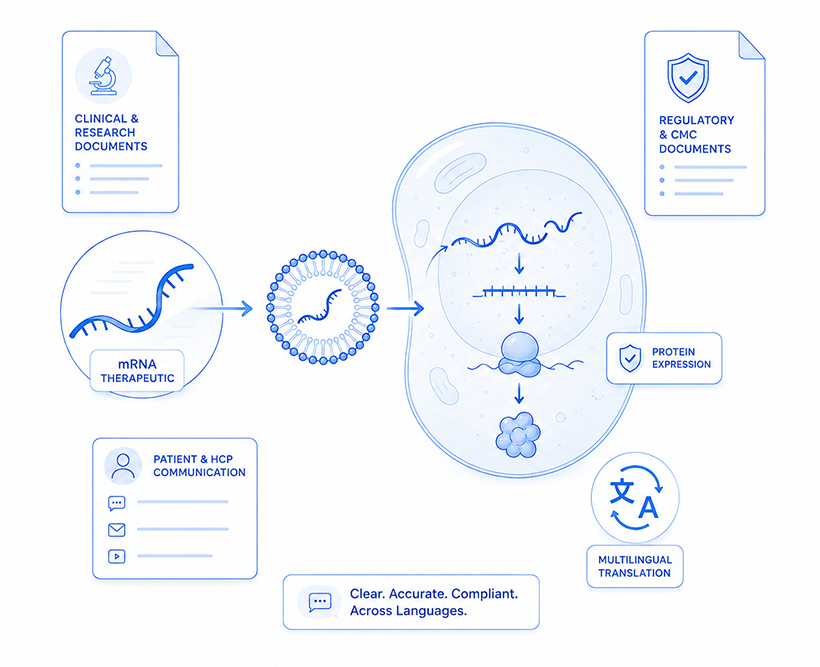
Sesen provides professional multilingual translation and localization for this connected RNA therapeutic content ecosystem. Our workflows combine specialized life sciences linguists, terminology management, translation memory, structured review, technology-assisted quality assurance, and final human quality control to help maintain accuracy as complex scientific information moves across documents, teams, languages, and development stages.
Scientific Accuracy
Translate specialized molecular, genetic, pharmacological, clinical, and regulatory concepts in the context in which they are actually used.
Cross-Document Consistency
Maintain approved terminology across research, CMC, clinical, safety, regulatory, medical, and patient-facing documentation.
Audience-Appropriate Communication
Preserve scientific meaning while adapting language for researchers, regulators, investigators, healthcare professionals, patients, and caregivers.
Lifecycle Continuity
Build multilingual language assets that can support an RNA program as documentation evolves from development through submission, launch, and ongoing communication.
RNA Modalities
One RNA Field. Multiple Therapeutic Strategies.
RNA therapeutics encompass multiple approaches for using or targeting RNA to influence biological processes. Each modality brings its own terminology, mechanisms, development pathways, delivery considerations, and documentation requirements.
mRNA Therapeutics
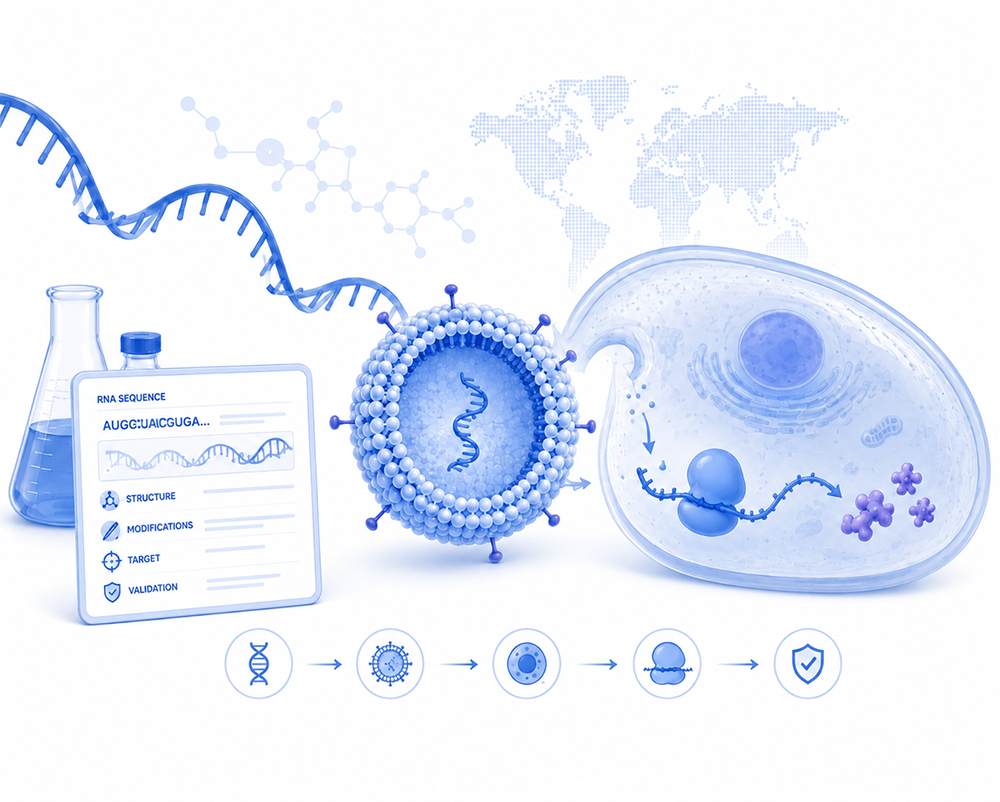
Messenger RNA can provide cells with instructions to produce proteins or antigens for therapeutic purposes. Programs may span infectious-disease vaccines, therapeutic vaccines, cancer immunotherapies, protein expression approaches, delivery technologies, clinical development, and regulatory communication.
Protein Expression
Therapeutic Vaccines
Cancer Immunotherapy
Delivery Technologies
Personalized mRNA & Neoantigen Therapies
Individualized mRNA approaches can connect genomic or tumor information with patient-specific therapeutic design, introducing specialized terminology around sequencing, mutations, neoantigens, biomarkers, constructs, manufacturing, clinical workflows, and patient communication.
siRNA & RNA Interference
Small interfering RNA and related RNA interference approaches regulate gene expression through sequence-specific mechanisms. Translation may involve targets, RNAi mechanisms, delivery systems, pharmacology, clinical development, safety information, and regulatory content.
Antisense Oligonucleotides
Antisense oligonucleotide therapies can target specific RNA sequences to alter RNA processing or downstream protein expression. Their documentation can span genetic disease research, sequence-specific terminology, pharmacology, bioanalysis, clinical studies, CMC, and regulatory content.
Emerging RNA Medicines
RNA science continues to expand into RNA editing, microRNA-based approaches, next-generation delivery systems, self-amplifying RNA, and other developing therapeutic platforms. Sesen helps teams establish multilingual terminology that can evolve with the science.
Personalized Medicine
When the Medicine Becomes More Personalized, Communication Does Too
Some of the most important advances in RNA therapeutics are bringing drug development closer to the underlying molecular characteristics of an individual disease—or even an individual patient.
In oncology, RNA-based approaches can connect tumor sequencing, mutation analysis, biomarker information, antigen selection, and individualized therapeutic design. In rare and genetically defined diseases, highly targeted RNA approaches may address specific molecular causes within very small patient populations.
Sesen helps life sciences teams maintain the linguistic continuity needed when individualized scientific information moves between researchers, manufacturing teams, clinical sites, regulators, healthcare professionals, and patients.
Precision Oncology
Tumor biology, mutations, biomarkers, neoantigens, therapeutic targets, endpoints, and treatment terminology.
Explore Oncology Translation
Rare & Genetic Diseases
Genetically defined conditions, targeted RNA approaches, specialized studies, and patient communication.
Explore Rare Disease Translation
Genomic & Molecular Content
Genetic variation, molecular targets, mechanisms, biomarkers, assays, and clinical development.
Explore Genomics & Gene TherapyThe therapeutic information may become increasingly individualized. The multilingual quality requirements cannot.
Genomic Information
Therapeutic Design
Manufacturing
Clinical Use
Regulatory Evidence
Patient Communication
Platform Development
A Programmable Therapeutic Platform Creates New Multilingual Complexity
RNA platforms can enable developers to work with related therapeutic technologies while changing sequences, targets, constructs, formulations, or biological instructions for different applications.
Some scientific information changes from program to program. Some platform terminology remains stable. Some content is reused across studies or regulatory documents. Other language must be updated precisely when the therapeutic design changes.
When the therapeutic instructions change, the language surrounding them must remain controlled.
Platform Terminology
→
Controlled + Reused
Sequence / Target
→
Precisely Updated
CMC / Process Language
→
Version Aligned
Clinical / Regulatory Content
→
Context Validated
Sesen combines terminology governance, translation memory, version-aware workflows, human review, and structured quality assurance so global teams can update multilingual content without losing the language decisions that should remain consistent.
RNA Translation Support Across the Therapeutic Lifecycle
RNA therapeutic development generates a connected body of scientific and regulated information. Sesen supports that content from early research through global clinical development, regulatory submission, safety communication, and patient engagement.
01
Research & Discovery
Targets, molecular mechanisms, RNA constructs, assays, biomarkers, and early scientific findings.
02
Preclinical Development
Pharmacology, toxicology, biodistribution, bioanalytical, and other nonclinical documentation.
03
CMC & Manufacturing
Manufacturing, analytical control, characterization, formulation, delivery, specifications, stability, and quality.
04
Clinical Development
Protocols, investigator materials, clinical systems, site documentation, assessments, safety updates, and patient content.
05
Regulatory Submission
Submission content, health authority correspondence, CTD/eCTD documentation, amendments, and responses.
06
Safety & Pharmacovigilance
Adverse-event, safety, risk, and pharmacovigilance content aligned with the clinical program.
07
Medical Affairs & Launch
Scientific, HCP, educational, labeling, and launch-related communication.
08
Patient Communication
Consent, education, results, treatment information, and other patient-facing materials.
Scientific Development
Preserving Scientific Meaning From Early Research Forward
RNA programs often begin with highly specialized scientific vocabulary long before clinical or regulatory documents are created.
Targets, genes, proteins, mutations, sequences, constructs, molecular pathways, delivery technologies, biomarkers, assays, and mechanisms of action may become foundational terminology for everything that follows.
Sesen helps organizations establish accurate multilingual language early and carry validated terminology into downstream documentation.
Research reports
Scientific presentations
Molecular biology documentation
Genomic and transcriptomic content
Target and pathway descriptions
Mechanism-of-action content
Biomarker and assay documentation
Scientific publications
Pharmacology reports
Toxicology documentation
Biodistribution studies
Bioanalytical reports
PK / PD content
Immunogenicity-related documentation
Nonclinical study summaries
Research protocols
For mRNA programs, this may also include specialized language associated with lipid nanoparticles or other delivery technologies, platform processes, sequence-related changes, and analytical controls.
The product described in scientific documentation must remain the same product described in manufacturing records, quality documentation, regulatory submissions, and subsequent lifecycle updates.
Drug substance documentation
Drug product documentation
Manufacturing process descriptions
Process development documentation
Analytical methods
Characterization reports
Specifications
Stability documentation
Validation materials
Raw and starting material documentation
Formulation content
Delivery-system documentation
Quality-control documentation
Change-control materials
Batch-related documentation
Standard operating procedures
CTD/eCTD Module 3 content
RNA Construct→
Manufacturing Process→
Analytical Control→
Specification→
Stability→
Regulatory Submission
Translation for the CMC and Manufacturing Complexity Behind RNA Medicines
An RNA therapeutic is more than its sequence. Manufacturing and quality documentation can bring together specialized terminology for materials, synthesis, purification, structure, analytical control, formulation, delivery, stability, and finished-product control.
From Complex Mechanisms to Clear Multilingual Clinical Execution
The scientific language of an RNA therapy ultimately has to work in a clinical environment. Investigators need precision. Study sites need operational clarity. Regulators need controlled evidence. Patients need understandable explanations of participation, procedures, risks, and potential benefits.
Protocols & Study Design
Clinical trial protocols, protocol synopses, amendments, eligibility criteria, treatment and dosing information, endpoint descriptions, study procedures, and visit schedules.
Explore Protocol TranslationInvestigator & Site Documentation
Investigator's brochures, investigator meeting materials, site manuals, pharmacy and laboratory manuals, study training, site communications, and clinical operations documentation.
Explore Investigator Brochure TranslationPatient & Consent Content
Informed consent forms, assent and re-consent, patient information sheets, recruitment content, treatment instructions, study participation materials, and patient education.
Explore ICF TranslationClinical Data & Digital Study Content
CRFs and eCRFs, clinical outcome assessments, PROs and ePROs, eCOA interfaces, patient diaries, eConsent, patient apps and portals, and digital trial instructions.
Explore eCOA TranslationStudy Reporting
Clinical study reports, clinical narratives, tables, listings and figures, results summaries, supporting appendices, publications, and abstracts.
Explore CSR TranslationThe goal is not to make every audience receive the same language. It is to make every audience receive the right language without changing the underlying science.
Explore Clinical Trial TranslationRegulatory Translation Built for Scientific Consistency
Regulatory submissions bring together the scientific story of an RNA therapeutic across quality, manufacturing, nonclinical, clinical, safety, and product information.
CMC
How the therapeutic is made and controlled.
Nonclinical
How its biological and safety profile is characterized before and alongside clinical development.
Clinical
How the therapeutic is studied in people.
Safety
How risks and safety observations are documented.
Regulatory
How the complete body of evidence is communicated to health authorities.
Regulatory Content We Support
- IND- and CTA-related documentation
- Regulatory application content
- CTD and eCTD documentation
- Module summaries
- CMC submission content
- Nonclinical documentation
- Clinical documentation
- Health authority correspondence
- Questions and responses
- Amendments
- Variations
- Supporting scientific documentation
- Product information
- Lifecycle updates
Terminology Governance
One RNA Vocabulary Across Every Document
RNA therapeutic development can generate thousands of terminology decisions. Those documents do not need identical wording. They do need controlled meaning.
A target or molecular concept may first appear in a research report, then move into CMC documentation, a clinical protocol, an investigator's brochure, a regulatory submission, a safety narrative, and eventually a patient-facing explanation.
Project glossaries, translation memories, approved references, previous translations, reviewer decisions, and customer terminology can become managed language assets rather than being rediscovered with each new file.
Identify→
Define→
Validate→
Translate→
Review→
Reuse→
Maintain
Terminology governance creates scientific continuity across an evolving global development program.
Target / Gene
Genes, targets, mutations, pathways, and related molecular concepts.
RNA Construct
Sequence design, constructs, modifications, and product-specific concepts.
Mechanism of Action
Technical mechanisms across research, clinical, regulatory, and medical communication.
Delivery Technology
Formulations, conjugates, lipid nanoparticles, delivery systems, and administration.
Biomarker / Assay
Biomarkers, analytical methods, assay terminology, thresholds, and measurement concepts.
Clinical Endpoint
Endpoints across protocols, clinical systems, reports, regulatory content, and scientific communication.
Regulatory Terminology
Approved product, clinical, CMC, safety, and health-authority language.
Patient Explanation
Patient-appropriate language for consent, education, and plain-language communication.
Accurate Safety Language Across Clinical Development and Global Markets
RNA therapeutic safety information can evolve alongside clinical development. Adverse events, laboratory findings, immunogenicity concepts, risks, warnings, investigator communications, and updated safety language may appear across multiple documents and reporting cycles.
Adverse-event documentation
Serious adverse-event content
Safety narratives
Investigator safety communications
Safety letters
DSUR-related content
Periodic safety documentation
Risk-management materials
Risk communication
Post-market safety content where applicable
Safety-related labeling updates
Keep Safety Terminology Connected
Clinical Observations
Adverse Event Language
Risk Communication
Regulatory Safety Content
Updated Patient / HCP Communication
Taking RNA Science From Development to Global Medical Communication
As an RNA program advances, its scientific story reaches audiences far beyond the original research and development team.
Medical affairs professionals, investigators, healthcare providers, scientific communities, commercial teams, and patients may all need access to accurate information—at different levels of technical detail.
Explore Medical & Scientific Translation
Scientific Community
Manuscripts, publications, abstracts, posters, congress materials, and scientific presentations.
Medical Affairs
Medical information, scientific exchange, HCP education, and professional training.
Launch & Product Education
Product education, launch-related scientific content, labeling, and product information where applicable.
Healthcare Professionals
Accurate scientific language adapted for clinical and professional audiences without changing underlying meaning.
Complex RNA Science, Explained Clearly to Patients
Patients do not need a molecular biology textbook to understand a clinical study or treatment. They do need information they can understand well enough to make informed decisions, follow instructions, report experiences accurately, and participate meaningfully in their care.
Scientific Source
Technical terminology appropriate for researchers, medical writers, investigators, and regulators.
Clinical Communication
Accurate clinical language appropriate for study sites, healthcare professionals, and trial operations.
Patient Understanding
Clear, culturally appropriate communication that preserves essential meaning without unnecessary technical complexity.
Informed consent forms
Assent and re-consent materials
Patient information sheets
Trial recruitment materials
Patient education
Treatment instructions
Questionnaires
Patient-reported outcomes
eCOA and ePRO content
Digital patient experiences
Study results communication
Plain-language summaries
Patient safety communication
Specialized Human Review for High-Stakes RNA Content
Complex RNA terminology requires contextual judgment. A technically plausible translation can still be wrong if a term is interpreted outside the context of the therapeutic mechanism, study design, manufacturing process, regulatory document, or intended audience.
Sesen uses a human-led, technology-supported quality model designed for specialized life sciences content.
Human judgment remains responsible for the final multilingual content. Technology strengthens the workflow; it does not replace scientific context or professional review.
Specialized Linguist Selection
Professional native linguists are matched according to language pair, content type, scientific or clinical subject matter, intended use, and project requirements.
Terminology Management
Approved terminology, product names, targets, biomarkers, assays, clinical concepts, CMC language, and customer-preferred usage can be established and reused consistently.
Translation Memory
Previously translated and approved content can be identified and reused where appropriate across related documents, versions, and recurring updates.
Independent Review
Bilingual review examines meaning, terminology, completeness, fluency, intended audience, and contextual accuracy.
Technology-Assisted QA
Automated and AI-assisted checks can help identify potential issues involving numbers, terminology, consistency, omissions, formatting, and repeated content for human attention.
Final Human Quality Control
Human quality control remains the final checkpoint for regulated, scientific, clinical, and patient-facing content.
Version-Aware Delivery
Updated documents, protocol amendments, submission revisions, safety changes, and recurring content can be managed against existing language assets.
Global RNA Programs
Supporting RNA Therapeutic Development in 150+ Languages
RNA research may begin in one laboratory, but global development can quickly involve clinical sites, investigators, regulatory teams, manufacturing operations, affiliates, reviewers, healthcare professionals, and patients across many countries.
Centralized terminology, translation memory, quality processes, and multilingual production help organizations maintain consistency as the same RNA program expands across markets and languages.
North America
U.S. and Canadian clinical, regulatory, medical, and patient-facing content, including regional language requirements.
Europe
EU and other European markets across clinical development, regulatory submissions, scientific communication, and patient materials.
Asia-Pacific
Major clinical and regulatory markets including Japan, China, Korea, and other APAC countries.
Latin America
Spanish and Portuguese programs for clinical research, regulatory documentation, patient communication, training, and regional activities.
Why Sesen
A Translation Partner Built for Complex Life Sciences Programs
RNA therapeutics sit at the intersection of rapidly evolving science and highly controlled development. Sesen brings together the linguistic, scientific, operational, and technology capabilities needed to support that environment across languages.
Scientific Accuracy
Specialized life sciences translation for molecular biology, genetics, RNA science, clinical medicine, CMC, safety, and regulatory content.
Terminology Continuity
Controlled language that follows the therapeutic program across documents, teams, audiences, versions, and development stages.
Connected Lifecycle Support
One multilingual framework for research, preclinical, manufacturing, clinical development, regulatory submission, medical affairs, and patient communication.
Professional Human Expertise
Qualified professional linguists and reviewers remain responsible for meaning, context, terminology, readability, and final quality.
ISO-Certified Quality
Structured quality systems supported by ISO 17100, ISO 9001, and ISO 13485 quality-management expertise relevant to regulated life sciences environments.
Secure, Scalable Delivery
Controlled project access, secure infrastructure, terminology, translation memory, and project management support single documents through multi-country portfolios.
mRNA & RNA Therapeutics Translation FAQs
Answers to common questions about specialized multilingual support for RNA-based medicines and development programs.
mRNA and RNA therapeutics translation services provide specialized multilingual support for the scientific, CMC, clinical, regulatory, safety, medical, and patient-facing content associated with RNA-based medicines. This can include documentation for mRNA therapeutics, personalized mRNA approaches, RNA interference and siRNA, antisense oligonucleotides, and other RNA-based therapeutic platforms.
Sesen can support multilingual documentation associated with mRNA therapeutics, personalized mRNA and neoantigen approaches, siRNA and RNA interference, antisense oligonucleotides, and emerging RNA technologies. The workflow is matched to the document type, scientific subject matter, audience, regulatory use, and target languages.
Yes. Sesen supports oncology-related multilingual content including clinical protocols, investigator's brochures, informed consent forms, biomarker and scientific documentation, CMC content, regulatory submissions, safety materials, clinical study reports, medical affairs content, and patient communication.
Yes. Sesen supports multilingual rare-disease documentation spanning scientific research, clinical development, informed consent, patient communication, regulatory submissions, safety content, and other materials associated with specialized therapeutic programs.
Sesen translates CMC content including manufacturing process descriptions, analytical methods, specifications, characterization documentation, stability materials, validation documentation, formulation and delivery-system content, quality records, SOPs, and CTD/eCTD Module 3 materials.
Sesen can establish project-specific glossaries and terminology resources covering product terminology, targets, genes, mutations, biomarkers, assays, mechanisms of action, delivery technologies, clinical endpoints, CMC terms, and regulatory language. Translation memory, approved references, reviewer decisions, and previous translations can then support continuity as documents evolve.
Yes. Sesen can support individual documents or coordinated multilingual programs spanning research, preclinical documentation, CMC, clinical trials, regulatory submissions, pharmacovigilance, medical affairs, and patient communication.
Sesen uses technology to support professional translation workflows, including translation memory, terminology tools, automated checks, and AI-assisted quality assurance where appropriate. For specialized scientific, regulated, clinical, and patient-facing content, professional human linguists and reviewers remain responsible for contextual judgment and final multilingual quality.
Sesen provides life sciences translation and localization in more than 150 languages, supporting regional and global development programs across North America, Europe, Asia-Pacific, Latin America, and other international markets.
RNA therapeutic content often combines interconnected terminology involving sequences, genes, molecular targets, therapeutic constructs, delivery technologies, analytical methods, biomarkers, manufacturing, clinical endpoints, and regulatory evidence. Because those concepts may move through many documents, effective RNA translation requires both scientific subject-matter understanding and strong cross-document terminology governance.
Build Multilingual Consistency Into Your RNA Program
Whether you are translating a single specialized document or coordinating language across an international RNA therapeutic program, Sesen can help keep scientific meaning, terminology, and quality connected from development through global communication.