Cell Therapies
Support for autologous and allogeneic cell therapies, CAR-T, TCR-T, TIL, NK and engineered NK-cell approaches, stem-cell-based therapies, and other specialized cellular platforms.

Connected CGT Content
Cell and gene therapies generate an interconnected body of scientific, manufacturing, clinical, regulatory, treatment, patient, and safety information. Consistency across documents can be as important as accuracy within any single file.
Sesen approaches cell and gene therapy translation as a connected multilingual program, helping preserve product terminology, mechanisms of action, cell and vector nomenclature, manufacturing language, clinical concepts, dosing information, safety terminology, and patient-facing explanations as the therapy progresses.
CGT programs can involve living cells, genetic modification, viral or non-viral delivery, genome editing, patient-specific manufacturing, or combinations of these approaches.
Support for autologous and allogeneic cell therapies, CAR-T, TCR-T, TIL, NK and engineered NK-cell approaches, stem-cell-based therapies, and other specialized cellular platforms.
Translation for in-vivo and ex-vivo programs involving gene addition or replacement, viral and non-viral delivery, vectors, constructs, target tissues, biodistribution, and immunogenicity.
Specialized language support for CRISPR-based and other editing programs, including editing efficiency, off-target assessment, genome integrity, delivery, and nonclinical evidence.
Consistent terminology for genetically modified cells, gene-edited cells, vector-modified cell products, and other platforms where cell therapy and gene engineering converge.
Converging Technologies
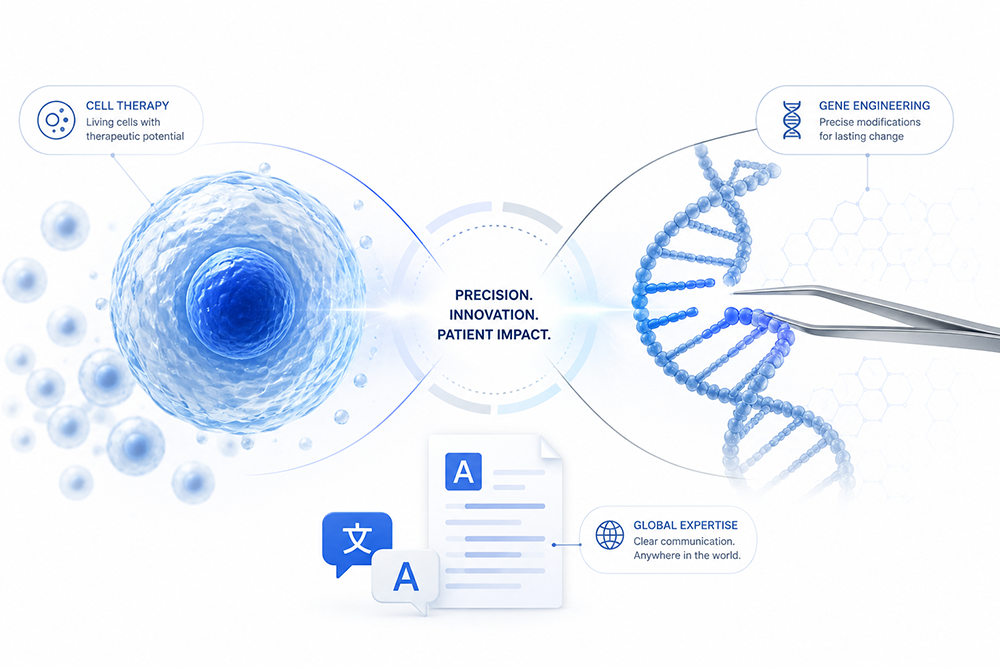
The traditional boundary between cell therapy and gene therapy is increasingly fluid. A therapeutic cell may be collected from a patient or donor, genetically modified or edited, expanded and characterized, tested for release, transported to a treatment center, and administered as a specialized therapeutic product.
Every stage can introduce terminology that must remain aligned across the target, construct, editing method, cell population, manufacturing process, release criteria, dosing strategy, administration procedure, and safety profile.
Terminology Governance
A term translated differently across a protocol, CMC document, informed consent form, labeling document, and safety communication can create confusion even when each translation is grammatically correct. Sesen builds terminology control into the translation workflow from the beginning.
Before a cell or gene therapy reaches patients, scientific and nonclinical teams generate evidence describing how the therapeutic approach works, how the product is characterized, and how potential risks are evaluated.
Sesen supports translation of research, preclinical, pharmacology, toxicology, biodistribution, assay, analytical, manuscript, and presentation content while preserving the terminology that will later carry into clinical and regulatory documents.
Research reports, pharmacology and toxicology documentation, biodistribution studies, assay descriptions, scientific protocols, and safety assessments.
Language around editing strategy, targets, delivery, editing efficiency, off-target assessment, genome integrity, and associated analytical evidence.
CGT trials can involve specialized eligibility criteria, treatment procedures, conditioning regimens, cell collection or administration workflows, intensive monitoring, and patient-facing explanations that require careful multilingual handling.
Protocols, amendments, Investigator’s Brochures, scientific content, clinical reports, and statistical documentation.
Site manuals, pharmacy and treatment manuals, laboratory instructions, training, and operational communications.
ICFs, assent forms, recruitment materials, patient instructions, eConsent, diaries, and ePRO/eCOA content.
IRB and ethics committee packages, protocol summaries, responses, amendments, and supporting documents.
Product & Process
In cell and gene therapy, the therapeutic product and the manufacturing process can be exceptionally interconnected. Multilingual documentation must maintain exact process, material, assay, specification, and product terminology as programs advance.
Product descriptions, starting materials, process-development reports, critical process parameters, and critical quality attributes.
Analytical methods, potency assays, specifications, release testing, method validation, characterization, and stability content.
SOPs, work instructions, batch records, manufacturing instructions, training materials, and technology-transfer content.
Deviations, CAPA, change controls, validation records, quality agreements, comparability, and lifecycle changes.
Identity & Traceability
For autologous therapies and other patient-specific programs, multilingual documentation must communicate identifiers, instructions, handling requirements, process steps, and controlled text without introducing unnecessary ambiguity.
Sesen translates the controlled documentation that supports these workflows. Physical chain of custody, product release, identity verification, logistics, and clinical administration remain under the control of the responsible client and healthcare organizations.
CGT regulatory programs bring together product identity, manufacturing control, nonclinical evidence, clinical performance, benefit-risk profile, safety monitoring, and lifecycle updates. Sesen helps connect that evidence across languages.
Language support for FDA/CBER programs, IND and BLA content, CTD/eCTD submissions, briefing packages, health-authority correspondence, responses, and lifecycle content.
Translation for European advanced therapy programs, including clinical and marketing-authorization content, SmPCs, labeling, package leaflets, authority communication, and lifecycle changes.
Multilingual support for PMDA, Health Canada, NMPA, and other national or regional health-authority programs according to the markets, documents, and client instructions involved.
Patients & Caregivers
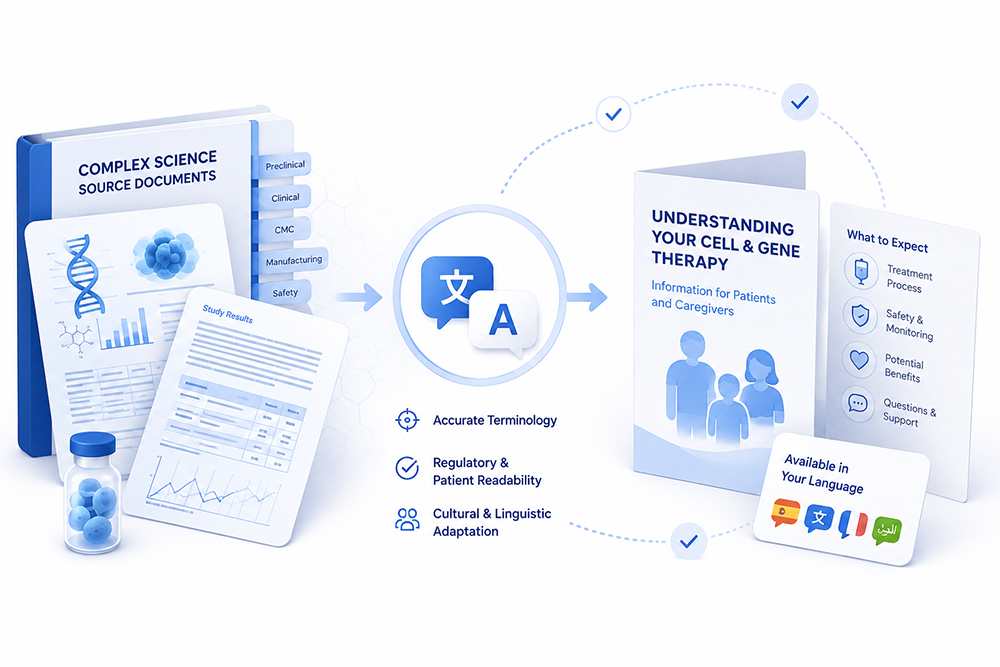
Cell and gene therapies can involve unfamiliar science, complex treatment pathways, important risks, specialized procedures, and extended follow-up. Patient-facing translations must remain faithful to approved source content while communicating clearly enough for patients and caregivers to understand.
Sesen supports informed consent, assent, patient information, recruitment, collection instructions, treatment preparation, caregiver materials, follow-up content, safety communication, eCOA/ePRO, and digital patient content.
Translation requirements continue after administration and approval. CGT programs may require specialized post-treatment monitoring, safety communication, labeling updates, and long-term follow-up documentation.
Translation memory, approved terminology, version-aware project management, and structured human review help keep new safety and follow-up content aligned with the established multilingual history of the product.
Adverse-event and SAE content, safety narratives, investigator safety communications, risk-management materials, and aggregate safety reports.
Patient follow-up materials, site communications, labeling updates, postapproval safety documentation, and lifecycle content that must remain aligned over time.
CGT is a therapeutic modality, not a single therapeutic area. Sesen connects cell and gene therapy expertise with the disease areas and advanced therapeutic platforms where these programs are being developed.
CAR-T, cellular immunotherapies, engineered immune-cell approaches, and cancer-directed gene therapies.
Gene replacement, genome editing, small patient populations, and specialized patient communities.
Emerging engineered-cell applications, immune modulation, and advanced therapy research.
Gene therapy programs for neurological and neurogenetic conditions.
Sequencing, NGS, biomarkers, molecular diagnostics, genomic data, bioinformatics, and genetic testing.
mRNA, siRNA/RNAi, antisense approaches, RNA delivery, and RNA therapeutic platforms.
Broader biologic-product development across clinical, CMC, regulatory, labeling, safety, and commercialization.
Scientific and medical communication across life sciences research, development, and global publication.
Program-Level Language Control
A CGT program may generate hundreds of related content assets over years of development. Sesen helps preserve the approved source meaning, product nomenclature, multilingual glossary, translation memory, and style guidance across the major content streams.
Product nomenclature · multilingual glossary · translation memory · style guidance
When a protocol is amended, manufacturing terminology changes, new safety information emerges, or another market is added, existing language assets can provide continuity instead of restarting the translation process from zero.
Protocols · Investigator materials · ICFs · site content
Processes · assays · specifications · SOPs · quality content
CTD/eCTD · applications · authority responses · labeling
Patient information · treatment materials · safety · follow-up
Instead of treating each document as an isolated transaction, Sesen can preserve terminology, translation memory, review feedback, and approved language assets as your CGT program evolves.
Confirm document families, languages, markets, audiences, source formats, timelines, and client-review needs.
Assign linguists and reviewers based on scientific, clinical, CMC, regulatory, safety, or patient-facing content needs.
Consolidate product nomenclature, glossaries, translation memory, abbreviations, style guidance, and reference content.
Use the appropriate human-led workflow for content sensitivity, complexity, intended use, and client requirements.
Review meaning, terminology, numbers, units, names, abbreviations, completeness, and audience appropriateness.
Support formatted documents, labeling, patient materials, digital clinical content, and presentation-sensitive assets.
Deliver agreed file formats and preserve approved terminology and translation memory for future reuse.
Support amendments, new markets, health-authority responses, manufacturing changes, labeling revisions, and safety updates.
Cell and gene therapy content can combine specialized science, regulated documentation, and patient-facing communication. Sesen’s workflow focuses on scientific meaning, terminology, numerical accuracy, audience appropriateness, and lifecycle continuity.
Sesen combines professional life sciences linguists, independent review, terminology management, translation memory, structured QA, and final human quality control within ISO-certified translation processes designed for regulated multilingual content.
Sesen supports multilingual documentation across the CGT development and product lifecycle, from early research and clinical studies through manufacturing, regulatory submissions, treatment, safety, and lifecycle updates.
Research reports · Pharmacology and toxicology · Biodistribution · Safety assessments · Assay documentation · Scientific manuscripts
Protocols · Amendments · Investigator’s Brochures · ICFs · CRFs/eCRFs · Site manuals · eCOA/ePRO · CSRs
CMC documentation · Process descriptions · Analytical methods · Potency assays · SOPs · Batch records · Technology transfer
IND/CTA support · BLA/MAA content · CTD/eCTD modules · Briefing packages · Authority correspondence · Responses
Collection instructions · Treatment-center materials · Patient information · Caregiver materials · Product information · Digital content
AE/SAE content · Safety narratives · Investigator communications · Risk-management content · Long-term follow-up · Labeling updates
It is specialized language translation for the scientific, clinical, manufacturing, regulatory, patient-facing, and safety content associated with cellular and gene-based therapeutic products. The workflow must preserve product-specific terminology across related documents and long development timelines.
Yes. Sesen supports multilingual content for CAR-T and broader engineered-cell programs, including autologous and allogeneic approaches, genetically modified cells, gene-edited cells, TCR-based therapies, and other specialized cellular platforms.
Yes. Sesen translates process descriptions, analytical methods, specifications, potency assays, validation documentation, SOPs, batch records, technology-transfer materials, quality documents, deviations, CAPA, and change controls.
Yes. Sesen provides language translation for multilingual regulatory content supporting FDA, EMA, PMDA, Health Canada, NMPA, and other health-authority programs. Sesen supports the language layer; regulatory strategy remains with the client and its advisors.
Cell and gene therapy translation focuses on therapeutic-product development and lifecycle content. Genomics and precision medicine translation focuses on sequencing, NGS, biomarkers, molecular diagnostics, bioinformatics, genomic research, and genetic testing.
Sesen uses a human-led, technology-supported approach. Translation memory, terminology tools, automation, and AI-assisted quality checks can improve consistency and scale, while qualified professionals remain responsible for contextual meaning and final linguistic quality.
Whether you are preparing an early-stage study, expanding a multinational clinical trial, developing CMC documentation, translating manufacturing procedures, responding to a health authority, preparing patient materials, or managing lifecycle updates, Sesen can build a multilingual workflow around your CGT program.