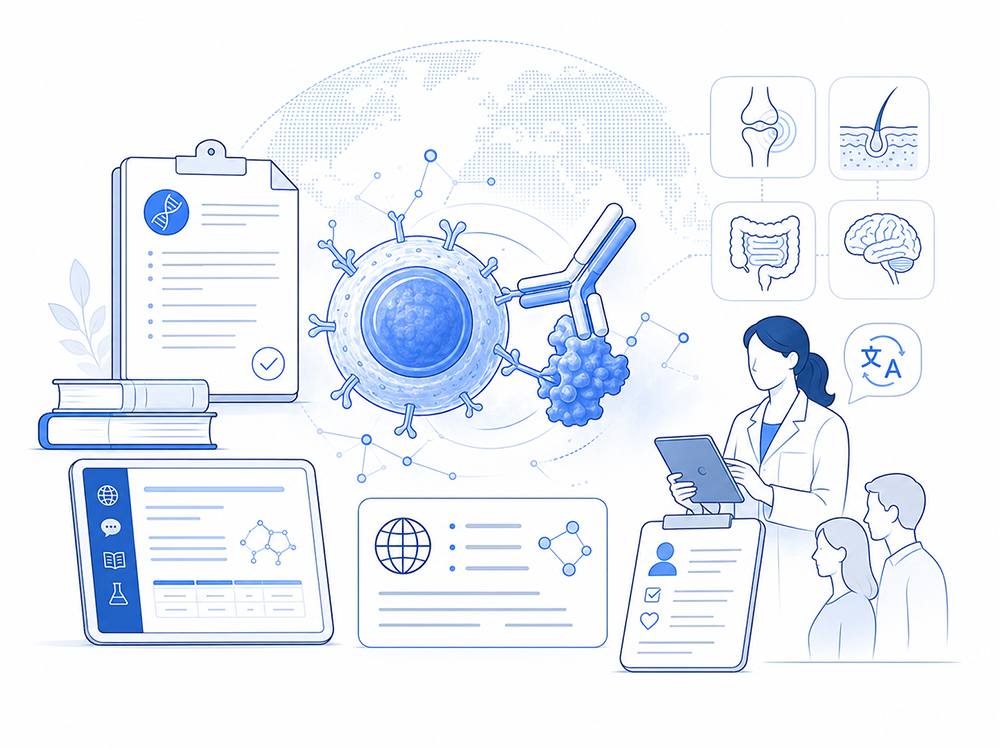
Mechanistic Precision
Preserve relationships among immune cells, targets, pathways, biomarkers, and therapeutic mechanisms.

Immunology is built on relationships. An immune cell interacts with a receptor. A signaling pathway affects a biological response. A biomarker helps characterize disease activity. A therapeutic target connects a mechanism of action to an expected clinical effect. Those relationships have to remain intact when the science moves into another language.
Preserve relationships among immune cells, targets, pathways, biomarkers, and therapeutic mechanisms.
Use terminology appropriate to the indication, study design, endpoint, intended audience, and way the content will be used.
Carry approved language across protocols, assessments, regulatory content, safety, labeling, and Medical Affairs.
Apply structured checks to doses, laboratory values, units, percentages, tables, scales, and other high-risk numerical content.
Therapeutic Area Coverage
Autoimmune and immune-mediated inflammatory diseases (IMIDs) cross conventional medical specialties, yet many programs share interconnected immune mechanisms, terminology, biomarkers, therapeutic targets, and clinical-development challenges.
A therapeutic target may move from one indication to another. A biomarker used in one study may reappear in another. A mechanism established in scientific documentation may later need to remain recognizable in protocols, clinical outcome assessments, regulatory submissions, labeling, and patient communication.
Different indications require different language. The underlying science still needs to remain connected.
Immunology terminology is rarely meaningful in isolation. Scientific understanding depends on how cells, molecules, pathways, targets, biomarkers, and clinical observations relate to one another.
The goal is not simply to find an equivalent term in another language. Translation needs to preserve how the target, pathway, biological response, and clinical effect relate to each other.
That context can appear in research reports, preclinical documentation, biomarker strategies, protocols, Investigator Brochures, regulatory dossiers, manuscripts, abstracts, posters, presentations, and patient-facing explanations.
Terminology Governance
The same receptor, cytokine, immune-cell population, biomarker, assay, endpoint, disease-activity concept, safety event, product term, or mechanism of action can appear repeatedly across the product lifecycle. Language should not drift as the evidence moves downstream.
Multi-Indication Development
Modern immunology development is increasingly organized around biological targets and therapeutic mechanisms that may extend across traditional disease boundaries.
A B-cell-directed therapy, receptor-targeting biologic, pathway inhibitor, complement-targeted treatment, or other immune-modulating approach may be studied across different autoimmune indications. Each indication can introduce its own populations, endpoints, disease-activity measures, safety considerations, investigators, regulatory pathways, and patient communication.
One mechanism. Multiple indications. One controlled multilingual knowledge base.
Immunology trials can combine complex disease biology, biomarkers, treatment schedules, eligibility criteria, immunogenicity, disease-activity assessments, patient-reported symptoms, laboratory testing, safety monitoring, and recurring protocol amendments.
COA & Linguistic Validation
Autoimmune and inflammatory diseases can affect patients in ways that laboratory values alone cannot fully describe: pain, fatigue, stiffness, mobility, physical function, itching, sleep, gastrointestinal symptoms, daily activities, treatment burden, quality of life, and disease flares.
Clinical outcome assessments may combine patient-reported, clinician-reported, observer-reported, performance-based, and electronic measures. The translated instrument needs to preserve the concept being measured, not simply the words on the screen.
Regulatory Lifecycle
By the time an immunology product enters regulatory review, its scientific language has already developed across research, clinical studies, manufacturing documentation, safety reporting, and product strategy. Regulatory translation should preserve those relationships.
Studies, reports, endpoints, safety and scientific conclusions
CTD/eCTD content, summaries and supporting documentation
Requests for information, sponsor responses and supporting analyses
Product information, SmPCs, PILs and market-specific labeling
Variations, new evidence, safety revisions and indication changes
Translation and review workflows are adapted to the authority, jurisdiction, document type, submission requirements, sponsor procedures, and approved references rather than assuming one universal regulatory pathway.
The therapeutic landscape for autoimmune and immune-mediated disease continues to move toward increasingly selective ways of modifying, suppressing, redirecting, or potentially rebalancing the immune response. Global language programs need to evolve with the science.
Mechanism-appropriate clinical language
Product, pathway and immunogenicity terminology
Target interaction, safety and response language
New terminology across science, manufacturing, clinical and patient content
Multilingual content involving monoclonal antibodies, cytokine- and receptor-targeted therapies, B-cell-directed therapies, FcRn approaches, complement-targeted therapies, and other pathway-specific biologics.
Specialized terminology spanning antibody engineering, target-cell biology, immune-cell engagement, safety monitoring, and clinical response, including investigational T-cell-engaging approaches being explored in autoimmune disease.
Language support for investigational CAR-T, CAAR-T, regulatory T-cell, other engineered immune-cell, autologous, allogeneic, and next-generation in-vivo approaches, including programs exploring deep immune-cell depletion and immune reset.
Preclinical and emerging programs involving antigen-specific tolerance, autoantigen delivery, mRNA/LNP platforms, in-vivo immune-cell programming, regulatory pathways, and precision immunoengineering.
Scientific precision includes development status. Emerging modalities should be communicated accurately without implying that investigational approaches are established standard autoimmune care.
A patient should not need to speak the language of an immunologist to understand what participation in a study involves. Yet the underlying science cannot simply disappear from the translation.
Scientific accuracy and patient comprehension should work together across informed consent, patient education, recruitment, digital communication, treatment instructions, and plain-language trial results.
Safety terminology can evolve from first-in-human studies through post-approval use, moving across clinical reports, safety systems, investigator communication, aggregate reports, regulatory submissions, risk-management content, and labeling.
Medical Affairs
Regulatory approval is not the end of scientific communication. Medical Affairs teams need to explain mechanisms, clinical evidence, disease state, safety, outcomes, and evolving data to healthcare professionals, experts, affiliates, field teams, and other scientific stakeholders around the world.
Manuscripts, abstracts, posters, publication summaries, and evidence materials.
Scientific presentations, speaker materials, handouts, and congress communication.
Training, scientific slide decks, field tools, discussion guides, and approved resources.
Briefing materials, discussion guides, expert communication, summaries, and follow-up documentation.
Standard response documents, scientific response content, product inquiries, and regional communication.
Outcomes research, real-world evidence, value communication, and observational-study content.
Program Change Control
Autoimmune and inflammatory drug-development programs can evolve over many years. Protocols are amended. New cohorts and indications are added. Safety information changes. Investigator Brochures are revised. Authorities ask new questions. Labeling evolves. Additional markets and languages are introduced.
Identify content that has been added, removed, or modified.
Preserve approved translations when the source has not changed.
Focus linguistic effort on new or revised content instead of unnecessarily retranslating the full document.
Maintain product, mechanism, endpoint, safety, and study terminology across versions.
Check whether source changes affect surrounding language, cross-references, formatting, or downstream content.
Capture approved terminology and reviewer decisions for future documents, studies, indications, and markets.
Quality Workflow
A scientific manuscript, an informed consent form, a regulatory response, an eCOA instrument, and a training presentation do not carry identical language risks.
Sesen adapts the multilingual workflow to the content, intended audience, regulatory context, languages, timeline, and quality requirements.
Understand the indication, development stage, audience, content type, languages, references, timeline, and intended use.
Align professional native linguists and reviewers with the relevant medical, scientific, clinical, regulatory, or patient-facing content.
Apply approved terminology, product language, glossaries, translation memory, previous translations, protocols, and client instructions.
Translate within the correct scientific, clinical, regulatory, safety, or patient context.
Review meaning, terminology, completeness, consistency, language quality, and audience appropriateness according to the project workflow.
Check terminology, numbers, units, omissions, repeated content, formatting, tags, and other detectable risks.
Review formatted documents, eCOA screens, digital content, patient materials, or other content where presentation affects quality.
Coordinate feedback and capture approved terminology and language decisions for appropriate reuse.
Complete final checks before the multilingual content is released.
Language technology can make global immunology programs more consistent and scalable. It should not replace the scientific judgment needed to understand what the content means.
Technology can support terminology matching, translation-memory reuse, repeated-content identification, version comparison, numerical checks, consistency analysis, completeness checks, and workflow automation.
Professional linguists and reviewers remain responsible for scientific context, medical meaning, ambiguous terminology, mechanism-of-action language, clinical interpretation, regulatory context, patient readability, cultural appropriateness, reviewer decisions, and final linguistic quality.
Multilingual support from clinical development and regulatory submission through labeling, safety, Medical Affairs, market access, and commercialization.
Translation for innovative immunology platforms, emerging modalities, multi-indication development, and rapidly evolving scientific content.
Scalable study-startup, patient, eCOA, linguistic-validation, amendment, safety, and clinical-operations support.
Specialized translation for biomarker programs, scientific research, clinical documentation, publications, and international collaboration.
Controlled multilingual workflows for submissions, authority communication, labeling, pharmacovigilance, and lifecycle updates.
Consistent scientific communication across publications, congresses, field medical, expert engagement, medical information, and global affiliates.
Immunology programs cross traditional content boundaries. Sesen's specialized life sciences services connect the clinical, regulatory, scientific, safety, patient, and digital content generated throughout development.
Global study documents, patient-facing content, site operations, amendments, safety, digital trials, and reporting.
COA, eCOA, ePRO, questionnaires, symptom scales, cognitive debriefing, and multilingual validation workflows.
Regulated dossiers, submissions, health authority communication, labeling, and lifecycle updates.
Case content, safety narratives, aggregate reporting, risk communication, and drug-safety operations.
Publications, congresses, MSL programs, medical information, HEOR/RWE, and global evidence exchange.
Scientific, clinical, CMC, regulatory, labeling, and lifecycle support for complex biological products.
Language support for engineered cell therapies, genetic technologies, advanced clinical programs, and patient communication.
Language support for RNA science, delivery systems, emerging immune-tolerance research, clinical development, and regulated communication.
Global Program Control
Global immunology development can involve multiple countries, regional language variants, clinical sites, ethics committees, health authorities, investigators, patient populations, affiliates, and reviewers, all working from source content that continues to change.
The challenge is not only translation volume. It is keeping scientific meaning, approved terminology, reviewer decisions, and current versions aligned across the program.
Why Sesen
Scientific breakthroughs depend on specialized knowledge. Global communication requires a language infrastructure capable of preserving that knowledge as it moves between people, documents, systems, countries, and development stages.
Answers to common questions about therapeutic-area expertise, clinical content, linguistic validation, regulatory support, terminology governance, multi-indication development, and language technology.
Immunology and autoimmune disease translation services provide specialized multilingual support for scientific, clinical, regulatory, safety, patient-facing, and Medical Affairs content related to the immune system, autoimmune disorders, inflammatory diseases, and immune-modulating therapies. These projects often require controlled terminology for immune cells, antibodies, cytokines, receptors, biomarkers, pathways, disease-activity measures, mechanisms of action, clinical endpoints, and therapeutic response.
Sesen can support translation programs across rheumatology, dermatology, gastroenterology, neuroimmunology, endocrinology, respiratory and allergic disease, and other immune-mediated therapeutic areas. Representative conditions include rheumatoid arthritis, systemic lupus erythematosus, Sjögren's disease, systemic sclerosis, inflammatory myopathies, psoriasis, psoriatic arthritis, atopic dermatitis, Crohn's disease, ulcerative colitis, multiple sclerosis, myasthenia gravis, type 1 diabetes, and other autoimmune or inflammatory diseases.
Sesen supports protocols, protocol amendments, Investigator Brochures, informed consent forms, assent forms, clinical study documents, CRFs/eCRFs, site manuals, laboratory and pharmacy manuals, ethics committee materials, patient recruitment content, patient diaries, questionnaires, eCOA/ePRO content, safety communication, Clinical Study Reports, trial result summaries, and other clinical research materials.
Sesen can develop and maintain program-specific glossaries, translation memories, approved terminology, product language, acronyms, reference content, do-not-translate instructions, and reviewer decisions. These assets help keep language aligned as scientific concepts move from research and clinical development into regulatory submissions, safety documentation, labeling, Medical Affairs, and patient communication.
Yes. Multi-indication programs benefit from centralized terminology and translation-memory management. Approved language relating to the mechanism, therapeutic target, product, administration, safety, and other shared concepts can be reused where appropriate, while indication-specific endpoints, assessments, disease terminology, and patient communication are managed separately.
Yes. Sesen provides translation and linguistic validation support for PRO, ePRO, eCOA, ClinRO, ObsRO, PerfO, symptom scales, quality-of-life measures, patient diaries, and other clinical outcome assessments. Depending on project requirements, workflows may include forward translation, reconciliation, back translation, harmonization, cognitive debriefing, screenshot review, in-context review, and validation documentation.
Yes. Sesen supports multilingual regulatory content including submission documents, CTD/eCTD content, clinical and scientific summaries, health authority correspondence, requests for information, sponsor responses, labeling, product information, and lifecycle updates. The specific workflow is adapted to the target market, authority, document type, sponsor procedures, and project requirements.
Yes. Sesen supports scientific, clinical, regulatory, patient, and other life sciences content related to biologics, targeted small molecules, advanced antibody technologies, engineered cell therapies, gene-based technologies, and emerging RNA-enabled approaches. For experimental modalities, translations should preserve both the scientific meaning and the distinction between established treatment and investigational development.
Patient-facing translation requires both accuracy and readability. Sesen's professional life sciences linguists preserve clinically important meaning while adapting sentence structure, terminology, and communication for the intended audience. Work may include informed consent forms, recruitment materials, education, visit instructions, eConsent, patient applications, treatment information, questionnaires, and plain-language study results.
Sesen can compare source versions, identify changed content, preserve approved translations for unchanged text, translate required updates, carry controlled terminology forward, and apply linguistic and quality review to the revised version. Translation memory and terminology management help manage amendments as controlled multilingual updates rather than repeatedly starting from the beginning.
Sesen uses language technology and AI-assisted tools where they can support translation-memory reuse, terminology consistency, quality checks, version comparison, workflow efficiency, and other appropriate tasks. Professional linguists remain responsible for scientific meaning, contextual judgment, patient readability, terminology decisions, and final linguistic quality. Workflows can be adapted to client requirements regarding AI and translation technology.
Whether you are translating one critical clinical document, launching a multinational autoimmune study, preparing a global regulatory submission, expanding a therapeutic platform into additional indications, or developing the next generation of immune-modulating therapies, the language surrounding the science needs to remain accurate and connected.
Tell us about your indication, content, languages, development stage, and timeline.