
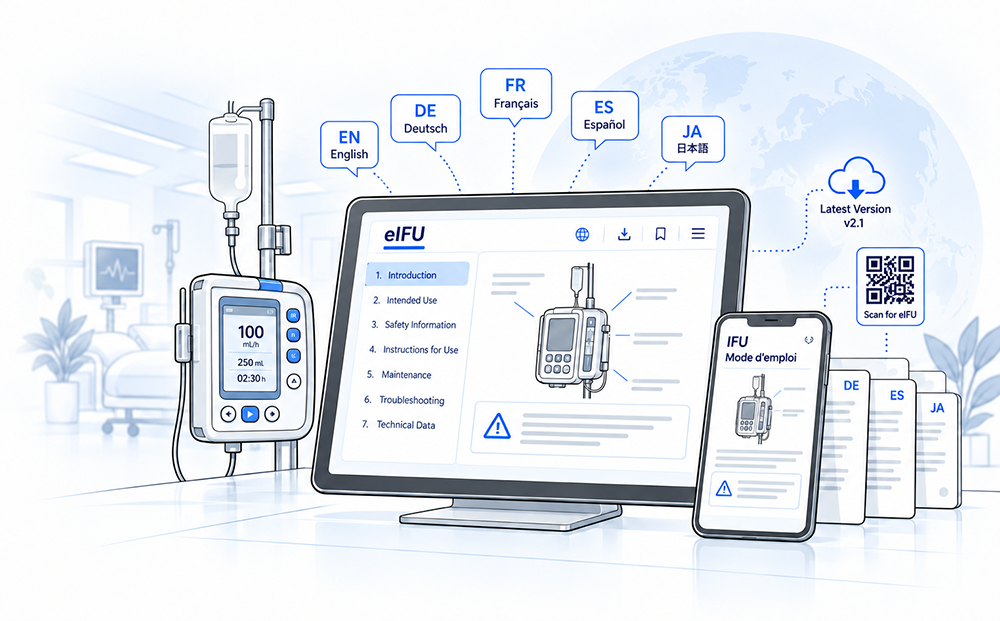
Medical Device ExpertiseSpecialized regulated-content workflows
ISO-Certified QualityISO 17100 · ISO 9001 · ISO 13485
Structured ContentXML · XLIFF · DITA · CMS workflows
Digital QAValidate language in electronic context
150+ LanguagesScalable global device programs
From Instructions for Use to Digital Information Delivery
Electronic Instructions for Use change more than the delivery format.
A conventional print-oriented IFU workflow may end with an approved printed document or final PDF. An eIFU adds an ongoing electronic delivery environment in which users need to reach the right instructions, in the right language, for the right product and version.
A downloadable PDF can itself form part of an eIFU program; the distinction is not the file extension. Electronic delivery adds requirements around access, content structure, navigation, links, version integrity, digital rendering, recurring updates, and consistency with related device information.
Traditional IFU
Approved Source
Translation
Professional Review
Layout
Final PDF / Print
Release
eIFU Lifecycle
Controlled Source
Translation
Structured / Digital Production
Electronic-Context QA
Publication-Ready Delivery
Version Management
Recurring Updates
Sesen brings these stages together in a controlled multilingual workflow designed for modern medical device content.
Explore IFU Translation Services for print, PDF, and broader IFU workflowsWhy Multilingual eIFUs Require More Than Translation
An eIFU can contain the same safety-critical instructions as a printed IFU, but electronic delivery introduces additional relationships that must remain controlled across languages, formats, and releases.
Content Integrity
Warnings, precautions, contraindications, procedures, measurements, device terminology, software references, and operating instructions need to preserve their intended meaning across every target language.
Digital Usability
Correct translation alone is not enough if localized navigation, hyperlinks, cross-references, tables, figures, downloads, or language-selection pathways do not function correctly in the digital environment.
Version Integrity
As products evolve, multilingual eIFUs need to remain aligned with the appropriate source revision, product configuration, and market release.
Connected Product Content
The same device term, warning, UI label, component name, or instruction may appear in the eIFU, device software, packaging, labels, training, quick-start guides, and technical documentation. Sesen helps maintain terminology continuity across these connected touchpoints.
Lifecycle Continuity
Previously approved translations, terminology, translation memory, reviewer decisions, and reusable content can be carried forward as new product versions are released, helping reduce unnecessary retranslation and review.
One device. Multiple languages. Multiple formats. Multiple releases. One controlled content system.
Multilingual Support Across the eIFU Lifecycle
Sesen supports electronic Instructions for Use from source preparation through recurring multilingual updates.
eIFU Translation
Translate medical, technical, safety, instructional, and user-facing content with linguists selected according to the device, subject matter, intended audience, and language requirements.
Independent Linguistic Review
Review translated content for accuracy, terminology, completeness, readability, consistency, and alignment with approved source information and reference materials.
Structured Content Localization
Localize reusable and structured content while preserving the elements that support downstream publishing, content reuse, and digital delivery.
Digital Production
Prepare multilingual content for electronic PDFs, websites, structured publishing systems, content management environments, software-delivered instructions, and other manufacturer-defined eIFU channels.
In-Context eIFU QA
Review translated content in the final or representative digital environment to identify linguistic, functional, formatting, or presentation issues that may not be visible during translation.
Version & Release Management
Reuse approved language across revisions, isolate changed content, coordinate reviewers and formats, and keep multilingual deliverables aligned with the intended release.
From Approved IFU to Multilingual eIFU
Sesen builds the localization workflow around your approved content, digital environment, languages, product terminology, quality requirements, and release process.
01
Source & Environment Assessment
Review the source IFU, target languages, existing translations, terminology resources, translation memories, previous versions, reference materials, source format, and intended electronic delivery environment.
02
Terminology Preparation
Identify and align product names, components, functions, procedures, warnings, safety terminology, UI references, technical terms, and recurring approved language.
03
Specialized Medical Device Translation
Translate new and changed content with professional linguists selected for the language pair and relevant medical-device subject matter.
04
Independent Professional Review
Review meaning, accuracy, terminology, completeness, consistency, readability, and appropriate communication for the intended users.
05
Structured & Digital Production
Prepare localized content for its intended electronic environment while preserving relevant tags, structure, hyperlinks, metadata, reusable components, and formatting relationships.
06
Electronic In-Context QA
Validate the localized content in its final or representative delivery format to identify missing content, incorrect placement, broken references, rendering issues, and other presentation problems.
07
Version & Release Validation
Confirm language and version alignment, translated-content completeness, terminology consistency, final corrections, and other agreed release checks.
08
Ongoing Lifecycle Management
Preserve approved translations, terminology, translation memories, reviewer feedback, and release history for future updates, new markets, and additional product configurations.
For recurring programs, approved language assets and product knowledge can support greater continuity with every subsequent release.
Localize eIFUs Across Digital and Structured Formats
Electronic Instructions for Use can be delivered through many different content architectures. Sesen adapts the localization workflow to the source environment and intended publishing process rather than forcing every eIFU into the same production model.
Electronic PDF
Translate and produce multilingual downloadable or interactive PDFs while maintaining document hierarchy, tables, graphics, hyperlinks, bookmarks, and other required elements.
HTML & Web-Based eIFUs
Localize web-delivered Instructions for Use while supporting language-specific content, navigation, links, text expansion, and in-context validation.
XML & Structured Content
Translate structured source content while preserving elements, attributes, tags, content relationships, and other non-translatable structure required by downstream systems.
DITA & Component-Based Documentation
Support reusable topic- and component-based documentation designed for multi-channel publishing and recurring product updates.
XLIFF & Localization Packages
Work with translation-ready interchange formats that connect content-management and localization environments.
CMS-Managed Content
Integrate translation workflows with manufacturer-managed content systems and structured publishing environments according to the agreed technical process.
Device & Software-Delivered Instructions
Support multilingual instructions presented through compatible device or software environments where electronic delivery forms part of the product experience.
QR-Linked eIFU Content
Localize content accessed through manufacturer-defined QR or digital access pathways while helping validate the appropriate multilingual content in the intended user context.
Electronic IFUs Under the EU MDR Framework
EU rules for electronic Instructions for Use expanded in 2025 for a broader range of professional-use medical devices.
Commission Implementing Regulation (EU) 2025/1234 amended Implementing Regulation (EU) 2021/2226, extending the framework to medical devices and accessories covered by the MDR that are intended for professional users, subject to the applicable requirements.
Professional-Use Devices
For devices intended for professional users, electronic Instructions for Use may replace paper instructions where the applicable requirements are met.
Foreseeable Lay Use
Where it is reasonably foreseeable that a device intended for professional use may also be used by lay persons, instructions intended for those lay users must be supplied in paper form.
Access & Version ManagementThe framework addresses electronic availability, revision management, website requirements, paper-copy access, and long-term version availability.
Digital Access & UDIThe 2025 amendment provides for the eIFU internet address to be supplied to the EUDAMED UDI database when the applicable device-registration requirement becomes mandatory.
Multilingual ControlLanguage availability, version integrity, structured publishing, and digital QA become important parts of the eIFU lifecycle.
Sesen supports the multilingual content, localization, terminology, structured production, version management, and linguistic QA components of electronic IFU programs. Device-specific regulatory applicability and compliance determinations remain with the manufacturer and its regulatory advisors.
Explore EU MDR IFU Translation ServicesVersion Continuity
Keep Every Language Aligned With Every Release
For many medical device teams, the most difficult eIFU project is not the first release. It is every release that follows.
Product information can change because of software updates, new device configurations, safety revisions, design changes, market expansion, regulatory updates, usability findings, or revised operating procedures. Retranslating entire Instructions for Use every time can increase cost, review workload, and unnecessary linguistic variation.
Version 4.1 SourceApproved source content enters the controlled update workflow.
Source Change DetectionIdentify added, changed, or removed content.
Approved Translation ReusePreserve previously reviewed multilingual content where appropriate.
Translate, Review & ValidateFocus linguistic work on new or modified material and run multilingual QA.
Version 4.1 ReleaseDeliver synchronized language versions for the agreed publishing workflow.
Sesen uses controlled multilingual assets and version-aware workflows to help focus translation effort where content has actually changed. This approach helps organizations maintain continuity between releases while reducing repetitive work for translators, reviewers, and client review teams.
Build a Reusable Multilingual Content Foundation
A scalable eIFU program depends on controlled linguistic assets that preserve approved language and product knowledge across future versions.
Translation Memory
Previously translated segments can be stored and reused when corresponding source content remains unchanged or sufficiently similar, preserving approved wording while focusing review on new or modified content.
Terminology Management
Product-specific terminology can cover device names, components, functions, procedures, warnings, software references, measurements, and other recurring concepts across connected content.
Version Comparison
Source comparison can help identify what changed between releases so translation and review teams can distinguish reusable content from material requiring new linguistic work.
Reviewer Decisions
Approved reviewer feedback can be carried into future releases so established terminology and language decisions do not need to be rediscovered with every update.
Human-Controlled Technology
Use AI Where It Strengthens Multilingual Quality
Sesen combines professional life sciences expertise with AI-assisted technology to improve efficiency, consistency, and quality control across complex multilingual programs.
Terminology Analysis
Identify recurring technical, medical, product, and safety terminology and help surface inconsistent usage across files or versions.
Source & Version Comparison
Help isolate additions, deletions, and modifications between source revisions so teams can focus on changed content.
Translation Memory Leverage
Match new source content against previously translated and approved material to maximize appropriate reuse.
Consistency QA
Surface inconsistent translations of recurring terms, warnings, device components, or repeated content.
Numeric & Structural Checks
Help identify potential discrepancies involving numbers, units, dates, tags, missing content, or structural elements.
Cross-Content Analysis
Compare related multilingual content across eIFUs, labels, software, packaging, and previous versions to identify inconsistencies that deserve review.
Professional Human Validation
Technology supports the process; it does not replace the professional linguistic expertise and human review required for high-quality regulated medical device content. Sesen configures AI and automation according to the content, risk, client requirements, confidentiality considerations, and agreed quality workflow.
Validate the eIFU Where Users Actually Access It
A translation can be correct in a bilingual editor and still contain problems after it enters a website, PDF, content-management system, or other electronic environment.
Sesen's in-context eIFU QA extends quality control into the user-facing format.
Language Navigation
Verify that language selection and language-specific content behave as intended within the defined electronic environment.
Version Integrity
Help confirm that the displayed language corresponds to the intended source and product release.
Links & Cross-References
Check localized hyperlinks, anchors, referenced sections, navigation elements, and supporting resources according to the agreed QA scope.
Content Completeness
Identify missing, duplicated, displaced, or untranslated content that may have been introduced during production.
Rendering & Layout
Review text expansion, clipping, wrapping, tables, headings, graphics, symbols, and other formatting elements in the localized output.
Complex Scripts & RTL
Check directionality, character rendering, layout behavior, and presentation for languages whose typographic requirements differ from the source.
Numbers, Units & Measurements
Validate numeric information, units, dates, measurements, and related content against the approved source and localized context.
Downloads & Linked Documents
Help verify that language-specific downloads or linked materials correspond to the intended language and version when included in the agreed testing scope.
QR-Linked Access Paths
Where QR codes form part of the manufacturer's defined access route, linguistic QA can include validation of the multilingual content reached through that pathway.
Translate the content. Validate the experience.
Explore Label Review & In-Context QA
Moving From Printed IFUs to Electronic Delivery?
Transitioning from paper instructions to eIFUs does not mean discarding years of approved multilingual content.
Existing IFUs may already contain valuable terminology, translation memory, reviewer decisions, approved warnings, product language, and previously validated translations.
Sesen can help organizations turn those assets into a more structured multilingual foundation for electronic delivery, whether the objective is to migrate a single product family or modernize a larger documentation portfolio.
01Existing IFUs & Multilingual Assets
02Content & Translation Audit
03Terminology & Translation Memory Consolidation
04Structured Content Preparation
05eIFU Translation & Localization
06Digital In-Context QA
07Controlled Multilingual Updates
Connected Product Content
One Device Vocabulary Across Every User Touchpoint
Electronic Instructions for Use do not exist in isolation.
The same product terminology can move across device labels, software interfaces, packaging, user guidance, technical documentation, training, service content, and future product updates. If these assets are translated independently, terminology can drift even when each individual translation appears reasonable.
Sesen approaches medical-device localization as a connected multilingual content system.
Approved Device Terminology
Shared With the eIFU
Medical Device Labeling
Device Software & SaMD
Packaging
Quick-Start & User Guides
Training & Support
Technical Documentation
eIFU Localization for Complex Medical Technologies
Sesen supports electronic Instructions for Use across a broad range of medical-device technologies and professional-use environments.
Diagnostic & Monitoring Systems
Patient monitoring, diagnostic imaging, testing platforms, ophthalmic systems, and related clinical technologies.
Laboratory & IVD Technologies
Laboratory instruments, diagnostic systems, testing workflows, reagents, software, operating procedures, and associated product information.
Surgical & Procedural Devices
Surgical technologies, procedural systems, instruments, equipment, and related software.
Therapeutic Devices
Devices used to deliver, support, or monitor treatment across clinical environments.
Implantable & Orthopedic Technologies
Complex instructions involving product configurations, procedures, components, warnings, and specialized professional terminology.
Connected Medical Devices
Devices that interact with software, networks, digital platforms, clinician applications, or connected workflows.
Medical Device Software & SaMD
Instructions associated with software-driven devices, standalone medical software, and digital clinical workflows.
Complex Product Families
Terminology and version-management support across multiple models, configurations, languages, and recurring release cycles.
Global Program Control
Scale Electronic Instructions Across Languages and Markets
Global eIFU programs can involve dozens of languages, recurring revisions, multiple product configurations, structured files, local reviewers, and synchronized market releases.
Sesen provides centralized multilingual program management across 150+ languages to help life sciences organizations reduce fragmentation across these workflows.
One multilingual knowledge base that can become stronger with every release.
150+ LanguagesScalable support for established and emerging medical-device markets.
Centralized Program ManagementCoordinate source content, language assignments, schedules, reviewers, files, and corrections.
Terminology GovernanceKeep approved product language connected across languages and release cycles.
Recurring Release SupportMaintain translation memory, production knowledge, review history, and update continuity over time.
Quality Infrastructure Built for Life Sciences
Electronic IFU localization combines technical documentation, medical-device terminology, digital content, and recurring quality control. Sesen supports these requirements through an ISO-certified quality infrastructure designed for professional translation and life sciences content.
ISO 17100
Translation Services
Certified translation-services processes supporting professional translation and linguistic review.
ISO 9001:2015
Quality Management
Quality-management systems supporting structured and repeatable operational processes.
ISO 13485:2016
Medical Device Quality
Medical-device quality-management infrastructure supporting Sesen's work with regulated device organizations.
EXPERTISE
Specialized Medical Device Linguists
Professional linguists selected according to language pair, content type, device subject matter, audience, and project requirements.
CONTROL
Controlled Multilingual Workflows
Terminology, translation memory, reference content, version history, reviewer feedback, QA, and project records support continuity across recurring programs.
SECURITY
Secure Content Handling
Controlled access and secure workflows support the handling of confidential medical-device documents, references, and multilingual project materials.
eIFU Translation Services FAQ
Answers to common questions about electronic Instructions for Use, digital formats, EU eIFU requirements, multilingual updates, structured content, and Sesen's localization role.
An eIFU is an Instruction for Use provided in electronic form rather than, or in some circumstances in addition to, a traditional paper document. Depending on the device and delivery model, electronic instructions may be accessed through a website, software, electronic document, device interface, or other permitted electronic environment.
For multilingual products, an eIFU program also requires control over language versions, terminology, digital presentation, updates, and the relationship between translated content and the approved source.
An IFU contains the instructions and information users need to understand and use a medical device appropriately. An eIFU provides those instructions electronically.
From a localization perspective, the linguistic requirements remain rigorous, but eIFUs introduce additional considerations such as digital formats, navigation, structured content, electronic rendering, links, language access, version management, and recurring online updates. Sesen provides dedicated IFU Translation Services for the broader translation workflow and specialized eIFU support for electronic and structured delivery environments.
Yes. Sesen translates and localizes electronic Instructions for Use for medical-device and diagnostic organizations across 150+ languages. Services can include source assessment, terminology preparation, professional translation, independent review, structured-content localization, digital production, in-context QA, version management, and recurring multilingual updates.
Sesen can support electronic PDF, HTML and web content, XML, XLIFF, DITA, structured content, CMS-managed source content, and other agreed localization formats. The workflow is configured according to the source architecture, target publishing environment, language requirements, and client process.
Under the current EU framework, manufacturers may provide Instructions for Use electronically instead of on paper for devices covered by the MDR and intended for professional users, subject to the applicable requirements.
Where it is reasonably foreseeable that a professional-use device may also be used by lay persons, instructions intended for those lay users must be supplied in paper form. Manufacturers remain responsible for determining the applicable regulatory requirements for their specific device and use scenario.
Commission Implementing Regulation (EU) 2025/1234, adopted in June 2025, expanded the scope of the EU eIFU framework beyond the narrower categories previously covered by Implementing Regulation (EU) 2021/2226.
The amended framework permits electronic rather than paper Instructions for Use for MDR devices intended for professional users, subject to the applicable conditions. It also addresses foreseeable lay use and introduces a future requirement to provide the eIFU internet address to the EUDAMED UDI database when the relevant registration requirement becomes applicable.
Sesen can compare revised source content with previous versions and use translation memory, approved terminology, prior translations, and reviewer history to identify reusable content. New or changed content can then be translated and reviewed while unchanged approved language is preserved where appropriate.
This helps maintain continuity while reducing unnecessary retranslation and repeated review across recurring releases.
Yes. Sesen can help evaluate existing multilingual IFUs, translation memories, terminology resources, previous versions, and approved content and prepare these assets for a more structured localization workflow. Support can extend through structured-content localization, digital production, multilingual QA, and ongoing updates within the manufacturer's selected eIFU publishing environment.
Sesen uses product terminology, client-approved glossaries, translation memory, prior translations, reference materials, reviewer feedback, and structured QA to help maintain terminology and meaning across related medical-device content. The same resources can support eIFUs, labels, packaging, software UI, technical documentation, training, and subsequent product releases.
Sesen uses AI-assisted technology where it can add measurable value within a controlled multilingual workflow. Applications may include terminology analysis, translation-memory leverage, source-version comparison, consistency checking, numeric and structural QA, and translation assistance where appropriate and approved.
Professional linguists remain responsible for the human linguistic review defined by the project workflow. AI supports quality and efficiency rather than replacing professional expertise.
Sesen's core role is multilingual eIFU content: translation, localization, structured production, terminology management, linguistic QA, version control, and recurring update support.
We can work with the manufacturer's selected CMS, publishing workflow, website, software environment, or eIFU platform according to the agreed technical process. Regulatory hosting and platform requirements remain the responsibility of the manufacturer and its designated technology and regulatory teams.
Build a Smarter Multilingual eIFU Workflow
Whether you are preparing electronic Instructions for Use for a new device, migrating from paper documentation, expanding into new markets, converting content to structured formats, or managing recurring multilingual updates across a global product portfolio, Sesen can build the localization workflow around your content, languages, formats, reviewers, technology, and release requirements.
Keep every language connected to the product, the approved terminology, and the right release.
Medical Device Expertise · Structured Content · Professional Review · Digital QA · Version Continuity · AI-Assisted Quality · 150+ Languages