Clinical Precision
Preserve ophthalmic anatomy, procedures, diagnostics, measurements, indications, warnings, and clinical meaning across languages.

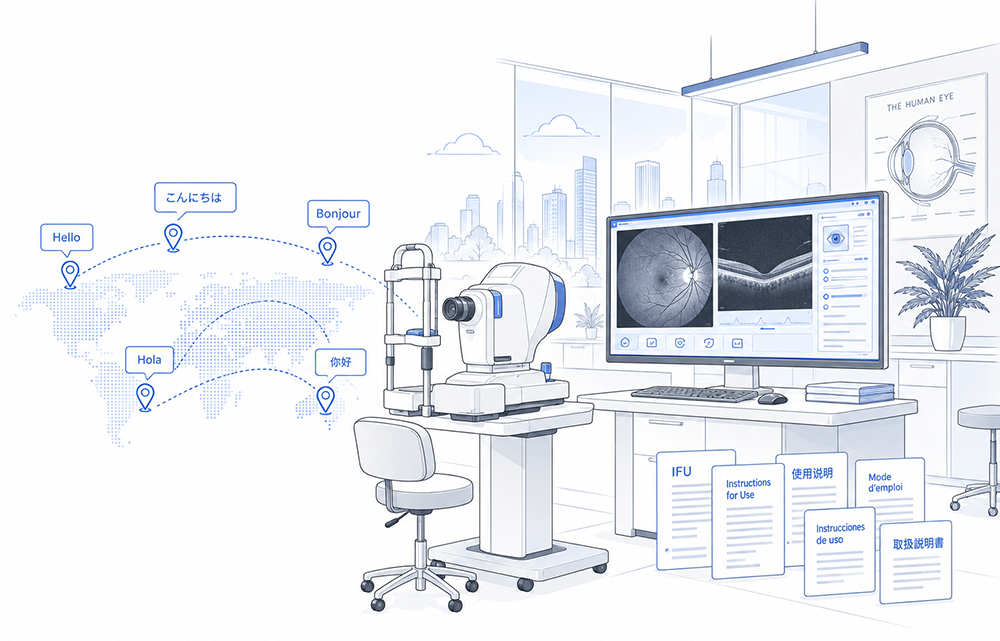
CONNECTED PRODUCT CONTENT
Modern ophthalmic products can combine optics, imaging, precision engineering, software, surgical workflows, clinical measurements, patient instructions, and recurring product updates. The language connecting those components needs to remain precise and consistent.
One ophthalmic device program can create hundreds of connected language decisions.
Preserve ophthalmic anatomy, procedures, diagnostics, measurements, indications, warnings, and clinical meaning across languages.
Support optical systems, lasers, imaging technologies, hardware components, embedded software, and device accessories.
Manage IFUs, labels, technical documentation, safety information, software, and regulatory materials through controlled workflows.
Maintain approved language across documents, interfaces, markets, product generations, and software releases.
Ophthalmic medical technology spans examination instruments, imaging platforms, surgical systems, implantable lenses, connected software, and increasingly AI-enabled diagnostic workflows. FDA organizes ophthalmic devices within its Ophthalmic medical-device specialty under 21 CFR Part 886, reflecting the breadth of technologies in this category. Sesen supports the language layer surrounding these products across regulated, technical, clinical, and user-facing content.
Translate the content surrounding technologies used to visualize, measure, document, and assess structures and functions of the eye.
Support multilingual content for technologies used in cataract treatment, lens replacement, and vision correction.
Translate technical and procedural content for systems used by ophthalmic surgeons and operating-room teams.
Support multilingual documentation and interfaces for laser-based ophthalmic treatment and refractive systems.
Support diagnosis, monitoring, treatment, and management content across retinal and glaucoma product environments.
Support multilingual product information for vision-correction and specialty lens technologies.
Localize software-driven ophthalmic experiences while keeping clinical terminology connected to the physical device and its documentation.
Support clear, usable multilingual communication as ophthalmic technology extends into home and remote-care settings.
REGULATED CONTENT
Ophthalmic device information moves through many formats before and after a product reaches the market. Sesen connects these content streams through shared terminology, translation memory, reviewer knowledge, structured QA, and version-aware workflows.
Translate instructions that help surgeons, clinicians, technicians, patients, and other intended users understand how an ophthalmic product should be operated, handled, maintained, or used.
Keep product information aligned across tightly constrained multilingual layouts and controlled artwork.
Support multilingual content used to describe, evaluate, document, register, and maintain ophthalmic technologies.
Localize ophthalmic software in the context in which clinicians, technicians, or patients actually use it.
Support content that connects product performance with clinical use, safety, usability, and evidence.
Extend approved ophthalmic terminology into the materials that support real-world use and recurring product operations.
TERMINOLOGY GOVERNANCE
Ophthalmic terminology crosses anatomy, optics, imaging, engineering, software, diagnostics, and surgery. The challenge is not choosing an accurate term once. It is preserving the right term everywhere it matters.
Examples of recurring terminology: anterior chamber · corneal thickness · diopter · intraocular pressure · macula · optic disc · retinal layer · toric axis · visual field
Maintain approved ophthalmic, device, software, measurement, and proprietary terminology across languages.
Reuse reviewed language across versions, product families, and recurring content where appropriate.
Preserve approved decisions from client teams, medical reviewers, engineers, and in-country reviewers.
Surface terminology, number, warning, and recurring-content differences across documents and systems.
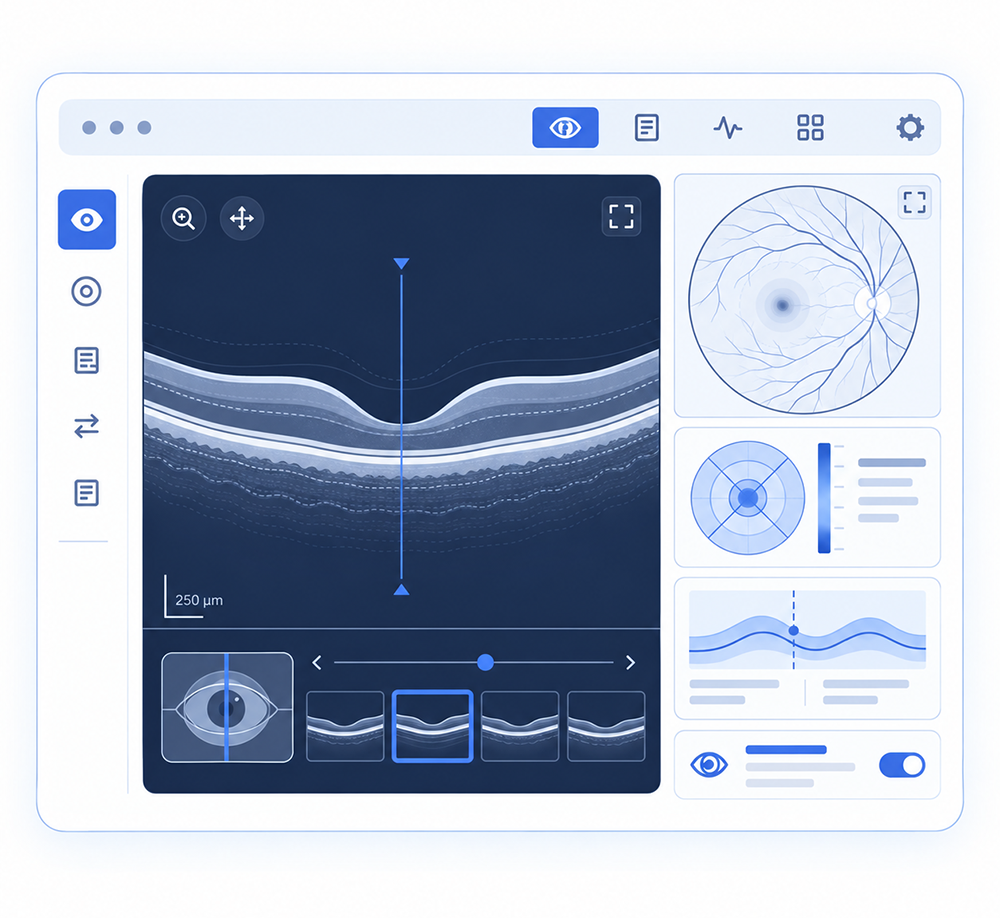
DIGITAL OPHTHALMOLOGY
Ophthalmic imaging and diagnostic systems increasingly depend on software to acquire images, control device functions, display measurements, analyze clinical information, and communicate results.
The same ophthalmic technology can generate content for a surgeon, an imaging technician, a service engineer, and a patient. Translation needs to preserve the underlying meaning while communicating appropriately to the person who must act on it.
Clinical terminology, procedures, measurements, treatment parameters, warnings, workflows, and professional training.
Device setup, patient positioning, image acquisition, calibration, operating instructions, and troubleshooting.
Installation, maintenance, repair, component terminology, diagnostics, technical bulletins, and service documentation.
Device onboarding, home use, implant information, warnings, monitoring guidance, digital interfaces, and support content.
Sesen provides centralized multilingual support across 150+ languages, helping ophthalmic device manufacturers coordinate terminology, versions, formatting, reviewer decisions, and recurring releases across global markets.
Support multilingual IFUs, labeling, software, technical content, and other device information for manufacturer-defined European language programs.
Coordinate Japanese, Simplified and Traditional Chinese, Korean, and other regional language programs with appropriate linguistic and technical expertise.
Support Spanish and Portuguese content for device launches, registrations, software, training, user documentation, and updates.
Support Arabic and other regional languages with right-to-left layout and multilingual production capabilities where required.
Centralize terminology, translation memory, reviewer history, reference materials, and recurring product knowledge across global launches.
SESENGPT + HUMAN EXPERTISE
AI can accelerate suitable multilingual workflows and help surface inconsistencies. Ophthalmic and medical-device content still requires professional judgment about clinical meaning, technical context, intended use, terminology, and final linguistic quality.
Review the device, content type, intended users, markets, languages, references, and project requirements.
Identify recurring ophthalmic, technical, regulatory, product, and software terms before translation.
Apply controlled AI-enabled workflows where appropriate, guided by approved terminology and translation memory.
Qualified native-language linguists review meaning, terminology, clinical context, readability, and intended use.
Surface potential terminology, number, omission, consistency, formatting, and cross-document issues.
Review formatted IFUs, labels, interfaces, software screens, and other final-context content where relevant.
Complete final professional checks and retain approved language assets for future updates.
AI strengthens the workflow. Professional human expertise remains responsible for the final language decisions.
Sesen aligns quality controls with the content type, intended users, project requirements, client processes, and multilingual production needs of each ophthalmic device program.
Sesen's quality framework includes ISO 17100, ISO 9001, and ISO 13485, supporting controlled translation and medical-device multilingual workflows.
Projects are matched with professional linguists and reviewers according to language pair, subject matter, device context, intended users, and project requirements.
Approved terminology, prior translations, style guidance, translation memory, and reviewer decisions support continuity across product versions and markets.
Professional review is configured around content sensitivity, intended use, regulatory context, client requirements, and the agreed quality process.
Support complex layouts, non-Latin scripts, right-to-left languages, software screens, labels, and formatted IFUs in the environment where users encounter them.
Controlled AWS-hosted systems support secure enterprise multilingual operations for sensitive life sciences and medical-device content.
LIFECYCLE CONTINUITY
Software is released. IFUs are revised. Warnings change. New languages are added. Labeling evolves. A product family expands. Sesen helps carry approved multilingual knowledge forward instead of restarting with every update.
Establish terminology and reusable language assets early across technical, clinical, regulatory, and user content.
Maintain language continuity as device evidence, intended use, risk content, and supporting documentation evolve.
Coordinate IFUs, labeling, software, training, packaging, and market-specific product information.
Translate the right delta while protecting approved terminology and unchanged multilingual content.
Support safety updates, PMS/PMCF, service content, new languages, and expanding product families.
Ophthalmic devices are one part of a broader ophthalmology ecosystem. Sesen also supports pharmaceutical, biotechnology, CRO, research, and healthcare organizations working across ophthalmology clinical development, regulatory documentation, scientific communication, and patient-facing content.
DEVICE SPECIALIZATION
For ophthalmic equipment, implants, imaging systems, surgical technologies, device software, IFUs, labeling, technical documentation, training, and post-market content.
THERAPEUTIC AREA
For ophthalmology clinical research, pharmaceutical and biotechnology programs, regulatory content, medical and scientific communication, and patient materials beyond the device itself.
Global ophthalmic technologies require multilingual workflows that understand how clinical terminology, physical devices, software, regulated documentation, intended users, and recurring product changes connect.
Professional resources selected for medical, technical, regulatory, software, scientific, and device-related content.
Coordinate IFUs, labeling, software, technical documentation, training, and recurring updates as one product ecosystem.
Maintain approved language across documents, interfaces, markets, product families, and successive versions.
Use SesenGPT, terminology intelligence, translation memory, content reuse, and AI-assisted QA where they add value.
Keep professional linguists and reviewers responsible for contextual judgment and final linguistic quality.
Coordinate multilingual projects across 150+ languages, multiple file types, reviewers, releases, and recurring device programs.
Ophthalmic device translation services support the translation and localization of content associated with medical devices used in ophthalmology and vision care. Depending on the product, this can include IFUs, labeling, software interfaces, technical documentation, regulatory materials, clinical content, surgical instructions, training, user manuals, patient information, and post-market communication.
Sesen supports multilingual content for OCT and retinal imaging systems, ophthalmic cameras, slit-lamp systems, phacoemulsification and surgical systems, intraocular lenses, ophthalmic lasers, glaucoma technologies, corneal diagnostic systems, tonometry and visual-field systems, contact lenses, ophthalmic software, AI-assisted retinal diagnostic applications, and connected or patient-operated technologies.
Yes. Sesen translates ophthalmic device IFUs, operating instructions, labels, packaging, warnings, safety content, implant information, user manuals, and related product documentation. Workflows can include terminology management, translation memory, professional review, multilingual formatting, in-context QA, and controlled version updates.
Yes. Sesen supports localization for ophthalmic imaging systems, OCT software, retinal imaging platforms, diagnostic interfaces, clinician dashboards, measurement labels, acquisition workflows, alerts, help content, and other device software, including contextual and in-interface linguistic review where appropriate.
Sesen can create and maintain multilingual glossaries, translation memories, approved terminology, style guidance, and reviewer decisions. These assets can be shared across IFUs, labels, software interfaces, technical documents, training, and subsequent revisions so product language remains aligned throughout the multilingual ecosystem.
Yes. Sesen supports multilingual documentation for intraocular lenses and other ophthalmic implant technologies, including technical content, IFUs, labeling, implantation instructions, clinical and regulatory materials, patient information, training, and product updates.
Yes. Sesen supports translation of IFUs, labeling, technical content, software, and related medical-device information for European multilingual programs. Manufacturers determine the requirements applicable to their device and target markets; Sesen provides the translation, review, formatting, terminology, and quality workflows that support those defined language programs.
Sesen uses AI as part of a controlled, human-supervised workflow. Depending on the content and project requirements, SesenGPT and related technologies can support draft translation, terminology extraction, content reuse, consistency checking, number and unit validation, completeness checks, version analysis, and multilingual QA. Professional linguists and reviewers remain responsible for final language decisions.
Yes. Translation memory and version-aware workflows can help identify changed content and reuse previously approved translations for revised IFUs, labeling updates, software releases, product variants, new device models, updated warnings, and new target markets.
Sesen supports ophthalmic device translation and localization across 150+ languages. Programs can range from a single target language to coordinated global releases involving multiple content types, languages, reviewers, and successive product updates.
From an OCT interface or surgical system to an intraocular lens IFU, retinal imaging platform, device label, technical file, or recurring software update, Sesen helps ophthalmic device manufacturers and global product teams manage multilingual content as one connected product ecosystem.