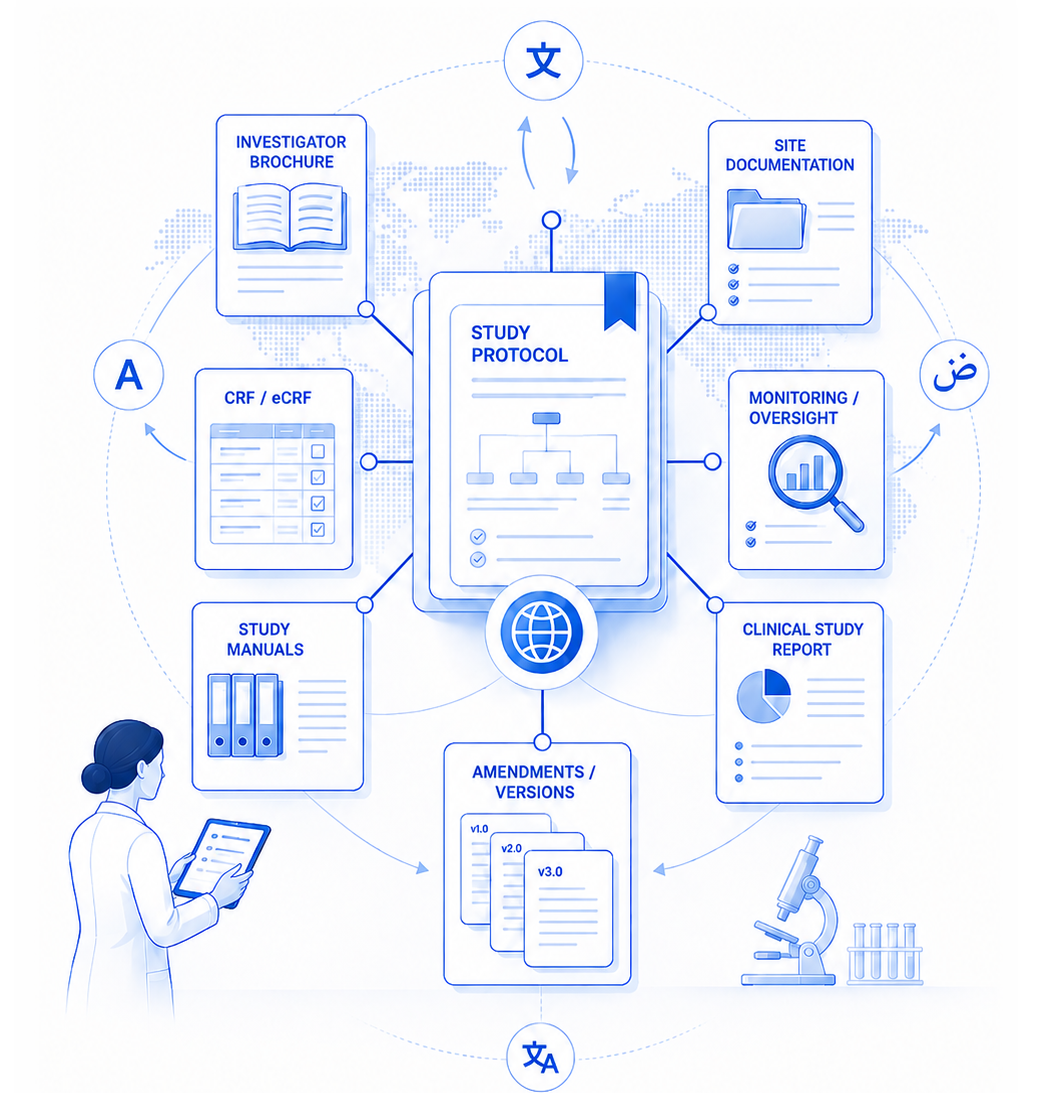
What are clinical study document translation services?
Clinical study document translation services convert the scientific, operational, data-collection, site, oversight, and reporting documents used in clinical research into the languages required by global study teams. Typical documents include clinical study protocols, Investigator Brochures, CRFs and eCRFs, study manuals, site documentation, monitoring content, Clinical Study Reports, amendments, and closeout documentation. Strong clinical study translation also involves terminology management, document formatting, version control, appropriate linguistic review, and alignment with related study content.
What clinical study documents does Sesen translate?
Sesen translates protocols and protocol amendments, Investigator Brochures, CRFs/eCRFs, laboratory and pharmacy manuals, site manuals, investigator documentation, operational instructions, monitoring and oversight content, Clinical Study Reports, and study closeout documentation. Sesen also provides dedicated services for related content such as informed consent forms, IRB and ethics materials, clinical outcome assessments, eCOA/ePRO content, pharmacovigilance documentation, and clinical training materials.
How does Sesen keep terminology consistent across clinical study documents?
Sesen can centralize study-specific terminology, sponsor-approved glossaries, product terminology, translation memory, reference materials, previously approved translations, style guidance, and reviewer feedback. These resources can be shared across related documents so recurring study concepts remain aligned as the translation program grows. Terminology QA and human review provide additional checks when the same concepts appear in multiple documents.
How does Sesen handle protocol amendments and revised study documents?
Sesen can compare an updated source document with the previous version, identify changed content, review whether important terminology has changed, reuse previously approved translations where appropriate, translate and review new material, and perform QA against the revised version. For larger programs, amendments can also be managed with awareness of related documents that may use the same study concepts.
Do all clinical study documents require back translation?
No. Back translation is an additional verification method rather than an automatic requirement for every clinical study document. Whether it is appropriate depends on the content type, intended use, sponsor or CRO requirements, institutional or ethics-review requirements, regulatory context, and the quality approach established for the study. Sesen can incorporate back translation, reconciliation, or other verification steps when they are required or add value to the specific project.
Is linguistic validation required for clinical study documents?
Not generally for every clinical study document. Formal linguistic validation is most closely associated with instruments such as Clinical Outcome Assessments, PROs, ePROs, and other measures where conceptual equivalence across languages may need to be demonstrated through a defined methodology. Protocols, Investigator Brochures, CRFs, study manuals, and Clinical Study Reports typically use translation and review workflows designed for their own intended use, content risk, and project requirements.
Can Sesen translate CRFs and eCRFs?
Yes. Sesen translates CRFs, eCRFs, field labels, instructions, response options, and related structured study content. CRF translation can be aligned with the study protocol, approved terminology, and supporting documentation to help preserve the meaning of data-collection fields across languages. Electronic implementations can also account for structured content, text constraints, repeated strings, and final language QA requirements.
Can Sesen translate Clinical Study Reports?
Yes. Sesen provides Clinical Study Report translation for scientific and regulatory use, including narrative content, tables, figures, statistical terminology, appendices, supporting documentation, and related report materials. Where appropriate, CSR translation can reference protocols, approved study terminology, previous translated documents, and other relevant materials to maintain continuity with the study documentation that preceded the report.
Can Sesen support an ongoing multilingual study instead of individual documents?
Yes. Sesen can support recurring clinical translation programs as studies add countries, sites, languages, documents, and amendments. Centralized terminology, translation memory, reference materials, linguistic teams, approved translations, reviewer feedback, and version-control practices help maintain continuity across ongoing study work.
Does Sesen use AI for clinical study document translation?
Yes, where appropriate within a controlled, human-led workflow. AI and language technology can assist with terminology, repetitive-content reuse, translation drafting for suitable content, consistency analysis, number and completeness checks, and other quality-control tasks. The appropriate level of AI assistance depends on the document, intended use, content risk, sponsor requirements, and quality expectations. Qualified life sciences professionals remain responsible for clinical meaning, contextual judgment, and final quality.
How many languages does Sesen support?
Sesen supports clinical study document translation across 150+ languages, including country- and region-specific variants for multinational research programs. Language planning can account for study countries, participating sites, intended users, locale requirements, sponsor terminology, previous translations, and the operational requirements of the clinical program.