Preserve Clinical Meaning
Maintain the intended meaning of objectives, endpoints, eligibility criteria, procedures, safety language, and operational instructions.

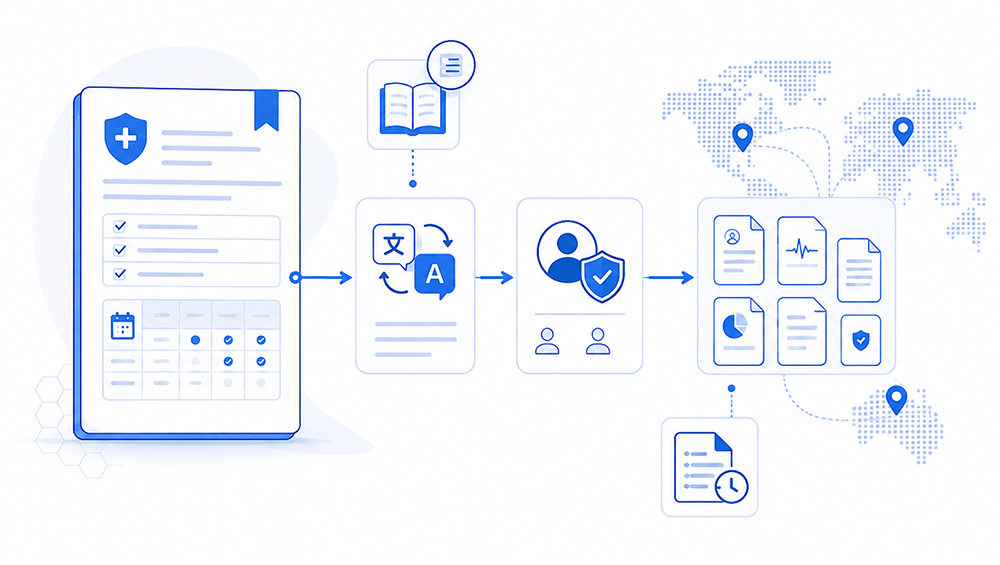
A clinical trial protocol defines how a study is designed and conducted. It brings together objectives and endpoints, eligibility criteria, study procedures, visit schedules, investigational product information, safety requirements, assessments, reporting expectations, and operational instructions.
When a study expands across languages and countries, those concepts need to remain clear and consistent wherever they appear. Sesen treats the protocol as foundational multilingual clinical content—not an isolated translation event.
Maintain the intended meaning of objectives, endpoints, eligibility criteria, procedures, safety language, and operational instructions.
Help investigators, coordinators, pharmacists, laboratory teams, monitors, and other site personnel work from clear protocol information.
Support country submissions, ethics or institutional review, investigator/site use, sponsor requirements, and multilingual study operations where applicable.
Use approved protocol terminology as an important reference for ICFs, CRFs, site content, training, and other related documentation.
Sesen supports the core protocol content required for multinational clinical research, from initial study startup through amendments and ongoing updates.
Complete protocols covering study design, objectives, methodology, procedures, safety requirements, assessments, statistical sections, appendices, and operational instructions.
Concise study overviews used by investigators, sites, reviewers, study teams, and other stakeholders.
Substantial and non-substantial amendments, revised protocol versions, amendment summaries, tracked changes, and supporting updates.
Inclusion and exclusion criteria, screening requirements, participant characteristics, and clinical thresholds.
Primary, secondary, exploratory, safety, efficacy, pharmacokinetic, pharmacodynamic, and other endpoint descriptions.
Visits, time points, assessments, treatment cycles, diagnostic procedures, laboratory activities, imaging, dosing instructions, and study-specific workflows.
Safety monitoring, reporting instructions, treatment modifications, discontinuation criteria, responsibilities, and other protocol-defined requirements.
Protocol updates, summaries, and supporting content that require controlled language handling for specific country, ethics, or institutional contexts.
A strong protocol workflow does more than move text from one language to another. It creates a reliable multilingual baseline that can continue to support the study when content changes.
Source study design, objectives, procedures, safety, and operational content.
Endpoints, eligibility criteria, procedures, products, abbreviations, and approved language.
Qualified life sciences linguists work with study context and controlled references.
Independent review addresses meaning, terminology, consistency, and completeness.
Structured checks help establish a reviewed multilingual reference for future updates.
Changed content is identified, updated, reviewed, and aligned with the controlled baseline.
Protocol language informs ICFs, CRFs, site materials, training, and other related content.
Languages, regional variants, review cycles, and recurring updates are coordinated globally.
Every clinical protocol develops its own language. Endpoints, eligibility criteria, investigational products, procedures, dosing, safety terminology, visits, assessments, and study-specific expressions may reappear across many downstream documents.
Identify terms carrying particular clinical, scientific, or operational meaning within the protocol.
Incorporate sponsor glossaries, previous translations, product terminology, reference studies, and established language where available.
Apply approved language consistently when the same concepts appear in protocol amendments and related documentation.
Check inconsistent terminology, unexplained variation, abbreviations, numbers, and other high-risk content before delivery.
Capture approved reviewer changes so future protocol versions and related content can reflect agreed study language.
The first approved protocol is rarely the end of the story. Eligibility criteria, visit schedules, procedures, safety information, endpoints, dosing, assessments, and operational requirements can change as the study progresses.
Establish the reviewed multilingual protocol and agreed study terminology.
Receive the revised source and identify additions, deletions, and modified content.
Determine which translated sections are affected and which approved content can remain unchanged.
Translate revised material in context and apply established terminology, review, and QA.
Identify where changed concepts may also appear in consent, CRF, site, training, manual, or safety content.
Deliver updated language versions with clear protocol and amendment version identification.
Translation memory and version comparison can help avoid unnecessary retranslation of unchanged content.
Reviewers can concentrate attention on revised material while retaining the context of the approved protocol.
Established terminology, abbreviations, endpoint language, and study-specific expressions remain available for future amendments.
A protocol sits within a larger clinical content ecosystem. Changes made at the protocol level may need to be reflected in participant-facing, site-facing, operational, safety, and data-collection materials.
Protocol procedures, visits, risks, treatment, and participant responsibilities often need to be expressed clearly in consent documentation.
Field labels, instructions, assessments, visit terminology, and data-collection content may depend directly on concepts defined in the protocol.
Protocols and amendments may be accompanied by multilingual consent materials, summaries, responses, and supporting documentation for ethics review.
Where protocol and investigator brochure content overlap, terminology for the investigational product, safety, administration, and clinical context should remain aligned.
Investigator meetings, site initiation, protocol training, SOPs, and eLearning may need to communicate study requirements across languages.
Study manuals, pharmacy and laboratory materials, worksheets, site communications, and operational guidance frequently rely on terminology and procedures established in the protocol.
Multinational clinical trials create a coordination challenge as much as a translation challenge. Sesen helps sponsors and CROs manage languages, regional variants, local review cycles, staggered launches, and amendments within a controlled multilingual workflow.
Translate multiple target languages concurrently using shared terminology, reference materials, and project instructions.
Manage appropriate language variants and market-specific requirements without losing alignment with the global study.
Support language delivery according to country startup plans rather than forcing every target into a single release schedule.
Capture, evaluate, and implement approved sponsor or in-country reviewer changes within a controlled workflow.
Use established terminology and translated assets when revised protocols move across an existing set of countries and languages.
Maintain clear source and target version identification so teams can distinguish current protocol content from superseded versions.
Because language requirements vary across countries and review contexts, Sesen plans each rollout around the study, jurisdiction, document use, and sponsor requirements.
Clinical protocols combine narrative medical content with tables, numbers, units, schedules, cross-references, abbreviations, statistical language, and tightly defined study terminology. Quality assurance has to account for all of them.
Review objectives, endpoints, eligibility criteria, procedures, interventions, safety information, and operational instructions in context.
Apply controlled study, therapeutic-area, product, procedure, and sponsor terminology consistently throughout the protocol.
Check doses, units, laboratory values, percentages, ranges, dates, visit windows, treatment cycles, and numerical criteria.
Review schedules of activities, tables, footnotes, legends, headings, and repeated structured content for completeness and alignment.
Check defined terms, acronyms, section references, tables, figures, appendices, and other internal relationships where applicable.
Account for headings, paragraphs, tables, notes, tracked changes, headers, footers, appendices, and complex multilingual formatting.
Human review remains central. Technology can identify potential issues, but clinical meaning, terminology choices, readability, and contextual judgment require qualified life sciences professionals.
Technology is most valuable when it helps teams improve consistency, identify change, reuse approved content, and focus expert attention where it matters.
Reuse previously translated and approved protocol language when the same or similar content appears in later versions.
Make established study terminology available across linguists, reviewers, amendments, and related documents.
Help identify what changed between protocol versions so amendment workflows can focus on the right content.
Identify potentially inconsistent translations of repeated terms, phrases, abbreviations, or study concepts.
Screen multilingual content for potential terminology, number, punctuation, omission, formatting, and consistency issues.
Use AI selectively for terminology application, change analysis, consistency review, quality support, and—when appropriate to the agreed workflow—translation assistance.
Qualified life sciences professionals remain responsible for contextual judgment and final linguistic quality. AI and automation are applied as workflow advantages—not as a substitute for expert review.
Protocol translation operates within a broader framework of Good Clinical Practice, regulatory review, ethics oversight, study operations, and country-specific requirements.
Current ICH GCP provides an international ethical, scientific, and quality framework for clinical trials involving human participants. Multilingual protocol content should remain fit for its intended clinical use within that quality-controlled environment.
Translated protocol content may support health authority submissions, ethics committee or institutional review, investigator/site use, sponsor processes, and country-specific clinical operations.
Language expectations can vary by country, authority, ethics committee, document type, and intended use. Multilingual planning should reflect the requirements that actually apply to each study and market.
Protocol language intended for investigators, regulators, operational teams, and ethics reviewers serves different purposes from participant-facing materials derived from the same study.
ICH M11, the Clinical electronic Structured Harmonised Protocol (CeSHarP) framework, provides a harmonized protocol template and technical specification designed to support more consistent protocol structure and interoperable electronic exchange. As protocol information becomes more reusable, multilingual workflows increasingly need to preserve more than document-level prose.
Sesen can adapt multilingual workflows to traditional protocol documents and increasingly structured content models, with terminology, review, QA, and version control designed around the format and operational requirements of each program.
Consistent representation of controlled clinical concepts across languages.
Awareness of how protocol elements connect to one another and downstream study content.
Accurate handling of fields, tables, defined sections, and reusable elements.
Clear management of what changed and which language versions reflect the current protocol.
Carry validated terminology and translated content forward as study information is reused.
Sesen supports organizations managing clinical research across individual countries, regional programs, and complex multinational studies.
Support protocol translation from study startup through amendments, country expansion, and ongoing clinical development.
Scale multilingual clinical operations as programs move into new sites, markets, indications, and trial phases.
Coordinate protocol translation across sponsors, countries, sites, languages, timelines, and recurring study updates.
Translate clinical investigation protocols and related documentation for global device and diagnostic studies.
Support multicenter and international research requiring accurate multilingual protocols and related study materials.
Access specialist linguistic and multilingual infrastructure without building a large internal localization operation.
Protocol linguists need to understand how terminology functions within the study design, therapeutic area, patient population, procedures, endpoints, and clinical context.
Whether a study requires one additional language or coordinated delivery across dozens of markets, Sesen can centralize terminology, project instructions, linguistic resources, reviewer feedback, translation memory, and recurring protocol updates.
Answers to common questions about multilingual protocol workflows, amendments, terminology, quality, and global delivery.
Clinical trial protocol translation is the translation of a clinical study protocol into one or more target languages for multinational research. It can include the full protocol, protocol synopsis, amendments, eligibility criteria, objectives and endpoints, schedules of activities, procedures, safety information, tables, appendices, and other protocol content. Because the protocol defines core aspects of study design and conduct, the work requires specialized clinical terminology, careful review, structured quality controls, and consistency with related study documentation.
A protocol may need translation for country submissions, ethics committee or institutional review, investigator and site use, multinational study operations, sponsor processes, or other local requirements. There is no universal rule requiring every protocol to be translated into every local language; requirements depend on the trial, jurisdiction, intended use, authority or institution, and sponsor strategy.
Sesen can use sponsor glossaries, previous translations, product terminology, reference documentation, translation memories, terminology databases, style guidance, and approved reviewer feedback to establish study-specific language. Approved terms can then be reused across amendments and related study documentation where appropriate.
When a revised protocol is received, Sesen can compare versions to identify changed content, preserve approved translations for unchanged material, translate revised sections, apply established terminology, and perform focused review and quality assurance. This helps maintain continuity between protocol versions while supporting faster amendment cycles.
Yes. Where an existing multilingual baseline is available, translation memory, terminology resources, version comparison, established linguistic teams, and focused QA can help accelerate updates. Actual turnaround depends on language count, document length, complexity, extent of change, review requirements, formatting, and delivery scope.
Yes, where appropriate. Protocol terminology can provide an important reference for informed consent forms, case report forms, site documentation, training, investigator materials, safety content, and other study documentation. Consistent concepts do not always require identical wording, however, because patient-facing, data-collection, investigator, and regulatory content serve different audiences.
Protocol quality assurance can include checks for doses, units, ranges, percentages, dates, time points, visit windows, treatment cycles, table content, footnotes, headings, repeated text, abbreviations, and internal references. Multilingual formatting can also be provided when translated protocols require preservation or recreation of complex layouts.
Yes. Sesen supports multilingual clinical translation programs across 150+ languages. Multiple target languages can be managed in parallel using shared terminology, translation memories, project instructions, source references, quality requirements, and centralized project management.
Sesen can use AI-enabled technology within controlled clinical translation workflows when appropriate to the content, risk, and customer requirements. AI and automation may assist with translation, terminology application, consistency analysis, version comparison, repetitive content reuse, and quality checks. Qualified life sciences professionals remain responsible for contextual judgment and final linguistic quality.
Not automatically. The appropriate methodology depends on the intended use of the translated content, applicable requirements, sponsor procedures, and project specifications. Standard protocol translation typically uses professional translation, independent review, terminology control, and quality assurance rather than automatically requiring the full linguistic-validation methodology used for certain clinical outcome assessments. Additional verification steps can be incorporated when required.
Sesen assigns linguists according to the required language pair, clinical subject matter, therapeutic area, content type, and project requirements. Protocol workflows can include specialized translation, independent linguistic review, subject-matter review where required, terminology management, automated QA, and final quality control.
Where available, provide the current source protocol and version, target languages and countries, delivery dates, previous protocol translations, earlier versions, sponsor terminology or glossaries, relevant product or study references, reviewer instructions, formatting requirements, and any certification requirements. Sesen can also help determine the appropriate multilingual workflow when not all reference materials are available at project startup.
Yes. Where required, Sesen can provide translation certification or a certificate of accuracy according to the agreed project requirements. Certification requirements can vary by recipient, institution, jurisdiction, and submission context, so the required format should be confirmed during project setup.
Sesen helps sponsors, CROs, and research teams carry the protocol's scientific, operational, and terminological foundation across languages—from initial translation and terminology control through expert review, amendments, related study documentation, and global rollout.