Patient-Reported Outcomes
Translate PRO and ePRO instruments that capture symptoms, function, treatment experience, quality of life, and other information reported directly by participants.

Endpoint Consistency
Neurology and CNS studies often depend on clinical outcome assessments that capture changes a laboratory test alone cannot fully describe.
A study may measure memory, cognition, speech, motor performance, seizure activity, fatigue, pain, behavior, activities of daily living, disease severity, or caregiver-observed change. The wording used to ask a question, explain a task, describe a response option, or instruct a rater can therefore carry clinical importance.
Sesen supports multilingual clinical outcome assessment content with workflows designed to preserve intended meaning while controlling terminology and linguistic variation across markets.
Translate PRO and ePRO instruments that capture symptoms, function, treatment experience, quality of life, and other information reported directly by participants.
Support ClinRO instruments, rating scales, examination content, and administration guidance used by trained healthcare professionals or investigators.
Translate ObsRO content used by caregivers, parents, or other observers when patients cannot fully report aspects of their own condition.
Support PerfO measures and instructions involving standardized tasks designed to assess cognitive, physical, or functional performance.
Manage language for neuropsychological, cognitive, behavioral, motor, functional, and disease-specific instruments where wording and administration context matter.
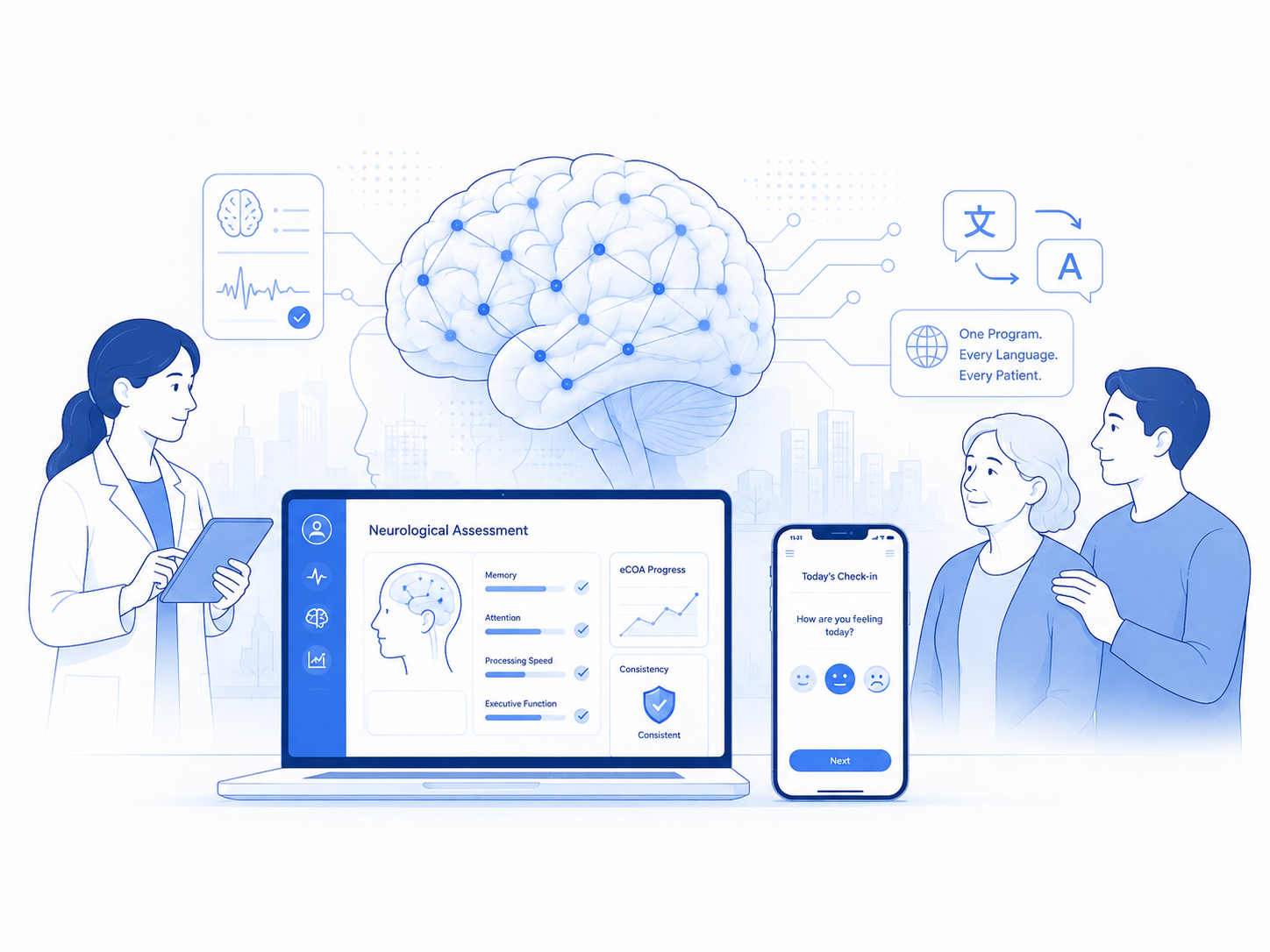
Prepare assessments for electronic delivery while accounting for response options, interface constraints, instructions, context, and multilingual implementation.
Neurological disease can change how people understand, remember, communicate, move, or report what they experience.
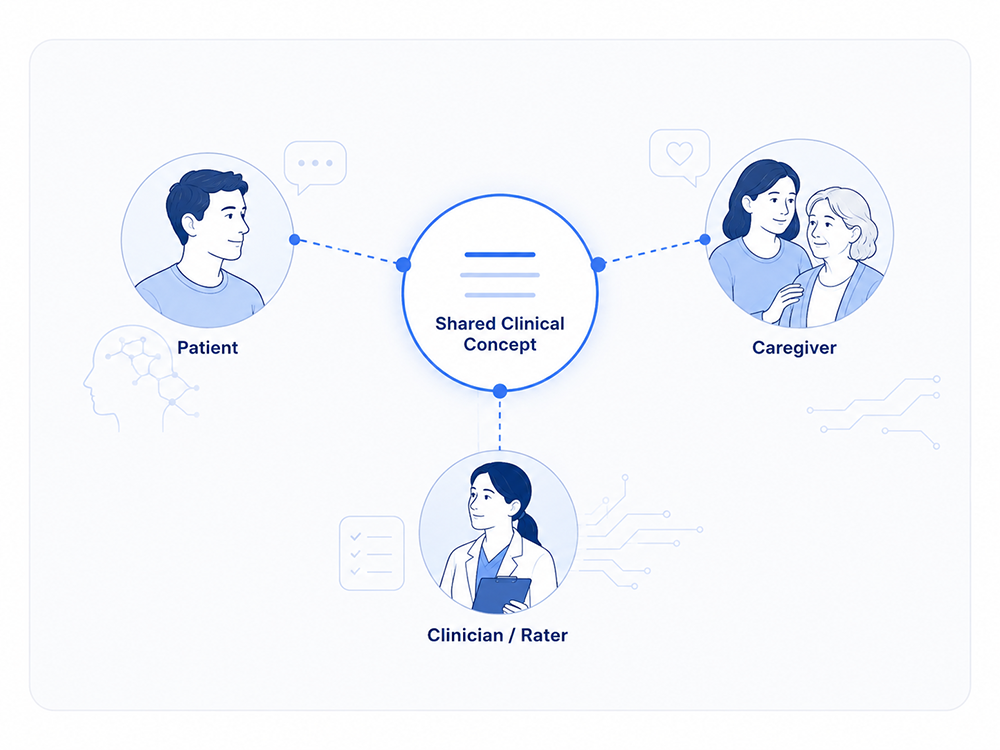
Depending on the condition and study design, communication may involve the patient, a parent or caregiver, an observer, an investigator, a clinician, a trained rater, or several of these groups at once. Each audience needs language appropriate to its role while the underlying clinical concepts remain aligned.
Informed consent, study instructions, questionnaires, diaries, ePRO content, educational materials, recruitment content, and other patient-facing communications.
Caregiver instructions, ObsRO instruments, questionnaires, study information, and related content where an observer contributes to understanding the patient's condition.
Investigator guidance, rater manuals, scoring instructions, administration guidance, site reference materials, and clinical training content.
Neurological disorders span different disease mechanisms, patient populations, clinical manifestations, outcome measures, and treatment approaches. Sesen supports multilingual programs across major CNS indications with linguistic resources matched to the scientific and clinical requirements of the content.
Support content spanning disease staging, cognition, function, motor symptoms, biomarkers, caregiver observations, long-term progression, safety, and patient communication.
Translate content involving seizure frequency and severity, patient and caregiver reporting, diaries, eCOA, medication instructions, clinical assessments, and adverse-event reporting.
Support multilingual content involving neurological function, relapses, disease activity, imaging, biomarkers, patient outcomes, and immune-mediated disease mechanisms.
Immunology & Autoimmune Translation ServicesSupport inherited neurological and neuromuscular disease programs involving specialized genetic terminology, motor function, caregiver participation, pediatric populations, and emerging therapeutic approaches.
Rare Disease Translation ServicesTranslate clinician-rated scales, motor and functional assessments, patient-reported content, study documentation, training materials, and related content for movement-disorder programs.
Support symptom diaries, frequency and severity measures, patient-reported outcomes, quality-of-life instruments, study instructions, clinical content, and patient communications.
Support specialized neurological content across a broader range of CNS development programs, with workflows adapted to the disease area, document type, audience, and intended use.
Support selected CNS programs involving cognition, behavior, psychiatric symptoms, or neurobehavioral outcomes through specialized assessments, patient content, clinical documentation, and related multilingual communications.
Multidimensional Evidence
Modern CNS development can combine molecular or genetic evidence with imaging, laboratory biomarkers, clinician assessments, patient reports, caregiver observations, cognitive performance, and everyday function.
Genomic, biomarker, mechanism-of-action, target, pathway, and molecular content for specialized neurological development programs.
Imaging endpoints, laboratory biomarkers, diagnostic concepts, disease staging, and related clinical documentation.
Neurological examinations, rating scales, clinician observations, cognitive assessments, motor measures, and functional endpoints.
Symptom reports, quality-of-life measures, diaries, questionnaires, caregiver observations, and other patient-centered evidence.
Assessments of cognition, movement, communication, daily activities, and other functional outcomes.
Rater & Site Consistency
Some CNS assessments depend on standardized administration as well as standardized content.
Investigators and raters may need to present instructions consistently, apply scoring criteria correctly, understand translated terminology, and work from the same approved version of an assessment or training resource.
Controlled multilingual language does not replace clinical training or instrument validation. It helps reduce avoidable linguistic variation as study content moves across languages and sites.
Administration procedures, definitions, scoring guidance, examples, reference criteria, and related instructions.
Investigator presentations, training modules, quick-reference materials, certification content, study manuals, and ongoing training updates.
Participant-facing, administrator-facing, and system-based instructions aligned with approved assessment terminology.
Amendments and revisions coordinated so multilingual sites can move to updated content without losing terminology continuity.
Approved sponsor, clinician, instrument-owner, or in-country reviewer decisions captured and applied consistently where appropriate.
eCOA platforms, mobile study applications, digital diaries, remote assessments, wearables, and connected technologies can extend neurological data collection beyond the traditional clinic visit.
Evolving CNS Science
Neurological drug development increasingly spans both established pharmacological approaches and therapies designed around more specific biological or genetic mechanisms.
These programs can introduce highly specialized molecular terminology, genetic nomenclature, novel mechanisms of action, complex administration procedures, long-term follow-up, specialized safety language, and new patient-communication challenges.
Connected Content
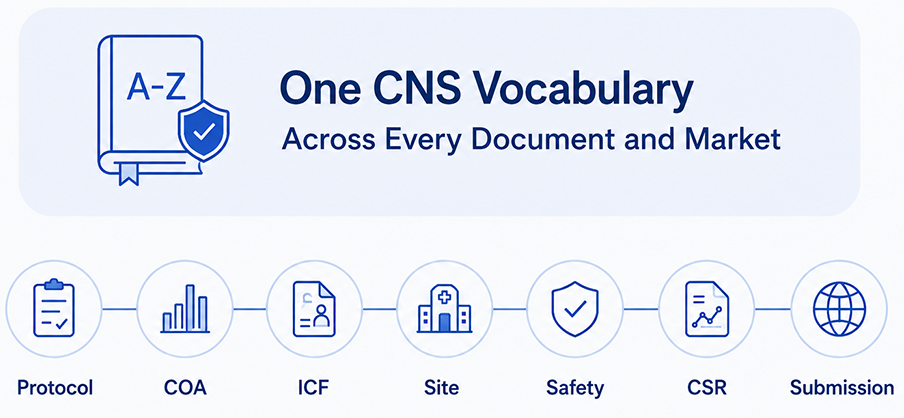
A neurological program does not produce isolated documents. Terminology introduced in early scientific and protocol content may later appear in assessments, patient materials, investigator training, safety documentation, study reports, regulatory submissions, and Medical Affairs communications.
Neurological development creates terminology that needs to remain stable long after the first translation is delivered.
Disease stages, anatomical terms, symptoms, biomarkers, endpoint names, scoring language, investigational products, mechanisms of action, dosing, genetic terminology, and safety concepts may recur across hundreds of related assets.
Sesen builds reusable linguistic assets around the program rather than treating every document as a new translation.
Different neurological content carries different risks and requirements. Sesen adapts translation and review according to the disease area, content type, intended audience, intended use, language combination, validation requirements, format, and client specifications.
Built around the content, not a one-size-fits-all workflow. A neurological questionnaire, protocol amendment, caregiver guide, gene-therapy ICF, eCOA screen, and clinical study report may require different combinations of professional expertise, validation, technology, and quality control.
Review the CNS indication, intended audience and use, source content, languages, existing terminology, file formats, and downstream requirements.
Identify established disease terminology, assessment names, product language, reference translations, glossaries, and approved resources.
Assign professional linguistic resources appropriate to the language pair and neurological, medical, clinical, scientific, or regulatory requirements.
Where required, a qualified second professional reviews accuracy, completeness, terminology, consistency, and communication.
Check translated content against related study materials, terminology, quantitative information, instructions, response structures, and context.
Add linguistic validation, harmonization, cognitive debriefing, eCOA implementation, software localization, DTP, or in-context review where appropriate.
Use structured checks to help identify terminology inconsistencies, numerical issues, omissions, formatting problems, and repeated-content deviations.
Review completed multilingual content against project requirements and prepare version-controlled deliverables for clinical, regulatory, patient, scientific, or digital use.
Strong CNS translation requires more than fluent target-language text. Quality must address scientific concepts, assessment context, numerical information, related documents, and the downstream use of the content.
Preserve source meaning, terminology, nuance, instructions, qualifications, and clinical intent.
Align disease concepts, endpoints, assessments, procedures, product terminology, and related study language.
Check doses, units, measurements, timepoints, percentages, scoring ranges, frequencies, dates, tables, and other quantitative information.
Apply approved terminology consistently across documents, languages, study phases, and revisions.
Review how translated content works within questionnaires, forms, eCOA screens, tables, diagrams, training assets, and formatted deliverables.
Check for omissions and untranslated content while managing amendments so updated language does not disrupt approved content unnecessarily.
Human linguistic judgment remains central. Translation technology, terminology systems, translation memory, and automated QA support consistency and efficiency without replacing the professional expertise required for specialized CNS content.
Multicountry neurological programs can produce large volumes of interconnected content across languages, sites, platforms, reviewers, and study phases. Sesen helps sponsors and CROs centralize those multilingual workflows.
Global language coverage for study populations, sites, regulators, patients, caregivers, and healthcare professionals.
Coordinate related CNS content through consistent workflows, terminology resources, review decisions, and project governance.
Build translation memory, glossaries, approved-language resources, and reference libraries that grow with the program.
Manage protocol amendments, assessment revisions, safety changes, training updates, and other evolving content across languages.
Specialized human expertise, clinical and regulatory depth, terminology governance, and scalable multilingual workflows come together around the needs of each CNS program.
Focused multilingual support across pharmaceutical, biotechnology, clinical research, regulatory, healthcare, medical technology, and scientific environments.
Linguistic resources matched to the language combination, neurological subject matter, content type, audience, and intended use.
Structured support for PRO, ClinRO, ObsRO, PerfO, eCOA, questionnaires, diaries, symptom scales, and linguistic validation.
Glossaries, translation memory, approved language, reviewer feedback, and technology-assisted QA help maintain consistency.
Support multilingual content from study design and patient participation through safety, reporting, regulatory submission, and Medical Affairs.
Professional linguists and reviewers remain responsible for meaning and context, supported by technology for consistency, reuse, and issue detection.
Common questions about multilingual neurological clinical trials, clinical outcome assessments, patient and caregiver materials, digital assessments, terminology, and ongoing CNS programs.
Sesen supports clinical, scientific, regulatory, patient-facing, safety, training, digital, and Medical Affairs content across neurological and CNS programs. Common materials include protocols, investigator's brochures, ICFs, clinical outcome assessments, questionnaires, patient diaries, eCOA content, rater materials, site training, pharmacovigilance content, clinical study reports, regulatory submissions, and scientific communications.
Yes. Sesen supports patient-reported outcomes (PROs), clinician-reported outcomes (ClinROs), observer-reported outcomes (ObsROs), performance outcomes (PerfOs), eCOA/ePRO, cognitive assessments, functional scales, symptom measures, patient diaries, and related clinical outcome assessment content. When an instrument requires more than standard translation, Sesen can provide a structured linguistic-validation workflow appropriate to the project requirements.
Sesen can coordinate multilingual content across the study lifecycle, including protocols, ICFs, patient and caregiver materials, assessments, site and rater content, digital study tools, safety documentation, study reports, and regulatory submissions. Program-level terminology resources, translation memory, controlled review, and version-aware workflows help keep related content aligned as the study evolves.
Yes. CNS programs may depend on communication with both participants and caregivers, particularly when cognition, communication, development, mobility, or disease progression affects a patient's ability to report independently. Sesen supports patient information, informed consent, caregiver instructions, questionnaires, diaries, observer-reported assessments, educational content, and related study materials with language appropriate to the intended audience.
Yes. Sesen supports eCOA, ePRO, digital questionnaires, study applications, remote-assessment instructions, and related clinical software content. Services can include translation, linguistic validation where required, terminology management, contextual review, interface-aware localization, and multilingual implementation support.
Yes. Many neurological programs intersect with rare disease, inherited disorders, molecular diagnostics, gene therapy, genome editing, and RNA-based approaches. Sesen can support specialized scientific, clinical, patient-facing, safety, and regulatory content while maintaining terminology across related documents.
Sesen can create and maintain program glossaries, translation memory, approved-language resources, reference libraries, and reviewer decisions. These assets help maintain consistent terminology across protocols, assessments, ICFs, site materials, safety content, reports, submissions, and subsequent revisions.
Yes. Version-aware workflows can identify changed and reused content, leverage approved translations where appropriate, and coordinate multilingual revisions across related study assets. This helps preserve previously approved language while focusing linguistic review on content that has changed.
From neurological assessments and patient communication to clinical documentation, safety content, digital trials, and global regulatory submissions, Sesen helps CNS teams manage multilingual content as one connected program.